
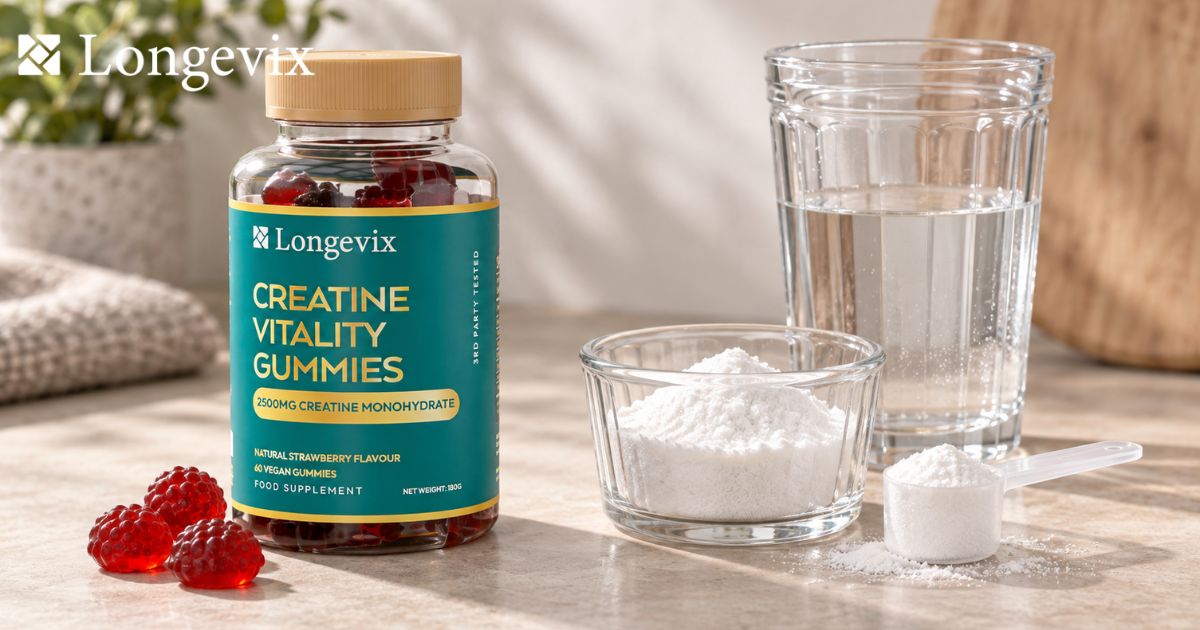
Choosing between creatine gummies vs powder can feel confusing because both formats may contain the same core ingredient, yet they fit very different routines. Powder often gives you greater dose flexibility, simple formulas, and easier value comparisons. Gummies can offer better convenience, taste, and portability when mixing a drink feels like a chore.
The real question isn’t which format looks more modern. It’s whether the product delivers a suitable amount of creatine monohydrate, fits your budget, and supports consistent daily use. Understanding ingredients, serving size, testing, cost, and muscle creatine stores can help you choose more confidently without falling for exaggerated marketing claims.
Creatine Gummies vs Powder: What’s the Real Difference?
The biggest difference lies in delivery rather than the creatine molecule itself. Powder usually contains loose creatine that you measure before use. Gummies hold creatine inside a chewable matrix. That changes preparation / mixing, flavour, texture, portability, serving structure, storage considerations, and the supporting ingredients needed to produce the finished supplement.
Powder can provide greater dose flexibility because small changes are easier to measure. Gummies normally use fixed piece counts, which can simplify a routine. However, four gummies from one company may differ greatly from four elsewhere. A useful format comparison should therefore begin with the actual creatine quantity rather than pieces or scoops.
|
Comparison point |
Creatine gummies |
Creatine powder |
|
Preparation |
Usually ready to chew |
Usually measured and mixed |
|
Portability |
Easy to carry |
Good when pre-portioned |
|
Dose adjustment |
Fixed gummy increments |
Usually more flexible |
|
Ingredient list |
Often more complex |
Can be very short |
|
Taste |
Usually flavoured |
Often neutral or mildly chalky |
|
Measurement |
Depends on labelled serving |
Scoop or weighed amount |
|
Solubility |
No mixing required |
Can affect the drinking experience |
|
Value assessment |
Requires dose and serving checks |
Often easier to compare per gram |
Creatine Monohydrate Is the Ingredient, Not the Format
That distinction matters because creatine monohydrate remains the most widely studied supplemental form. The US National Institutes of Health describes it as the most widely used and researched creatine form. A gummy doesn’t create a different molecule simply by changing the delivery method. NIH exercise and athletic performance fact sheet
Solubility Changes the Experience More Than the Goal
Powder users often notice solubility because some creatine may settle instead of disappearing completely into a drink. More liquid or thorough stirring can improve the experience. Gummies remove that practical issue because there’s nothing to mix. Easier consumption, however, shouldn’t be treated as proof of superior absorption or stronger physiological effects.
Do Creatine Gummies Work as Well as Powder?
The evidence needs a careful answer rather than a catchy yes or no. Gummies can deliver creatine, and research now exists on creatine supplied in gummy form. However, extensive research / clinical trials examine creatine monohydrate broadly, while direct comparisons between matched gummy and powder doses remain much more limited.
One 2026 randomised controlled trial studied 32 female collegiate and professional beach-volleyball athletes for ten weeks. The creatine group received 5 g per day in gummy form. Researchers reported improvements in countermovement-jump height and change-of-direction performance. However, the trial used a control group rather than a creatine-powder comparison group.
Research Case Study: Creatine Gummies in Female Athletes
The 2026 trial offers useful evidence that a creatine-monohydrate gummy formulation can work in a specific sporting population. Lean body mass, skeletal muscle mass, total body mass, and reaction time did not show significant group-by-time changes. The findings therefore support the studied product and context rather than every commercial gummy. Read the 2026 creatine gummy study
Direct Gummies vs Powder Research Is Still Developing
A University of Oklahoma crossover study is directly comparing 4.5 grams of creatine monohydrate from gummies with 4.5 grams from powder. Researchers plan to examine blood creatine responses over several hours. Until matched comparisons report results, claims that both formats have identical bioavailability remain stronger than the available direct evidence supports.
Absorption, Muscle Saturation and Results: Does Format Matter?
Absorption attracts attention because supplement marketing often promises rapid uptake. Yet regular creatine use has a broader goal. Repeated supplementation can increase muscle creatine stores, including phosphocreatine availability. That process develops over time. It doesn’t depend on creating an immediate sensation after chewing a gummy or drinking mixed powder.

For this reason, a different absorption rate would not automatically mean better training outcomes. Researchers would need to connect that difference with meaningful performance results. Training quality, total creatine exposure, diet, individual response, and muscle saturation can all matter more than how quickly a single serving appears in the bloodstream.
Why Muscle Creatine Stores Matter
Phosphocreatine helps regenerate ATP during demanding muscular work. This helps explain creatine’s stronger evidence for repeated high-intensity exercise, such as sprinting and resistance training. NIH guidance describes creatine as “one of the most thoroughly studied” sports supplements and reports benefits for repeated short, intense muscular efforts.
Short-Term Performance Needs the Right Context
Creatine’s strongest short-term performance evidence concerns activities involving repeated maximal or near-maximal effort. It isn’t a stimulant like caffeine. You shouldn’t expect an immediate buzz after taking it. Its usefulness develops through creatine availability and repeated training rather than a dramatic feeling shortly after consumption.
Dosage Accuracy: Gummies vs Powder Explained
Dose control creates one of the clearest differences between the formats. Gummies provide fixed pieces. Powder generally allows smaller adjustments. Yet fixed portions don’t automatically guarantee better dose accuracy. The gummy still needs to contain its declared amount, while an inaccurately filled powder scoop can also introduce measurement variation.
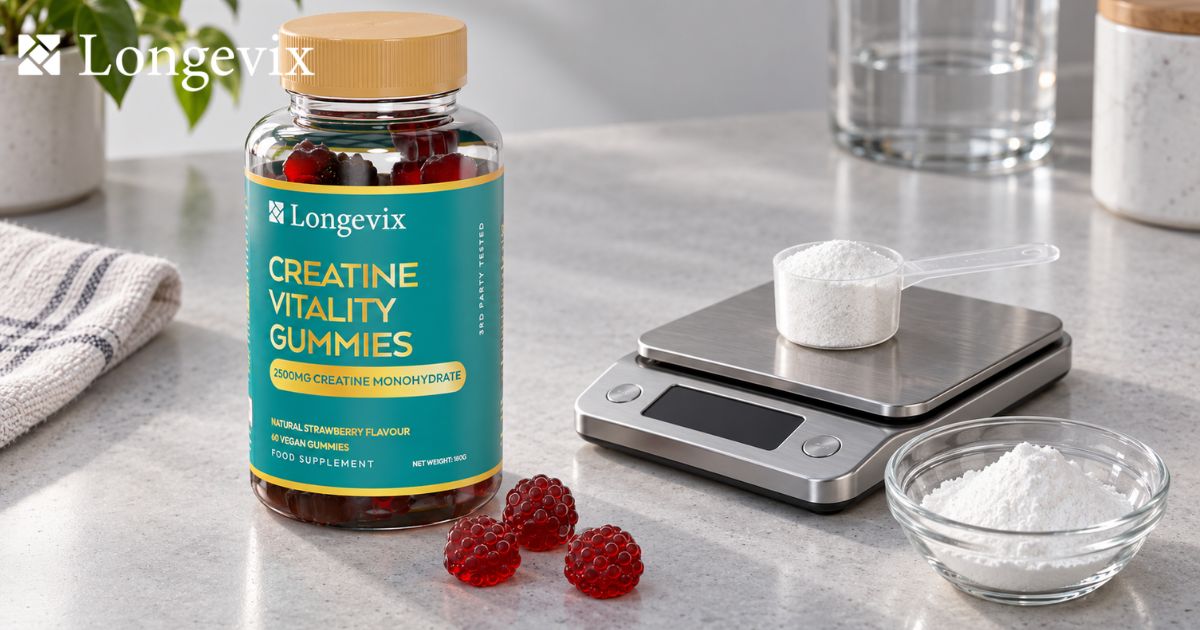
Research often examines maintenance intakes around three to five grams daily. A familiar daily dose, including 5 g per day, comes from research protocols and particular products. That figure should not automatically become the direction for every commercial formula, especially when a gummy contains several active ingredients alongside creatine.
Loading Versus Steady Daily Creatine
Traditional research loading protocols often use around 20 grams daily for several days before moving to lower maintenance amounts. This approach can raise muscle creatine stores more rapidly. However, research also shows that smaller regular intakes can increase stores over a longer period. Loading is therefore a strategy rather than a universal requirement.
Equivalent Daily Intake Is the Fairer Comparison
A fair comparison requires an equivalent daily intake of creatine. Saying “four gummies versus one scoop” reveals very little by itself. The scoop might contain three grams, five grams, or another quantity. Likewise, gummy formulas vary. Compare the labelled creatine amount in the complete serving before drawing conclusions about effectiveness.
Ingredients, Sugar and Additives: What Are You Really Taking?
Turn the package around before judging a gummy by its flavour. Plain creatine powder can have a very short ingredient list. Gummies need a physical matrix that creates taste, shape, chewiness, and stability. These non-active ingredients may include sweeteners, acids, flavourings, gelling agents, glazing ingredients, or other formulation components.
Those additions aren’t automatically bad. They simply change what you need to evaluate. Sugar, sweeteners, allergens, dietary suitability, and digestive tolerance may matter differently from person to person. Flavour may even support consistency / adherence. However, sweetness itself doesn’t demonstrate greater creatine absorption or superior training outcomes.
More Active Ingredients Don’t Automatically Mean More Creatine Benefit
A multi-ingredient gummy can serve a broader formulation purpose than plain creatine powder. However, putting several compounds together doesn’t automatically create proven synergy. Each ingredient needs evidence appropriate to its role, quantity, and intended outcome. Longevix’s own science and evidence approach similarly separates plausible mechanisms from demonstrated human results.
Convenience, Taste and Consistency: Where Gummies Can Shine
Small inconveniences can derail otherwise sensible routines. Gummies remove weighing, scooping, shaker bottles, powder residue, and unfinished drinks. Their strong portability can suit commuting, travelling, offices, or training away from home. For someone who regularly forgets powders, practical convenience may make daily supplementation easier to maintain.
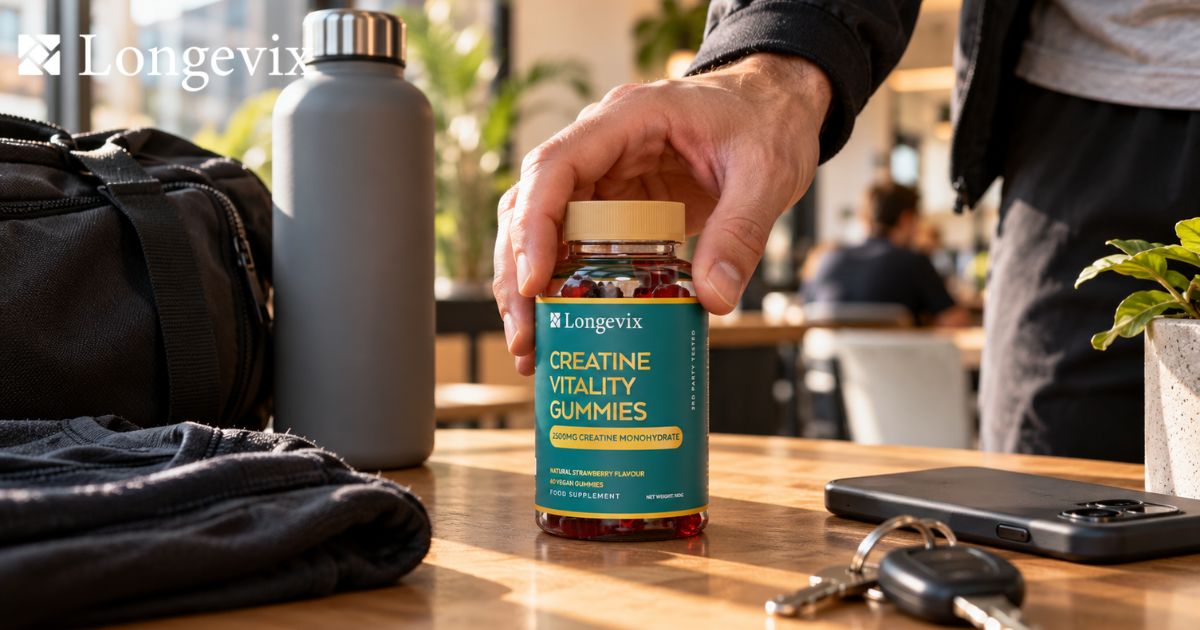
Powder can be equally simple when you already make a shake every morning. That makes consistency / adherence highly individual. The cheapest or most scientifically familiar format offers little real-world value when it stays unused. Still, convenience should never excuse unclear doses, unsuitable ingredients, or weak product information.
Routine Case Study: Convenience Versus Control
Imagine two gym users with similar training goals. One travels between client meetings throughout the week, making gummies easy to carry. Another trains at home and already weighs supplements beside breakfast. Powder gives that person greater dose flexibility with little added effort. The most practical format can therefore differ despite similar goals.
Creatine Gummies vs Powder Cost: Compare Value Properly
Pack price can disguise the true cost. A bottle containing 60 gummies doesn’t necessarily provide 60 servings because several pieces may make one complete serving. Powder tubs can create similar confusion when buyers focus on container weight. A stronger comparison uses serving count and, where quantities are disclosed, cost per gram of creatine.
Powder often offers attractive cost-effectiveness because a simple dry formula can be relatively economical to manufacture and package. Gummies require a more elaborate finished format. Yet the cheapest option isn’t automatically best value. A slightly dearer format that you use consistently may suit your routine better than powder you repeatedly skip.
|
Value measure |
What it tells you |
Why it matters |
|
Pack price |
Upfront spend |
Doesn’t reveal actual creatine exposure |
|
Cost per serving |
Price of one labelled serving |
Helps when serving sizes differ |
|
Cost per gram |
Price relative to creatine quantity |
Useful for like-for-like comparisons |
|
Servings per container |
Approximate product duration |
Prevents counting each gummy as one serving |
|
Routine value |
Whether the format fits daily use |
Adds practical context beyond price |
The 60-Gummy Trap
Suppose two hypothetical bottles each contain 60 gummies. One needs two gummies per serving, giving 30 servings. The other needs four, giving 15. Their bottle counts look identical while their value differs considerably. That is why cost per gram and complete serving information reveal more than the number printed prominently on the front.
Quality, Stability and Testing: What Should You Check?
Quality language can sound reassuring while describing very different measurements. Identity checks whether the expected substance is present. Potency measures quantity. Purity examines specified unwanted material or conformity with a standard. Stability evaluates performance over time. Good dose accuracy therefore requires more than attractive packaging or an impressive raw-material claim.
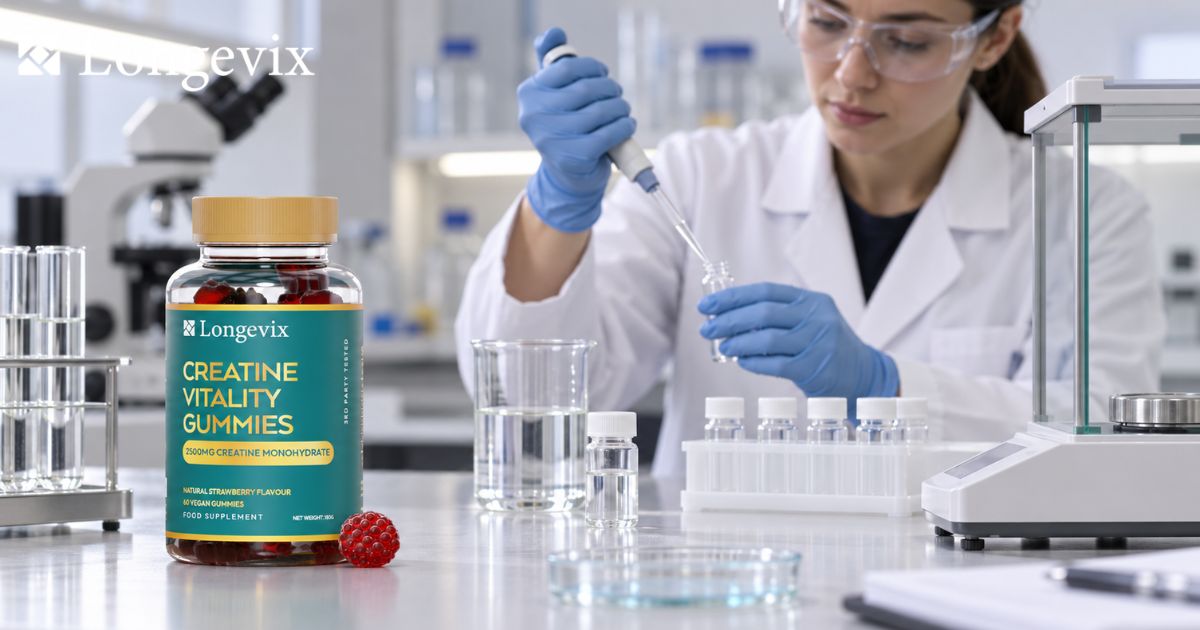
The format creates different practical challenges too. Gummies contain moisture within a structured matrix, while powders can attract humidity and clump. Visible texture changes don’t automatically prove potency loss. Product-specific specifications, storage instructions, dates, and appropriate testing provide stronger evidence. Longevix explains these distinctions on its Certificates and testing-document page.
Finished-Product Testing Answers Different Questions
A raw-material report can describe the incoming creatine ingredient. It doesn’t automatically prove how much remains in every finished gummy after manufacturing and storage. Likewise, a contaminant panel doesn’t establish clinical effectiveness. Useful testing should identify the sample, relevant batch, tests performed, units, specifications, results, provider, and reporting date.
Research Evidence and Product Evidence Aren’t the Same
This distinction matters throughout research / clinical trials. Evidence showing that creatine monohydrate supports certain performance outcomes doesn’t prove that every retail gummy delivers the studied amount. Ingredient research supports ingredient-level conclusions. Finished-product evidence helps answer separate questions about the actual formulation, its potency, and its quality controls.
Where Longevix Creatine Vitality Gummies Fit the Comparison
Longevix currently offers Creatine Vitality Gummies, rather than a standalone creatine powder. The live product information identifies creatine monohydrate, trimethylglycine or TMG, taurine, and vitamin B12. The bottle contains 60 strawberry-flavoured gummies, with four gummies forming one labelled serving and 15 servings per container.
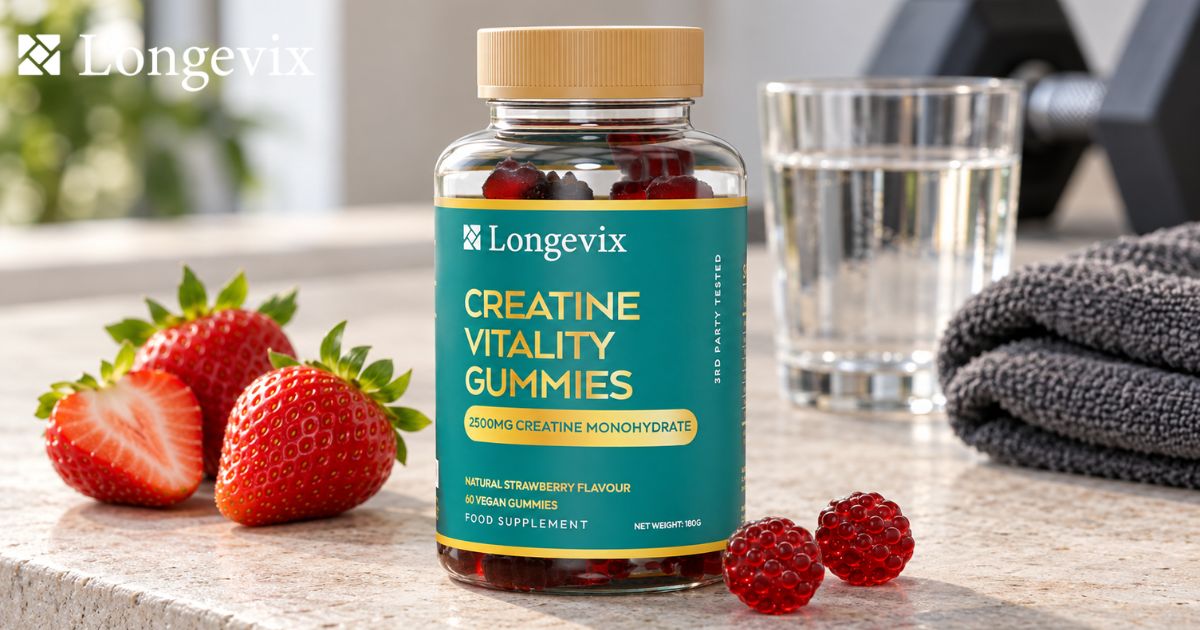
That makes Longevix a multi-ingredient gummy rather than a direct equivalent of single-ingredient powder. Importantly, the website directs customers to the physical label for the complete quantities. Those values shouldn’t be estimated. Therefore, an accurate Longevix cost per gram calculation or scoop-to-gummy conversion cannot currently be derived from the online ingredient information alone.
|
Longevix product detail |
Current verified information |
|
Product |
Longevix Creatine Vitality Gummies |
|
Format |
Strawberry-flavoured gummies |
|
Creatine form |
Creatine monohydrate |
|
Other listed actives |
TMG, taurine, vitamin B12 |
|
Pack size |
60 gummies |
|
Labelled serving |
4 gummies |
|
Servings per container |
15 |
|
Individual active quantities online |
Check the latest physical label |
|
Directions online |
Take up to four gummies daily, following the product label |
|
Central certificate index |
No separate Creatine Vitality Gummies document currently listed |
Why You Shouldn’t Copy Powder Dosing Onto Longevix Gummies
Plain creatine powder may contain only one active ingredient. Longevix gummies contain several. Increasing gummy intake simply to imitate a powder loading protocol would also increase the other listed ingredients. Product-specific directions therefore matter. Follow the current physical label instead of turning a research protocol into an improvised serving instruction.
Testing Should Match the Product and Batch
The product page currently presents a testing-document option and advises customers to match documentation with their product and batch. However, the Longevix testing-document index does not currently list a separate Creatine Vitality Gummies document. Until a matching report is accessible, avoid treating a product-specific creatine-gummy COA as publicly verified.
Creatine Gummies or Powder: Which Format Fits Your Routine?
The better format depends on what you value. Powder may suit you when you want simple ingredients, easy cost per gram comparisons, and greater dose flexibility. Gummies may suit you when flavour, portability, and minimal preparation matter. Neither deserves automatic superiority simply because one feels more traditional or more modern.
Before choosing, compare the creatine form, amount per complete serving, ingredient list, serving structure, storage guidance, available quality evidence, price, and routine fit. Most importantly, consider whether the format lets you maintain an appropriate equivalent daily intake consistently. Practical reliability matters more than fashionable packaging.
The Truth Before You Choose
Creatine gummies vs powder isn’t really a battle between new and old formats. It is a decision between different ways of delivering creatine. Established performance benefits relate mainly to creatine itself, appropriate intake, training, and regular use. Packaging should make those fundamentals easier rather than distract you from them.
For Longevix customers, the same principle applies. Review the Creatine Vitality Gummies product information, read the physical label, confirm the serving structure, and check any matching documentation that is available. Gummies can offer welcome convenience. Powder can provide greater measurement control. Your priorities determine which practical advantage matters most.
Frequently asked questions
Are Creatine Gummies as Effective as Powder?
They can be effective when they provide an appropriate amount of creatine consistently. Direct gummy-versus-powder research remains limited, so identical results shouldn’t be assumed solely from the delivery format.
Are Creatine Gummies as Good as Creatine Powder?
They can be a useful alternative when taste and portability matter. Powder often offers simpler formulas and greater dose adjustment, while gummies can make regular use easier for some people.
Is Powder Cheaper Than Gummies?
Creatine powder is often cheaper per gram because dry formulations can be simpler to manufacture. Compare actual creatine quantities and complete serving sizes rather than judging value from pack price alone.
Do Creatine Gummies Actually Work?
Yes. Research now shows that a creatine-monohydrate gummy can support selected performance outcomes in a studied athletic population. Results still depend on dose, training, formulation quality, and consistent use.
How Many Creatine Gummies Equal a Scoop of Powder?
There is no universal conversion. Compare the labelled grams of creatine in the complete gummy serving with the grams supplied by the powder serving. Piece count and scoop size alone cannot provide an accurate comparison.


