
Do NAD gummies break an intermittent fast? If they contain calories, they do not meet the rules of a strict calorie-free fast. However, the answer also depends on the gummy's ingredients, serving size and your reasons for fasting. Even sugar-free gummies may contain carbohydrates or other ingredients that contribute energy.
For people following a 16:8 fasting routine, taking gummies during the eating window is generally the simplest way to avoid uncertainty. But does nicotinamide riboside (NR), a common NAD+ precursor, affect fasting independently of the gummy base?
This guide examines the nutrition, human research and practical timing considerations, including what the available Longevix product information can—and cannot—confirm.
Do NAD Gummies Break a Fast? The Short Answer
NAD gummies containing energy-providing ingredients break a strict calorie-free fast. Whether a small serving meaningfully affects your wider fasting goals is a different question, and one that cannot be answered from the product name alone.
Gummies are not simply capsules in a chewable form. Their texture, flavour and stability depend on additional ingredients. Depending on the formulation, these may contribute sugars, other carbohydrates or energy-yielding sweeteners.
A product described as sugar-free is not necessarily calorie-free. Likewise, a product containing an NAD+ precursor is not automatically compatible with fasting.
|
What you are taking |
Practical fasting consideration |
|---|---|
|
NAD gummies containing calories |
Do not meet a strict zero-calorie fasting rule |
|
Sugar-free NAD gummies |
May still contain calories; check the complete nutritional information |
|
NAD gummies with unknown calorie content |
Fasting compatibility cannot be confirmed from the available information |
|
NAD-related supplements taken during the eating window |
Avoid uncertainty about consuming the supplement during the fasting period |
For someone following intermittent fasting primarily to manage their eating schedule, a small amount of energy may have a different practical significance than it would for someone observing a strict zero-calorie protocol.
The safest general approach is to understand your fasting objective and check the complete formulation before deciding when to take a supplement.
What Does “Breaking an Intermittent Fast” Actually Mean?
Intermittent fasting describes several eating patterns rather than one universal set of dietary rules.
The common principle is alternating periods of eating with periods when food intake is restricted. However, the duration, permitted intake and intended outcomes can differ considerably.
Strict Calorie-Free Fasting Versus a Flexible Eating Plan
A strict calorie-free fast excludes energy-containing foods and drinks during the fasting window. Under this definition, a gummy providing calories does not qualify, even if the amount is small.
A more flexible approach might focus on maintaining an eating schedule or managing total dietary energy intake. Someone using this approach may consider the overall pattern more important than a minor deviation.
That does not mean calories become metabolically irrelevant. It means the practical significance of consuming them depends partly on the goal being assessed.
Importantly, no scientifically established calorie threshold can guarantee that all fasting-related biological processes continue unchanged.
How 16:8, 14:10 and 5:2 Fasting Differ
With 16:8 fasting, a person generally fasts for 16 hours and eats within an eight-hour window. A 14:10 schedule follows the same principle with a shorter fasting period.
The 5:2 approach is different. It involves eating normally on five days and restricting energy intake on two days, rather than necessarily avoiding all calories for a continuous daily period.
These distinctions matter when deciding whether to include supplements. A gummy taken during a restricted-calorie day may count towards that day's intake, while the same gummy would fall outside the permitted intake of a strict zero-calorie fasting window.
A 2026 Cochrane review of intermittent fasting, covering 22 randomised trials involving 1,995 adults, found that intermittent fasting was unlikely to produce greater weight loss than conventional dietary advice.
This suggests that long-term weight management should not be reduced to a single question about whether a small supplement serving technically interrupts a fast.
Why Do Gummy Ingredients Matter During Fasting?
The active supplement ingredient is only one part of a gummy's formulation.
A manufacturer must also create a product with an appropriate consistency, taste and shelf life. The ingredients used for those purposes can influence the finished product's nutritional profile.
Sugars and Digestible Carbohydrates
Some gummies contain glucose syrup, sucrose or other energy-providing carbohydrates. Their presence can contribute calories to the full serving.
Digestible carbohydrate generally provides approximately four kilocalories per gram under UK food energy-calculation rules.
Consider a hypothetical supplement serving containing two grams of digestible carbohydrate:
2g × 4 kcal = approximately 8 kcal
That calculation illustrates the energy contribution of the carbohydrate alone. It is not a measurement of any Longevix product, and it does not establish a particular insulin response.
The same distinction applies to products advertised with a prominent amount of an active ingredient. A label displaying 300mg of NR does not tell you how much energy the finished gummies provide.
Polyols, Sweeteners and Gummy Bases
Sugar-free gummy manufacturers may use sugar alcohols, also called polyols, to provide sweetness and texture.
Examples used in some confectionery and supplement formulations include maltitol, sorbitol and erythritol. These are examples of possible ingredients, not a confirmed list of ingredients in Longevix gummies.
Different sweeteners have different nutritional properties. Under UK energy-conversion rules, most polyols are assigned approximately 2.4 kcal per gram, while erythritol is assigned a zero-energy factor.
Other gummy ingredients, including certain fibres and gelling agents, may also affect the finished product's energy calculation.
The relevant UK rules are set out in Regulation (EU) No 1169/2011, Annex XIV, as applicable in Great Britain.
This is why the complete nutritional information matters more than whether a gummy tastes sweet.
What Is Inside Longevix NAD+ Support Gummies?
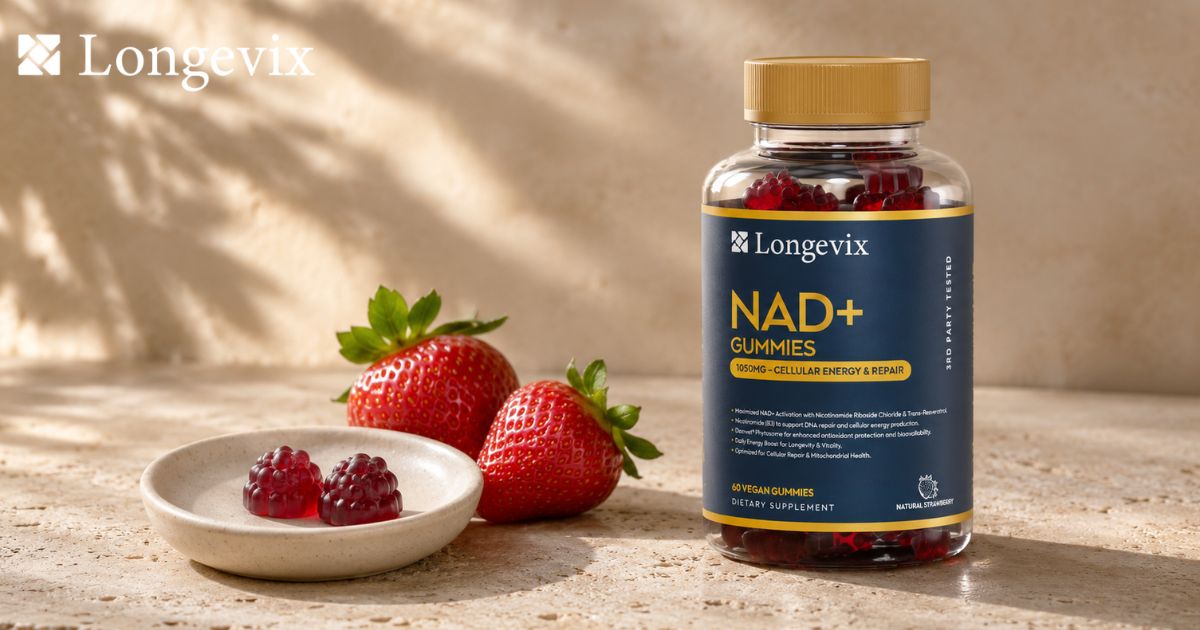
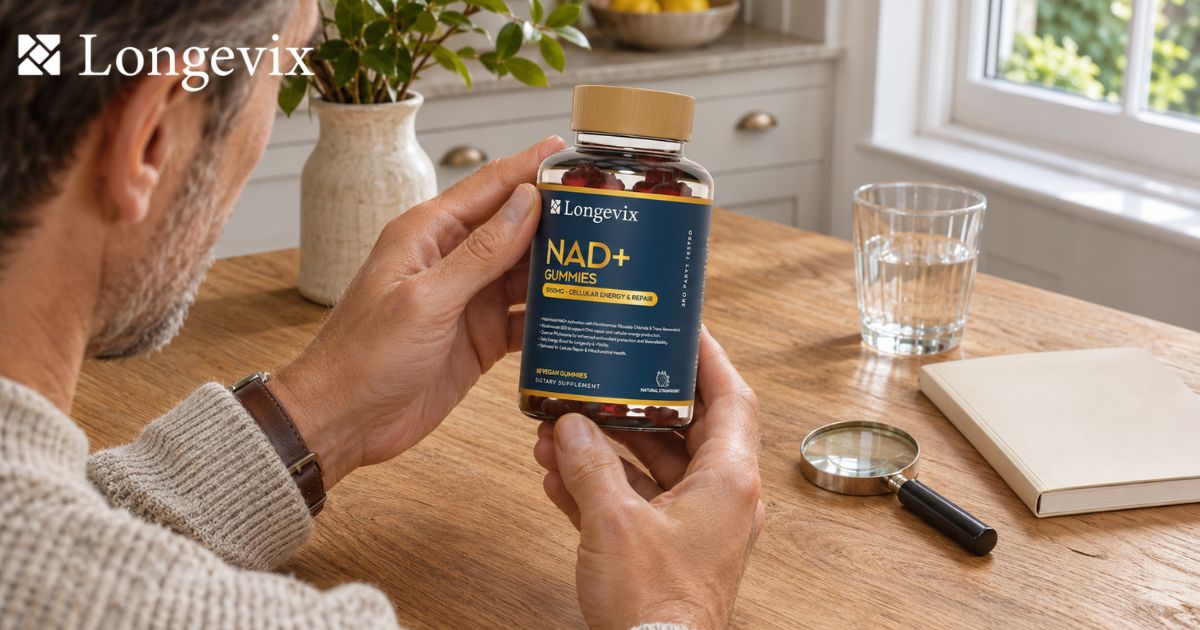
Longevix offers a strawberry-flavoured supplement called Longevix NAD+ Support Gummies.
The published product information identifies a bottle containing 60 gummies, with two gummies making up one labelled daily serving. That provides 30 servings per bottle.
The name describes a formula associated with NAD+ metabolism. The product contains nicotinamide riboside and nicotinamide rather than a stated serving of intact NAD+.
The Four Listed Active Ingredients
According to the official product listing, each two-gummy serving contains:
|
Active ingredient |
Published amount per two gummies |
Scientific context |
|---|---|---|
|
Nicotinamide riboside (NR) |
300mg |
A vitamin B3-related precursor used in NAD+ biosynthesis |
|
Quercetin |
250mg |
A flavonoid investigated in nutritional and experimental research |
|
Trans-resveratrol |
250mg |
A polyphenolic compound with a separate research and regulatory profile |
|
Nicotinamide (vitamin B3) |
250mg |
A vitamin B3 form that participates in NAD+ metabolism |
NAD+, short for nicotinamide adenine dinucleotide, is a coenzyme involved in normal cellular metabolism. It participates in reactions that help cells process nutrients and in the activity of several enzymes.
Nicotinamide riboside can enter biochemical pathways used to produce NAD+. That established biological role should not be confused with evidence that a finished supplement improves energy, health or longevity.
For more detail about the distinction between NAD+, NR and their formulations, see the Longevix NR gummies guide.
What the Current Product Information Does Not Reveal
Although the official listing gives amounts for the four active ingredients, it does not provide a complete public breakdown of:
· Total calories per two-gummy serving
· Total sugars and carbohydrates per serving
· Exact sweeteners and their amounts
· All other ingredients contributing to the gummy base
These missing details prevent a reliable product-specific conclusion about whether the gummies satisfy a strict calorie-free fast.
The website directs consumers to the physical label for the complete ingredient list, allergen information and directions.
A testing document is linked from the product page. Such documentation can be useful when its identity and batch match the product, but it should not be assumed to verify calories, sweeteners or fasting compatibility unless those measurements are actually included.
Until the relevant information is confirmed, Longevix NAD+ Support Gummies should not be described as proven calorie-free or fasting-compatible.
Do Sugar-Free NAD Gummies Break an Intermittent Fast?
Yes, sugar-free NAD gummies can still break a strict calorie-free fast if their other ingredients contribute energy.
The term sugar-free describes the sugar content of a food. It does not establish that the finished product contains no calories.
Sugar-Free Does Not Mean Calorie-Free
In Great Britain, the conditions for making a sugar-free nutrition claim generally require no more than 0.5g of sugars per 100g or 100ml.
This threshold is established under the applicable nutrition and health claims legislation.
A gummy could satisfy that sugar threshold while containing other substances that contribute energy.
For example, a product may use certain polyols instead of traditional sugar. The resulting product might contain very little sugar without being completely free from calories.
In the United States, sugar-free labelling generally uses a different threshold based on the serving and applicable reference amount. Readers should not assume that UK and US nutrition claims are calculated identically.
The existing Longevix article about sugar-free NAD gummies explores label terminology and product selection in greater depth.
How to Read Nutritional Information Per Serving
When checking a gummy supplement, start with the number of gummies required for a complete serving.
A nutritional value stated per 100g is not automatically the value consumed in one daily serving.
Look for total energy in kilocalories, total carbohydrate, sugars and any listed polyols. Then establish how much of the product you would actually consume.
If a bottle instructs you to take two gummies, consider the nutritional information for both gummies together.
Where the label is incomplete or difficult to interpret, ask the manufacturer for the current finished-product nutritional specification rather than estimating from the active ingredients.
A small numerical value may have limited practical significance for some dietary goals, but it should not be presented as proof that a strict fast remains uninterrupted.
Do NR and NAD-Related Ingredients Affect Insulin or Autophagy?
The science here requires an important distinction: research showing that a supplement changes NAD-related biomarkers does not necessarily tell us whether consuming that supplement during a fast changes insulin responses, autophagy or fasting outcomes.
What Human NR Trials Actually Measured
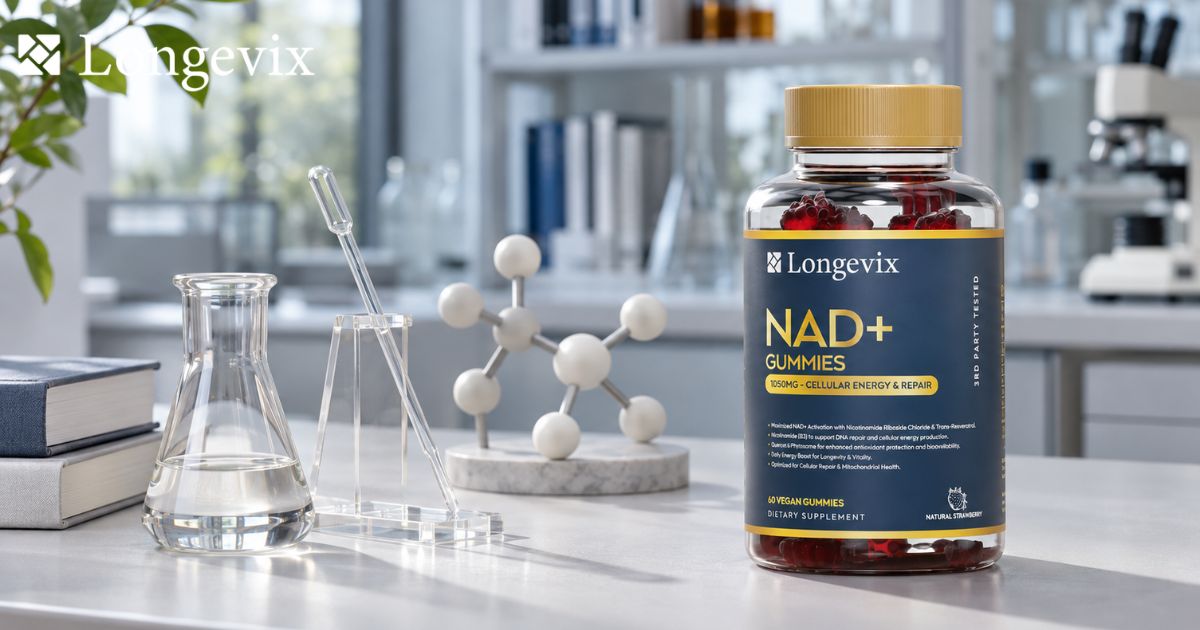
Nicotinamide riboside has been investigated in human clinical trials because it is a precursor involved in NAD+ production.
A 2019 randomised, double-blind clinical trial investigated daily amounts of 100mg, 300mg and 1,000mg NR over eight weeks in healthy overweight adults.
Researchers found dose-dependent increases in whole-blood NAD+ concentrations. Those findings support NR's biochemical activity under the tested conditions.
They do not establish that taking an NR-containing gummy during intermittent fasting preserves the fast or produces a particular health benefit.
Human research has also produced less encouraging results for some metabolic outcomes.
In a 12-week placebo-controlled trial involving 40 men with obesity and insulin resistance, supplementation with 2,000mg NR daily did not significantly improve insulin sensitivity.
A separate analysis of the trial found no significant effect on several fasting or glucose-challenge measures of glucose and insulin regulation.
These results do not prove that a lower dose has no immediate effect under every circumstance. They demonstrate why a claim about fasting compatibility cannot be inferred from the broader NR research.
A 2026 systematic review of NAD+ supplementation reached a similarly cautious conclusion. Across 33 human intervention studies and 80 rodent studies, NAD-related supplementation showed clearer biochemical effects than consistent improvements in functional or metabolic health outcomes.
Why Autophagy Claims Need Caution
Autophagy is a biological process through which cells break down and recycle certain cellular components.
It occurs naturally and is regulated by several interacting pathways, including those responsive to nutrient availability.
Fasting has been studied for its potential influence on these processes. However, much of the mechanistic research comes from laboratory experiments and animal studies.
Human evidence is more limited.
A 2025 exploratory study of intermittent fasting and autophagy assessed 121 people with obesity who were assigned to different dietary interventions over six months.
Researchers observed a between-group difference in an autophagy-related measure at six months, but the findings were exploratory and did not establish a precise calorie threshold at which autophagy begins or stops.
The study did not test commercial NAD gummies.
Consequently, there is no reliable basis for claiming that one NAD gummy will stop autophagy completely, or that consuming several gummies will leave it unaffected.
What the Evidence Actually Establishes
|
Question |
Evidence-based conclusion |
|---|---|
|
Does NR participate in NAD+ production? |
Yes, this is an established biochemical relationship |
|
Can oral NR raise NAD-related blood markers? |
Yes, under conditions examined in human trials |
|
Does raising NAD+ guarantee improvements in health? |
No; clinical outcomes remain inconsistent or uncertain |
|
Do Longevix gummies preserve fasting-related insulin responses? |
Not established by verified finished-product trials |
|
Do NAD gummies stop or stimulate autophagy in humans? |
No directly applicable controlled human evidence was verified |
|
Is there a proven safe calorie threshold for preserving all fasting effects? |
No universal threshold has been established |
The most useful distinction is between what an ingredient does in a biochemical pathway and what the completed supplement has actually been shown to do in people.
Does Your Fasting Goal Change the Answer?
Yes. Your reasons for fasting influence how you should interpret a supplement's nutritional content and the evidence surrounding it.
|
Fasting goal |
How to assess NAD gummies |
Practical consideration |
|---|---|---|
|
Strict zero-calorie fasting |
Any energy-containing serving falls outside the protocol |
Keep gummies within the eating window |
|
Weight management |
Consider the broader daily energy intake and dietary consistency |
Small energy contributions may matter less than overall adherence |
|
Metabolic health |
Avoid assuming that a small serving has no effect on glucose or insulin |
Assess the formula and follow individual medical advice |
|
Fasting for autophagy |
No validated gummy-calorie threshold guarantees preservation of autophagy |
Avoid making claims about an unmeasured biological response |
|
Medical fasting |
Follow the exact instructions from your healthcare provider |
Do not take supplements unless permitted |
Fasting for Weight Management
Weight management involves more than whether a fasting timer has been interrupted.
Total dietary intake, nutritional quality, physical activity, sleep, adherence and individual circumstances may influence long-term results.
The 2026 Cochrane findings suggest that intermittent fasting is not necessarily more effective than conventional dietary advice for weight loss.
This does not mean supplement calories should be ignored. It means that a small departure from a fasting schedule should not automatically be equated with losing all potential progress.
Fasting for Metabolic Goals
Some people use time-restricted eating because they are interested in blood glucose, insulin sensitivity or other metabolic markers.
These outcomes should not be reduced to a simple “insulin spike” explanation.
Responses can vary with the nutritional composition, amount consumed, individual physiology and wider dietary circumstances.
Importantly, the NR trials discussed above did not establish the immediate insulin response to a finished Longevix gummy consumed during fasting.
Someone managing diabetes should seek individual clinical guidance before fasting, especially when taking medicines that can lower blood glucose.
Strict Fasting and Medical Fasting
Fasting before a blood test, medical procedure or operation is different from a voluntary dietary routine.
Even a small supplement serving may conflict with instructions intended to standardise a test or reduce procedural risks.
NHS hospital guidance on fasting blood tests emphasises following the instructions provided for the particular investigation.
Do not substitute general intermittent-fasting advice for medical fasting instructions.
When Should You Take NAD Gummies During a 16:8 Fast?
For someone following a strict 16:8 eating schedule, taking a supplement during the eating window is a straightforward way to avoid uncertainty about consuming gummies during the fasting period.
This is a scheduling consideration, not proof that taking NAD gummies with food improves their effectiveness.
Taking Supplements With the First Meal
Suppose your eating window begins at midday.
Taking a supplement with your first meal, where its label and your individual circumstances allow, keeps it outside the preceding fasting window.
If your eating period begins at 10am, the same principle applies at breakfast or another meal during that period.
However, the correct timing should always respect the product's instructions and any advice from a qualified healthcare professional.
Sample Daily Fasting Schedules
|
Fasting routine |
Example eating window |
Illustrative supplement timing |
|---|---|---|
|
16:8 |
12:00–20:00 |
With lunch at 12:00 |
|
16:8 |
10:00–18:00 |
With breakfast at 10:00 |
|
14:10 |
09:00–19:00 |
With breakfast or lunch |
|
16:8 |
13:00–21:00 |
With the first meal at 13:00 |
These examples describe possible schedules, not recommendations to take a particular product or dose.
A supplement should not be added to your routine solely because it is marketed for NAD+ support. Whether it is appropriate depends on your nutritional needs, the complete formulation, safety considerations and any relevant regulatory restrictions.
There is no sufficiently established clinical basis for claiming that taking NAD gummies immediately before, during or after a fast produces superior longevity or metabolic outcomes.

Are NAD Gummies Safe to Take on an Empty Stomach?
Taking a gummy on an empty stomach may be tolerated differently from taking it with a meal.
Some people experience gastrointestinal discomfort with certain supplements. Depending on the formula, potential concerns can include nausea, bloating, abdominal discomfort or loose stools.
These symptoms may relate to an active ingredient, the gummy base, sweeteners, other dietary factors or individual sensitivity.
However, the frequency of these reactions has not been established through a verified clinical trial of the finished Longevix formula.
The Longevix NAD+ gummies side-effects guide discusses the listed ingredients and relevant safety questions in greater detail.
Extra caution is appropriate when combining products containing nicotinamide riboside, nicotinamide, resveratrol or other overlapping ingredients.
People who are pregnant, breastfeeding, taking prescription medicines or managing medical conditions should obtain professional advice before considering such supplements.
Fasting also introduces its own safety considerations.
The NHS Specialist Pharmacy Service guidance on medicines during fasting highlights risks such as dehydration, changes to medicine timing and hypoglycaemia among people using certain diabetes treatments.
Do not change prescribed medicine doses or timing to accommodate a fasting schedule without professional guidance.
Anyone who becomes unwell while fasting should prioritise their health rather than maintaining the fasting window.
UK Label and Regulatory Checks Before Taking NAD Gummies
Before selecting a food supplement, UK consumers should consider more than its advertised active ingredients.
The complete formulation, ingredient identity, daily serving, nutritional information and relevant warnings all matter.
UK food supplements must also comply with applicable food law. The availability of a product for purchase does not, by itself, establish regulatory compliance.

Checking Nicotinamide Riboside
Great Britain's authorised novel-food register includes nicotinamide riboside chloride, subject to specific identity, composition, use and labelling conditions.
The listed conditions include a maximum of 300mg per day for the general adult population under that authorisation.
Longevix lists 300mg of nicotinamide riboside per two-gummy serving. However, its public product description does not sufficiently establish the exact regulatory identity and specifications of the ingredient.
The applicable authorisation and the finished product's compliance therefore require confirmation.
An authorisation for a specified ingredient should never be interpreted as automatic approval of every formula containing that ingredient.
Checking Trans-Resveratrol
Trans-resveratrol is another ingredient whose source matters.
The Great Britain novel-food authorisation for synthetic trans-resveratrol specifies a maximum of 150mg daily in adult supplements in capsule or tablet form.
A separate authorisation exists for trans-resveratrol from a microbial source, with different conditions.
The Longevix product listing states 250mg trans-resveratrol per two gummies but does not establish which source and authorisation apply.
That distinction requires product-specific regulatory verification before the formulation can be described as compliant with applicable Great Britain rules.
Nutrition and Health Claims
In Great Britain, food and supplement marketing must follow applicable nutrition and health-claim requirements.
Claims about disease treatment, prevention or cure are not appropriate for ordinary food supplements.
Likewise, claims that NAD gummies extend lifespan, repair DNA, prevent metabolic disease or guarantee improved cellular health cannot be justified simply by describing NAD+ biology.
The GOV.UK guidance on supplement labelling and claims provides further information.
Northern Ireland can be subject to different novel-food requirements. US supplement and labelling rules also differ, so regulatory conclusions should not be transferred automatically between markets.
The practical lesson is to look for accurate, verifiable information rather than assuming that a popular ingredient or persuasive product description establishes its safety or legal status.
The Bottom Line: How to Decide When to Take Your Gummies
If your fasting routine requires zero calories, do not assume NAD gummies are suitable during the fasting window.
Whether they technically interrupt that rule depends on their energy contribution, while their wider biological effects remain a separate scientific question.
The most sensible approach is to establish your fasting goal, examine the full product label, check the energy content of the complete serving and account for any medical considerations.
Where the nutritional information is uncertain, choosing a time within your eating window avoids the question of consuming gummies during a strict calorie-free fast. That does not remove the need to check the supplement's suitability, safety and regulatory status.
Longevix publishes information about its NAD+ Support Gummies and offers additional educational resources about sugar-free NAD gummies and autophagy and fasting.
Before making a supplement decision, review the current physical label and seek clarification about any missing nutritional or regulatory information.
A clear label and an informed decision are more valuable than a promise that a gummy cannot break your fast.
Frequently asked questions
Do Sugar-Free NAD Gummies Break a Fast?
They can. Sugar-free does not necessarily mean calorie-free, and a gummy may contain energy-providing ingredients other than sugar. Check the full nutritional information before assuming it meets a strict fasting rule.
Can I Take NAD Gummies During a 16:8 Fast?
If you follow a strict calorie-free protocol, taking gummies within your eight-hour eating window avoids consuming them during the fast. Whether a particular supplement is suitable for you still depends on its ingredients, directions and your circumstances.
Do NAD Gummies Stop Autophagy?
There is no directly applicable controlled human evidence establishing whether a serving of Longevix NAD+ Support Gummies stops, preserves or stimulates autophagy during fasting. Claims about a precise calorie threshold or guaranteed biological response would be premature.
Does Nicotinamide Riboside Raise Insulin While Fasting?
Human NR research has examined NAD-related biomarkers and some metabolic outcomes, but it does not establish the immediate insulin response to the finished Longevix gummy during fasting. The complete formulation and individual circumstances may also matter.
How Many Calories Are in Longevix NAD+ Support Gummies?
The accessible official product listing does not confirm the total calories per two-gummy serving. It lists the four active ingredients but directs readers to the physical label for complete formulation information. A verified finished-product nutrition panel is needed to establish the calorie content.