Finding the right nicotinamide riboside dosage can feel confusing. Research uses different amounts, study lengths, and participant groups. Nicotinamide riboside, or NR, is a vitamin B3-related compound used by the body in pathways that produce NAD+. Human studies have examined NAD+ levels, insulin sensitivity, and several metabolic markers after NR intake. Yet a larger dose doesn’t automatically deliver better results.
Your product formulation, labelled directions, health circumstances, medicines, and total supplement intake all matter. This guide separates clinical research from everyday dosing, compares current Longevix products, and explains NR supplementation without turning experimental research protocols into personal medical advice.
What Is Nicotinamide Riboside and Why Does Dosage Matter?
Nicotinamide riboside belongs to the vitamin B3 family. Your cells can use it within pathways that generate NAD+, a coenzyme involved in energy metabolism and many cellular reactions. However, nicotinamide riboside supplementation isn’t a simple case of taking more to gain more. Human biology has checks, limits, and interconnected pathways.
Dosage matters because researchers measure very different outcomes. One trial might examine NAD metabolites, while another studies insulin sensitivity or cardiovascular markers. A favourable change in one measurement doesn’t prove wider metabolic benefits. This distinction is central to Longevix’s science-led approach, which separates biological plausibility from demonstrated human outcomes.
How Does NR Relate to NAD+ Production?
NR enters the NAD+ biosynthetic pathway through enzymes called nicotinamide riboside kinases. NR can then contribute to NMN formation before further conversion towards NAD+. Think of it as a biochemical relay rather than a direct switch. Measurements in blood and tissues may therefore differ according to the sample, method, population, and study design.
Why Isn’t a Higher Nicotinamide Riboside Dose Automatically Better?
Higher NR intake can create stronger changes in certain NAD-related measurements. Yet dose-dependent increases in biomarkers don’t prove equally dose-dependent health improvements. Researchers must separately test outcomes such as physical function, cognition, blood pressure, metabolic health, or quality of life before concluding that a larger dose offers greater practical benefit.
What Nicotinamide Riboside Dosages Have Human Studies Used?
Published human clinical trials have investigated a broad range of mg/day dosages. One eight-week randomised, double-blind study compared 100 mg, 300 mg, and 1,000 mg daily. Other controlled trials have explored 1,000 mg, 2,000 mg, and even 3,000 mg daily in specific research populations.
Those numbers need context. High research doses aren’t consumer targets. Many NR studies remain relatively small, and several metabolic investigations fall within roughly 6–12 weeks duration. Participants may also undergo screening and medical monitoring. A dose tolerated under those conditions doesn’t automatically become an appropriate long-term amount for a healthy adult.

Research Case Study: 100 mg, 300 mg and 1,000 mg Daily
An eight-week randomised trial studied healthy overweight adults receiving 100 mg, 300 mg, 1,000 mg NR, or placebo daily. Researchers reported dose-dependent increases in whole-blood NAD+ and related metabolites. Crucially, those results demonstrate biological activity rather than proving that 1,000 mg provides the best consumer outcome. View the PubMed study.
Research Case Study: 1,000 mg in Middle-Aged and Older Adults
A six-week crossover trial investigated 1,000 mg daily in healthy middle-aged and older adults. NR increased NAD-related metabolism and was well tolerated during the intervention. Exploratory cardiovascular findings also appeared. However, exploratory results need replication before becoming broad health claims. Read the Nature Communications study.
Research Case Study: 2,000 mg in Men With Obesity
A twelve-week trial tested 2,000 mg NR daily in obese, insulin-resistant men. Despite the high dose, NR didn’t improve insulin sensitivity or whole-body glucose metabolism compared with placebo. The result provides a useful reality check: promising biochemical mechanisms don’t always translate into meaningful metabolic improvements. Read the study.
Research Case Study: 1,000 mg and Body Composition
Another six-week study investigated 1,000 mg daily in overweight or obese adults. Researchers reported minor changes in body composition, including relative fat-free mass, alongside changes in muscle acetylcarnitine metabolism. Sleeping metabolic rate also increased, although most other metabolic-health outcomes remained unchanged. Read the PubMed record.
|
Human research example |
NR amount |
Duration |
Population |
Main lesson |
|
Conze et al. |
100, 300 or 1,000 mg/day |
8 weeks |
Healthy overweight adults |
Whole-blood NAD+ rose in a dose-dependent manner |
|
Martens et al. |
1,000 mg/day |
6 weeks |
Middle-aged and older adults |
NAD+ metabolism increased; broader findings remained exploratory |
|
Dollerup et al. |
2,000 mg/day |
12 weeks |
Obese, insulin-resistant men |
No improvement in insulin sensitivity or whole-body glucose metabolism |
|
Remie et al. |
1,000 mg/day |
6 weeks |
Overweight or obese adults |
Minor body-composition and sleeping-metabolic-rate changes |
|
NR-SAFE |
3,000 mg/day |
4 weeks |
People with Parkinson’s disease |
Short-term phase I safety evidence, not a general dosing recommendation |
Is There a Recommended Nicotinamide Riboside Dosage?
No single daily NR amount has been established as optimal for every adult. Research doses answer tightly defined scientific questions. They don’t act as universal prescriptions. For commercial supplements, the formulation, applicable regulatory limits, current product directions, individual circumstances, and professional advice all deserve consideration.
This distinction prevents a common mistake: copying the highest number from a study. Even strong randomized controlled trials apply to particular participants and conditions. Findings involving older adults / obese adults can inform scientific understanding, but they can’t determine an individual dosage for every healthy adult.
Research Dosage vs Recommended Product Serving
A study dose belongs to a clinical protocol. A labelled serving belongs to a particular commercial formulation. Those numbers may look similar, but their meaning differs. Trials specify ingredients, participant criteria, duration, monitoring, and outcomes. Product directions describe intended use. Neither automatically replaces individual medical advice.
Is 300 mg of Nicotinamide Riboside Enough?
Three hundred milligrams has appeared in clinical research and in current Longevix formulations. The NR + TMG Capsules and NAD+ Support Gummies each provide 300 mg NR per labelled serving. However, evidence doesn’t establish 300 mg as universally sufficient for every goal or individual.
What About a 500 mg Nicotinamide Riboside Dosage?
The current Longevix Pure Nicotinamide Riboside Powder product page lists a 1,000mg labelled serving and a 1,000mg measuring scoop. That is a product specification, not proof of an ideal medical dose. UK readers should also consider the specific regulatory context described below before interpreting this amount as a daily recommendation.
UK and US Nicotinamide Riboside Context
Regulatory context matters. Great Britain’s current authorised novel-food register lists nicotinamide riboside chloride in food supplements at up to 300 mg/day for the general adult population, excluding pregnant and breastfeeding women. In the US, an FDA GRAS notice concerns specified food uses. Neither framework proves universal clinical benefits at a particular dosage.
Nicotinamide Riboside Dosage in Longevix Products
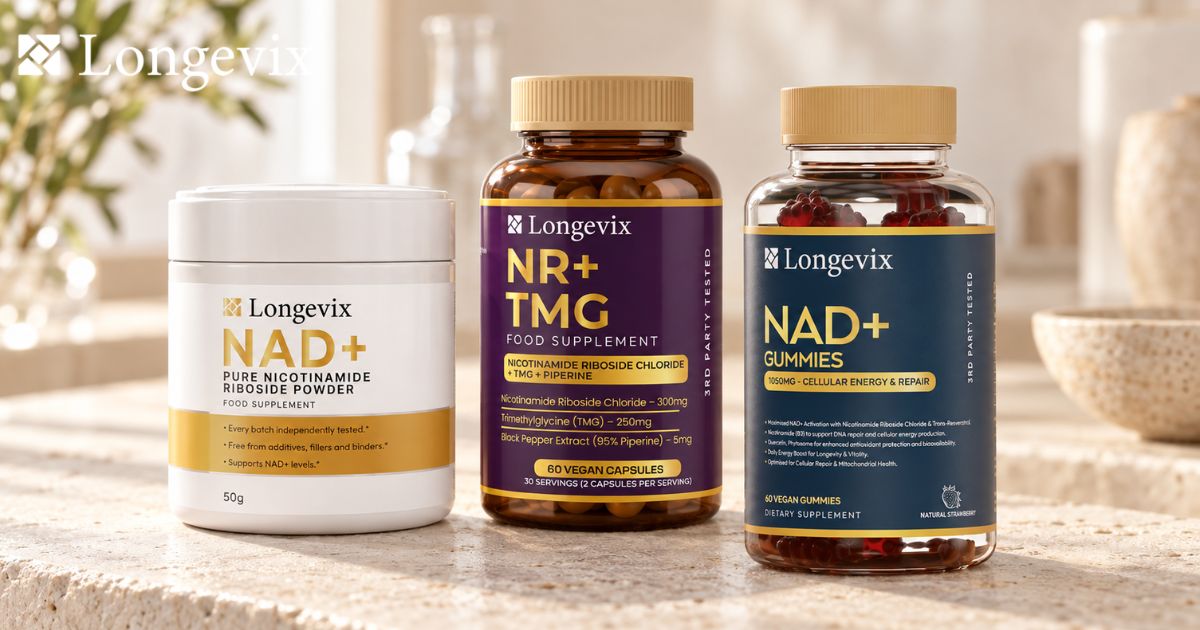
Longevix currently lists three NR-containing products with different formulations. Pure NR powder is listed with a 1,000mg labelled serving. NR + TMG Capsules contain 300 mg NR per two capsules. NAD+ Support Gummies contain 300 mg NR per two gummies. These figures describe product formulations rather than universally appropriate personal doses.

The milligram number also tells only part of the story. Capsules include TMG and piperine. Gummies combine NR with quercetin, trans-resveratrol, and nicotinamide. Consequently, comparing products purely by NR quantity can hide relevant formulation differences. Check the complete ingredient information, regulatory context, and current physical label before use.
|
Longevix product |
Labelled serving |
NR per serving |
Other listed actives |
|
Pure Nicotinamide Riboside Powder 50g |
One level scoop |
1,000mg listed on current product page |
No additional active listed on the current product record |
|
NR + TMG Capsules |
Two capsules |
300 mg |
TMG 250 mg, piperine 5 mg |
|
NAD+ Support Gummies |
Two gummies |
300 mg |
Quercetin 250 mg, trans-resveratrol 250 mg, nicotinamide 250 mg |
“Do not exceed the stated recommended daily amount.” — Longevix
Pure Nicotinamide Riboside Powder: 1,000mg labelled serving
The 50g Pure NR Powder contains nicotinamide riboside chloride and includes a 1,000mg measuring scoop. Its current page states approximately 50 servings at that amount. Because Great Britain’s authorised novel-food register currently specifies a lower maximum for general adult supplements, UK use deserves regulatory clarification.
NR + TMG Capsules: 300 mg NR Per Serving
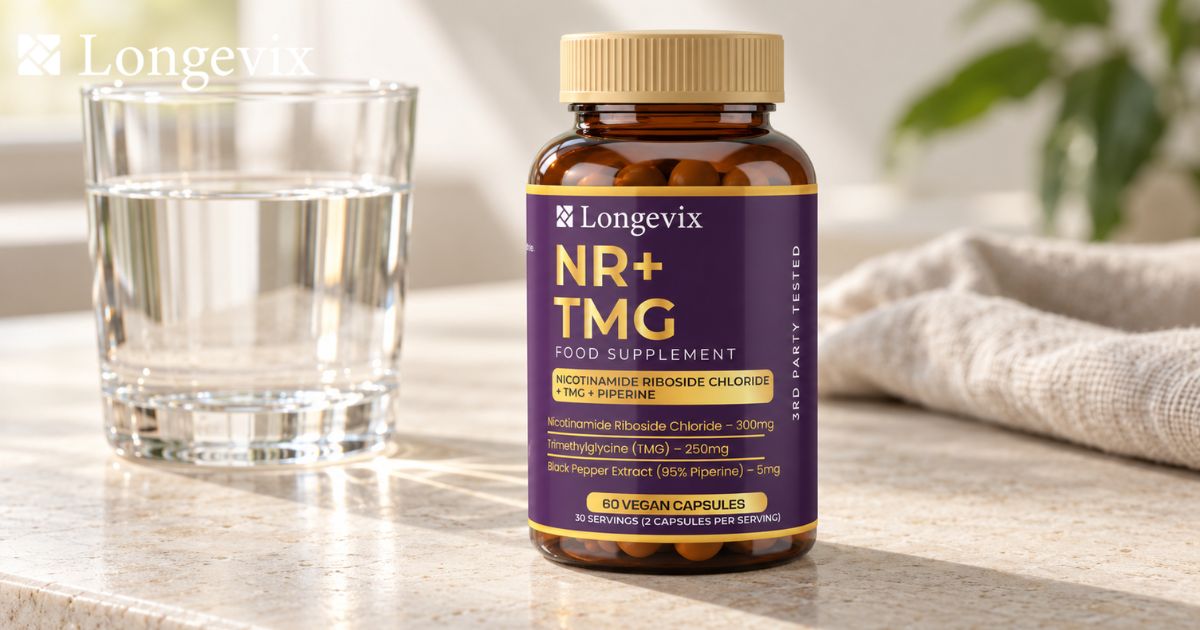
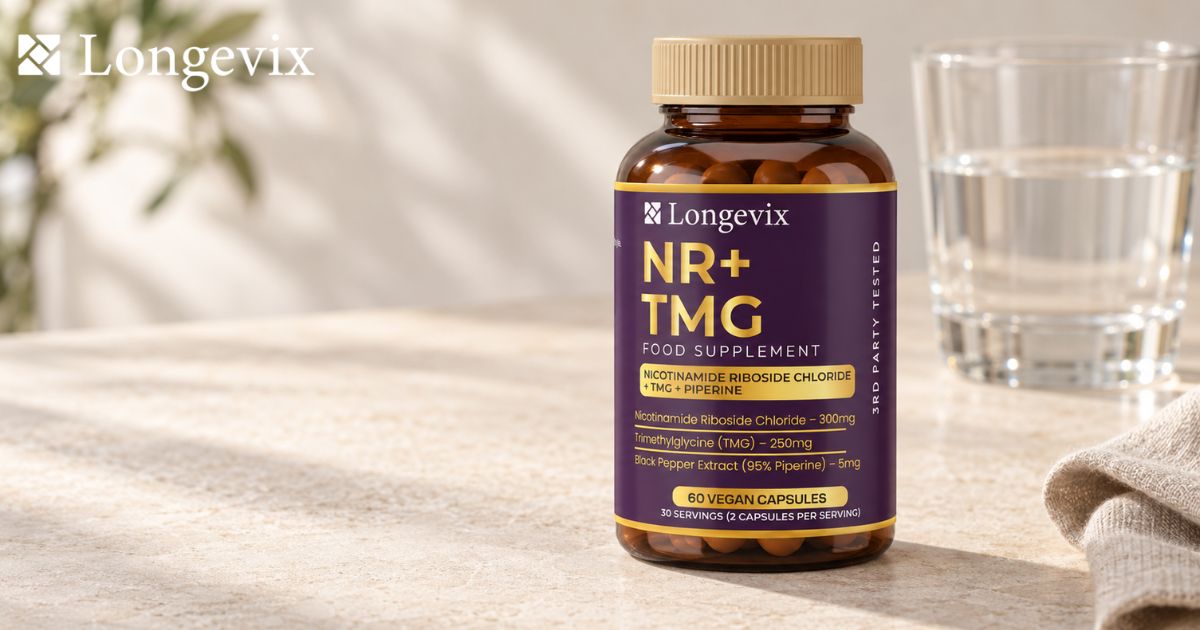
The NR + TMG Capsules provide 300 mg NR, 250 mg trimethylglycine, and 5 mg piperine per two-capsule serving. One bottle contains 60 capsules, providing 30 labelled servings. The current directions state two capsules daily while instructing users to follow the product label.
NAD+ Support Gummies: 300 mg NR Per Serving
The NAD+ Support Gummies contain four listed active ingredients. Two gummies provide 300 mg NR, 250 mg quercetin, 250 mg trans-resveratrol, and 250 mg nicotinamide. The bottle contains 60 gummies, providing 30 two-gummy servings according to the current product page.
300 mg vs 500 mg Nicotinamide Riboside
Higher isn’t automatically better. A 500 mg single-ingredient powder serving differs substantially from a 300 mg multi-ingredient formulation. Consider the complete formula, regulatory status, measuring method, existing supplements, medicines, and professional advice where appropriate. Current evidence doesn’t establish either amount as universally superior for every person or health objective.
How to Take Nicotinamide Riboside Correctly
Careful dosing begins with details that are easy to overlook. Check the amount per serving rather than assuming every NR product contains the same quantity. Powder requires accurate measurement, while capsules and gummies provide fixed units. Changing formats can alter NR intake even when every product appears to belong to the same NAD+ category.
Consistency matters, but restraint matters too. Don’t recreate high-dose clinical protocols at home or double a serving after forgetting an earlier dose. Research participants often undergo medical screening, laboratory testing, and structured monitoring. Those safeguards make clinical experimentation very different from ordinary supplement use.
How to Measure Nicotinamide Riboside Powder
The current Longevix Pure NR Powder page states that its included scoop measures approximately 1,000mg. A level scoop and a heaped scoop aren’t equivalent. Accurate measurement matters with concentrated powders. For UK consumers, applicable regulatory limits should also be considered before treating the website’s listed serving as routine daily guidance.

How to Take NR + TMG Capsules
Longevix currently directs users to take two NR + TMG capsules daily according to the product label. That serving contains NR, TMG, and piperine. If you already use other TMG or piperine-containing products, consider the combined intake rather than viewing the capsules as an isolated NR supplement.
How to Take NAD+ Support Gummies
Current Longevix directions state two NAD+ Support Gummies daily. The serving contains NR alongside nicotinamide, quercetin, and trans-resveratrol. Gummies may feel less medicinal because they’re chewable and flavoured. Nevertheless, their active ingredients deserve the same careful label reading as powders, capsules, or other food supplements.
Should You Split Your Daily NR Dosage?
Some clinical studies divide daily NR intake into separate doses. That doesn’t mean every commercial serving needs splitting. Study schedules reflect research design, pharmacokinetic questions, and specific populations. Unless appropriate product directions or qualified professional advice support a change, don’t assume that copying a trial’s dosing schedule improves everyday results.
When Is the Best Time to Take Nicotinamide Riboside?
Morning use often appears in online discussions because NAD+ biology interacts with cellular energy and circadian rhythms. However, human evidence hasn’t established one universally superior time for taking NR. Most studies examine exposure, NAD metabolites, safety and tolerability, or clinical outcomes rather than directly comparing identical morning and evening doses.
That evidence gap is important. A plausible biological mechanism isn’t proof of a practical timing advantage. Follow applicable product directions and choose a routine you can use consistently. If medicines, health conditions, or multi-ingredient products complicate timing, a pharmacist or qualified healthcare professional can provide individual guidance.

Morning or Night: Does NR Timing Matter?
There isn’t strong human evidence proving that taking the same NR dose in the morning produces better clinical outcomes than taking it later. Circadian NAD+ biology remains scientifically interesting, but translating molecular rhythms into a universal dosing rule would move beyond current evidence. Timing claims should therefore remain cautious and specific.
Should You Take Nicotinamide Riboside With Food?
Whether NR should be taken with food depends partly on the formulation and its directions. A pure powder and a multi-ingredient gummy aren’t identical products. Additional ingredients can also affect practical tolerability. Avoid assuming that every nicotinamide riboside product requires either an empty stomach or a meal unless reliable instructions support that claim.
Routine Beats Chasing an Unsupported Perfect Time
A dependable routine can reduce accidental changes in supplement use. Think of it like catching a regular train rather than searching for a mythical express service. However, consistency alone doesn’t guarantee stronger physiological effects. It simply makes it easier to follow an appropriate serving schedule without repeatedly changing timing or quantity.
How Long Should You Take Nicotinamide Riboside?
Duration changes how every nicotinamide riboside dosage should be interpreted. Four weeks, six weeks, and twelve weeks represent different exposure periods. Short studies can identify early biomarker changes or obvious tolerability issues. They cannot tell researchers everything about continuous use over several years or decades.
Published trials range from short interventions to several months. Longer exposure isn’t automatically more beneficial, while short trials cannot settle lifelong safety and tolerability. Sensible interpretation always pairs the dosage with study length, participant characteristics, formulation, comparator, measured outcomes, and any relevant adverse events.
What Does 6–12 Weeks of NR Research Tell Us?
Several metabolic trials fall within a 6–12 weeks duration window. Researchers have used these periods to investigate NAD metabolism, cardiovascular markers, obesity-related outcomes, and skeletal-muscle metabolism. Such studies provide useful short-to-medium-term information. They don’t establish an ideal lifelong supplementation schedule for otherwise healthy consumers.
How Quickly Can NR Affect NAD-Related Biomarkers?
Human trials show that NR can alter the NAD metabolome within relatively short periods. However, NAD+ levels are biochemical measurements rather than a timer for feeling younger, sharper, or more energetic. Changes in laboratory markers need separate evidence before they can support claims about wellbeing, performance, disease risk, or longevity.
Research Case Study: Short High-Dose NR in Parkinson’s Disease
The NADPARK phase I trial investigated NR in people with Parkinson’s disease, while the later NR-SAFE study tested 3,000 mg daily for four weeks under medical supervision. NR-SAFE focused primarily on high-dose safety and tolerability. These neurological trials support further research, not routine high-dose self-supplementation by healthy adults.
Does NR Need to Be Taken Forever?
No current human evidence establishes lifelong NR use as necessary for everyone. Clinical trials investigate defined questions over defined periods. Long-term decisions should therefore consider why you’re using NR, applicable product directions, total supplement exposure, medicines, health conditions, and the considerable limits of evidence on continuous multi-year supplementation.
What Factors Can Affect Your Nicotinamide Riboside Dosage?
People respond differently to nutrition and supplementation. Age, medical history, medicines, diet, formulation, and concurrent supplements can all affect how relevant a study becomes. Research involving older adults / obese adults demonstrates why copying one trial dose into every population oversimplifies a much more complicated question.
Product composition adds another layer. A pure NR powder differs from a gummy containing several other active ingredients. Looking only at milligrams may overlook nicotinamide exposure, TMG intake, piperine, resveratrol, or quercetin. Your complete supplement routine provides more useful context than one isolated NR number.
Age, Weight and Metabolic Health
NR studies have included healthy older adults, overweight participants, and people with insulin resistance. Results haven’t been uniform. Some trials increase NAD-related biomarkers without improving the main metabolic endpoint. Age, weight, or metabolic status therefore doesn’t provide a simple formula for calculating a personalised nicotinamide riboside dose.
What Has Research Found About β-Cell Function?
Preclinical work has created interest in NAD metabolism and β-cell function. Human findings are less straightforward. In obese, insulin-resistant men, twelve weeks of 2,000 mg NR daily didn’t improve β-cell function, glucose tolerance, or incretin responses. This gap between laboratory promise and human outcomes reinforces the need for measured claims.
Don’t Confuse Nicotinamide With NR in Diabetic NAFLD Research
A study sometimes encountered during metabolic research involved diabetic NAFLD, but the intervention used nicotinamide rather than nicotinamide riboside. Both belong to the broader vitamin B3 family, yet they aren’t interchangeable compounds. Using nicotinamide data as direct proof for an NR dosage would misrepresent the intervention and weaken scientific accuracy.
What Do Kidney Studies Add to the Picture?
A randomised crossover study involving CKD patients tested NR at 1,000 mg daily for six weeks. Researchers examined exercise performance, mitochondrial metabolism, lipid measures, and plasma TCA cycle intermediates. NR altered several metabolic markers and the lipid profile, but it didn’t improve peak aerobic capacity or total work efficiency.
Medicines and Multi-Ingredient Formulas
Medication use deserves extra attention with combination supplements. Longevix NR + TMG Capsules contain 5 mg piperine per serving. Piperine can affect drug-metabolising pathways and bioavailability. If you take prescription medicines or manage a medical condition, discuss multi-ingredient supplementation with a pharmacist or qualified healthcare professional before changing your routine.
Can You Take NR With TMG, Resveratrol or Other NAD+ Ingredients?
Combination formulas can appear convincing because several ingredients connect with related biological pathways. Yet combining compounds doesn’t automatically prove synergy. TMG, resveratrol, nicotinamide, and quercetin each have separate evidence bases. Their presence alongside NR shouldn’t be presented as proof that a formula produces stronger anti-inflammatory effects or longevity outcomes.
This principle matters when comparing Longevix products. NR + TMG Capsules combine NR with TMG and piperine, while NAD+ Support Gummies contain NR, quercetin, trans-resveratrol, and nicotinamide. Consider every active ingredient, its quantity, possible overlap with other supplements, and relevant medicines rather than focusing solely on NR.
Nicotinamide Riboside and TMG
TMG, also called trimethylglycine, participates in methyl-donor metabolism. This biological role explains why it sometimes appears beside NAD+ precursors. Longevix combines 300 mg NR with 250 mg TMG per capsule serving. Current evidence, however, doesn’t establish that every person taking NR also needs additional TMG.
NR With Trans-Resveratrol and Quercetin
Longevix NAD+ Support Gummies combine 300 mg NR with 250 mg quercetin and 250 mg trans-resveratrol per two-gummy serving. Each ingredient has a separate research history. Combining them creates a broader formulation, but mechanistic overlap doesn’t prove superior clinical outcomes compared with using a single ingredient.
NR and Nicotinamide in the Same Formula
Two Longevix NAD+ Support Gummies contain 300 mg NR plus 250 mg nicotinamide. Both compounds belong to the wider vitamin B3 family, yet they enter NAD-related metabolism differently. This ingredient overlap shows why consumers should examine total formulation and vitamin B3 exposure rather than counting only nicotinamide riboside milligrams.
Can You Take NR and NMN Together?
NR and NMN both participate in pathways connected with NAD+ production. That shared role doesn’t prove that taking them together provides additive metabolic benefits. Combining two precursors can increase total supplement exposure without demonstrating extra value. Evidence from direct human comparisons would be needed before claiming that routine stacking offers superior outcomes.
Nicotinamide Riboside Side Effects, Safety and Who Should Be Careful
Published trials generally describe NR as reasonably well tolerated across the doses and durations studied. However, safety and tolerability always belong to specific research conditions. Trials screen participants, record adverse events, monitor laboratory results, and use predetermined protocols. Those safeguards differ from unsupervised long-term supplementation.

The evidence also varies by population. Trials in healthy overweight adults, people with obesity, neurological patients, and kidney-disease populations answer different questions. A dose tolerated for several weeks under medical supervision doesn’t prove indefinite safety for every adult, particularly when medicines or multi-ingredient supplements enter the picture.
Frequently asked questions
How much nicotinamide riboside should I take per day?
There’s no universal NR dose for everyone. Human studies have tested 100–1,000 mg daily and higher experimental amounts, but research doses aren’t personal recommendations. Follow applicable regulatory guidance, your product information, and qualified professional advice when individual circumstances require it.
Is nicotinamide riboside safe?
Human trials generally report favourable short-term safety and tolerability at studied doses. However, long-term safety across every dose, formulation, health condition, and medicine combination hasn’t been fully established.
What are the side effects of nicotinamide riboside?
Controlled trials have generally reported no major dose-related pattern of serious adverse events at commonly studied amounts. Individual reactions can still vary, particularly with high doses, medicines, existing medical conditions, or multi-ingredient formulations.
Does nicotinamide riboside increase NAD+ levels?
Yes. Human research shows that NR can increase NAD+ levels, including dose-dependent increases in whole blood. However, higher NAD+ biomarkers don’t automatically prove improvements in energy, cognition, weight, disease risk, or lifespan.
What is the best time to take nicotinamide riboside?
There’s no strong human evidence proving that morning or evening is universally superior. Follow your product’s applicable directions and use a consistent routine. If medicines or health conditions affect timing, ask a qualified healthcare professional.