

Choosing 2.5g creatine gummies can look simple until you compare labels, serving sizes, and research. The real question isn't only whether 2.5g sounds sufficient. It is whether that amount fits your routine, training goals, and complete formula. Creatine monohydrate remains the most studied form, particularly for muscle strength and repeated high-intensity exercise.
However, your daily creatine dose also depends on how many gummies make one serving. Some products may spread 2.5 g across several pieces. Others use different amounts entirely. Understanding dose, consistency, label accuracy, and third-party testing helps you judge a product without being distracted by glossy packaging or oversized claims.
What Does “2.5g Creatine Gummies” Actually Mean?
The phrase 2.5g creatine gummies describes an amount of creatine, not one standardised product format. One manufacturer could place 2.5g into one gummy. Another might spread the same amount across two or four pieces. Before judging whether the number looks impressive, establish exactly what that number represents.
Size doesn't solve the puzzle either. A large gummy may contain gelling agents, flavourings, acids, sweeteners and supporting ingredients alongside creatine. That makes the complete serving information much more useful than appearance. When comparing creatine monohydrate gummies, always distinguish gummy weight from actual creatine content.
2.5g Per Gummy vs 2.5g Per Serving
Suppose a hypothetical product contains 1.25g of creatine per gummy. Two pieces provide 2.5g. Another could contain 625mg per piece and require four gummies. Both reach the same total, although their convenience and titration differ. Gummy count alone therefore tells you surprisingly little about the real dose.
What Does 2.5 Grams Equal in Milligrams?
A 2.5g creatine serving equals 2,500mg. Converting competing labels into the same unit makes comparison easier. For example, two 1,250mg portions equal 2,500mg. Four 625mg portions also reach 2,500mg. Straightforward maths can turn an opaque supplement label into something far easier to understand.
|
Label example |
Calculation |
Total creatine |
|
1 gummy × 2.5g |
1 × 2.5g |
2.5g |
|
2 gummies × 1.25g |
2 × 1.25g |
2.5g |
|
4 gummies × 625mg |
4 × 625mg |
2,500mg or 2.5g |
|
2 gummies × 2.5g |
2 × 2.5g |
5g |
These examples explain the arithmetic only. They do not represent confirmed quantities in Longevix Creatine Vitality Gummies.
Is 2.5g of Creatine Actually Enough to Work?
Calling 2.5g automatically ineffective goes beyond the evidence. Calling it the ideal daily dose would be equally simplistic. Effects can depend on the outcome studied, supplementation period, baseline creatine stores, diet, body composition and training status. Creatine research also covers several different goals rather than one universal endpoint.
Direct evidence at 2.5g does exist. A small double-blind trial involved 31 weight-trained men receiving placebo, 2.5g creatine, or a magnesium-creatine product supplying 2.5g creatine daily. The creatine groups improved work performed during a fatigue test, although maximal bench-press changes were not significantly different.

Research Case Study: What the 2.5g Trial Actually Shows
This study matters because it tested 2.5g directly rather than borrowing conclusions from a 5g protocol. Yet it was small and short. It cannot establish the perfect daily intake for every athlete, woman, older adult or recreational exerciser. That distinction keeps strength training results in proportion to the evidence.
Enough for Which Outcome?
Creatine studies examine repeated high-intensity work, power, muscle strength, body composition and muscle creatine stores. Research also investigates neurological outcomes. A dose that affects one measure doesn't automatically optimise every other one. A better question is therefore: enough for which outcome, in which person, over what period?
2.5g vs 3g vs 5g Creatine: What Really Changes?
Creatine doses aren't opposing teams. Amounts such as 2.5g, 3g and 5g sit on a continuum. Changing the intake can influence how quickly total creatine exposure accumulates. Yet more doesn't automatically produce proportionally larger benefits. Duration, training, dietary intake and starting muscle creatine levels also influence the response.
The US National Institutes of Health notes that creatine studies commonly use 3–5g daily after an optional loading phase. It also identifies creatine monohydrate as the most widely used and studied form. Those research conventions provide useful context, but they don't create a compulsory dose for every person or every gummy.
|
Daily amount |
Useful context |
What it does not establish |
|
2.5g |
Directly tested in some low-dose research |
A universal optimum |
|
3g |
Studied for gradual increases in muscle creatine |
Guaranteed superiority over 2.5g |
|
5g |
Common in maintenance protocols |
A requirement for everyone |
|
Around 20g during loading |
Raises muscle stores faster |
A necessary starting strategy |
Why 3g Has Useful Research Context
A classic muscle-loading trial found that 3g daily produced an approximately 20% rise in muscle total creatine over 28 days. By comparison, 20g daily increased stores much faster. The experiment also found that 2g daily could maintain previously elevated stores after loading.
Where 5g Fits
Five grams appears often because maintenance protocols commonly use roughly 3–5g daily. That doesn't mean evidence surrounding high-dose creatine proves that the upper end suits everybody. Research protocols are designed for particular studies. Your personal routine should still consider product directions, diet, tolerance and professional advice where appropriate.
Does a 2.5g Daily Dose Simply Take Longer to Build Creatine Stores?
Creatine behaves more like filling a reservoir than flicking a switch. Your muscles store creatine and phosphocreatine. During short periods of demanding activity, phosphocreatine helps regenerate adenosine triphosphate (ATP). This energy-buffering role explains why creatine has its strongest performance evidence in repeated, intense muscular efforts.
Research suggests that lower daily intake can increase stores more gradually. In the Hultman study, 20g daily for six days increased muscle total creatine rapidly. Three grams daily achieved a similar approximate increase over 28 days. That doesn't prove 2.5g behaves identically, although it explains why dose and time should be considered together.
Loading Phase vs Steady Daily Intake
A conventional loading phase often uses about 20g daily, divided into smaller servings, for roughly five to seven days. A slower strategy can omit loading and use smaller regular amounts. The destination may be similar, but the journey takes longer. Loading is therefore an option rather than an unavoidable ritual.
Why Timing Isn't the Main Story
Creatine isn't a stimulant like caffeine. You don't need an immediate sensation after taking it. Stores change through repeated intake over time, making consistency highly relevant. For a dedicated look at pre-workout timing, see Creatine Gummies Before Workout: Unlock the Timing Truth.
2.5g Per Gummy or Per Serving? Do the Label Maths First
A headline dose can conceal more than it reveals. “2.5g per gummy” and “2.5g per serving” may sound similar at first glance, yet they create completely different daily intakes. They also change how quickly a bottle disappears and what the true cost per gram looks like after proper calculation.
Bottle count can be equally deceptive. Sixty gummies do not automatically equal sixty servings. If the labelled portion requires four pieces, that bottle contains fifteen complete servings. Doing this arithmetic before comparing prices protects you from paying more for an apparently larger pack that actually lasts fewer days.

Practical Case Study: The 60-Gummy Illusion
Imagine two bottles containing sixty gummies. Product A requires two pieces daily and provides thirty servings. Product B requires four and provides fifteen. Their containers may look equally generous on a shelf. Once you calculate the servings, value changes. Taste and texture still matter, although they shouldn't replace dosage transparency.
Why Cost Per Gram Gives Better Context
When a manufacturer publishes the creatine amount, divide the product price by the total grams supplied. Cost per gram gives more context than bottle price alone. However, price isn't everything. Testing, ingredient transparency, serving convenience, storage requirements and whether you'll actually use the product consistently also contribute to real-world value.
Does the Gummy Format Change How Creatine Works?
A gummy changes the delivery system, not the identity of creatine itself. When the active ingredient is creatine monohydrate, chewing it doesn't create a new molecule or automatically make it stronger. Gummies mainly change portability, preparation, flavour, serving style and supporting ingredients.
That distinction matters when comparing creatine powders vs gummies. Powder normally allows more flexible measurement and may use fewer additional ingredients. Gummies remove scoops and mixing. Neither format is automatically superior. Accurate formulation, stability, transparent labelling and regular use matter more than whether creatine arrives in a tub or chewable piece.
Creatine and the ATP System
Creatine's established biochemical role centres on phosphocreatine. During rapid energy demand, phosphocreatine can donate a phosphate group that helps regenerate adenosine triphosphate (ATP). This system supports short, intense work such as resistance exercise and sprint-type efforts rather than acting as a general stimulant.

Convenience Can Still Matter
A perfect supplement that remains untouched in a cupboard offers little practical value. Gummies may remove friction for people who dislike weighing powder or mixing drinks. That advantage concerns adherence rather than superior absorption. For a fuller comparison, see Creatine Gummies vs Powder: The Truth Before You Choose.
Can a 2.5g Creatine Gummy Really Deliver What the Label Says?
A dosage printed on packaging is only one part of supplement quality. Robust manufacturing practices and purity controls help establish whether the finished product meets its specification. Questions about ingredient identity, assay, contaminants and stability cannot be answered simply by reading a prominent number on the front label.
This is where third-party testing may add useful evidence. However, testing has a scope. A heavy-metals report doesn't confirm creatine potency. An assay doesn't automatically prove long-term stability. A certificate for a raw ingredient cannot silently become proof for every finished gummy produced from it.
Potency, Purity and Stability Answer Different Questions
Potency asks how much active material is present. Purity considers whether specified unwanted substances or compositional requirements meet defined limits. Stability asks whether relevant characteristics remain acceptable over time. Useful third-party lab results should therefore identify the sample, method, result, unit, date and applicable specification.
|
Test type |
Main question |
What it does not prove alone |
|
Identity |
Is the stated ingredient present? |
Exact potency |
|
Assay/potency |
How much active material was measured? |
Long-term stability |
|
Heavy metals |
Were selected metals assessed? |
Every contaminant |
|
Microbiology |
Were selected microbes tested? |
Creatine dose accuracy |
|
Stability |
Does the tested characteristic hold over time? |
Clinical effectiveness |
Ingredient Evidence Isn't Finished-Product Evidence
A clinical trial using verified creatine monohydrate supports knowledge about that ingredient. It does not verify every retail gummy. This distinction is central to manufacturing practices and purity because scientific evidence and product-quality evidence answer related but different questions.
How Longevix Creatine Vitality Gummies Fit the 2.5g Discussion
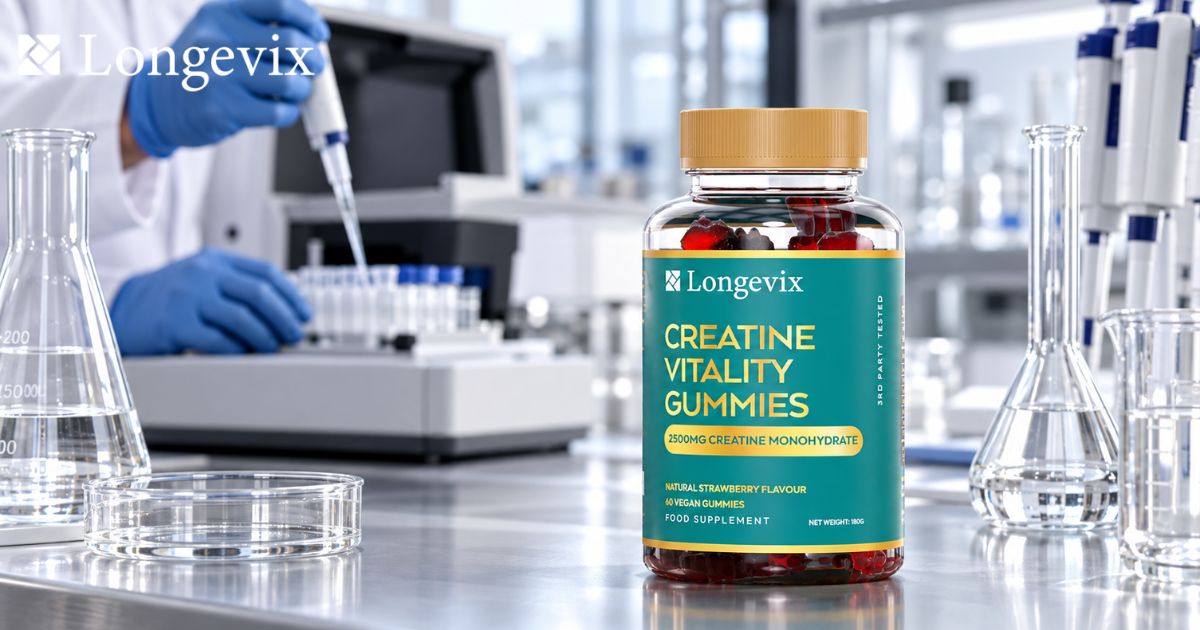
Longevix currently lists Creatine Vitality Gummies containing creatine monohydrate, taurine, trimethylglycine (TMG) and vitamin B12. The live shop lists 60 gummies with four gummies per labelled serving, giving 15 servings per bottle. It directs customers towards the current label for full serving information.
Crucially, accessible online information does not state that one gummy, or one four-gummy serving, supplies exactly 2.5g creatine. The product should therefore not be called a “Longevix 2.5g creatine gummy” without confirmation from the current physical label. That restraint improves trust rather than weakening the product discussion.
|
Longevix product detail |
Current online information |
|
Product |
Longevix Creatine Vitality Gummies |
|
Creatine form |
Creatine monohydrate |
|
Supporting actives |
Taurine, TMG and vitamin B12 |
|
Bottle contents |
60 gummies |
|
Labelled serving |
4 gummies |
|
Servings per bottle |
15 |
|
Exact individual active quantities |
Check the latest physical label |
A Broader Formula Needs Careful Interpretation
Creatine, taurine, TMG and vitamin B12 have distinct nutritional and physiological contexts. Their inclusion in one formula doesn't automatically prove greater muscle building and size, better absorption or superior cellular health and wellness. Claims about combinations should come from evidence relevant to the actual finished formulation.
What Longevix Testing Information Currently Shows
Longevix publishes a Certificates of Analysis page and advises customers to match documents with the relevant product, batch and tests performed. However, the current certificate index does not show a separate public Creatine Vitality Gummies document. The gummies therefore shouldn't be described as having a publicly available product-specific COA unless that changes.
See the current Longevix Creatine Vitality Gummies product information before relying on serving quantities or directions because formulations and packaging information can change.
Are 2.5g Creatine Gummies Safe for Daily Use?
Creatine has one of the deeper evidence bases among sports supplements. The NIH reports that creatine monohydrate is widely studied and that creatine can improve performance during repeated, high-intensity activity. Research in healthy adults also supports good tolerance at commonly investigated intakes, although individual responses vary.
Still, safety cannot be judged from the word “creatine” alone. Gummies may also contain flavourings, acids, sweeteners and additional active ingredients. Medicines, medical conditions and other supplements can change the picture. Follow the current product directions and seek individual professional advice when health circumstances make that appropriate.
Creatine, Water Weight and Exercise Recovery
Creatine can increase body weight partly through water retention. That change shouldn't automatically be labelled harmful dehydration. Evidence for exercise recovery is more nuanced than the performance evidence, which means claims about faster soreness relief or universal recovery benefits should remain conservative rather than being treated as established effects.
Sugar-Free Doesn't Automatically Mean Better
A sugar-free label answers one narrow dietary question. It doesn't automatically establish better quality, effectiveness or digestive tolerance. Alternative sweeteners may suit some people better than others. Anyone monitoring sugar content and blood-sugar concerns should inspect the complete ingredient and nutrition information instead of relying on one front-label phrase.
Who Should Take Extra Care?
Health content should never turn a population-level study into personalised medical advice. People who are pregnant or breastfeeding, use medication, have a medical condition or have been advised to monitor kidney function should discuss supplementation with an appropriate healthcare professional. Follow the product label and don't exceed its stated directions without suitable advice.
2.5g Creatine Gummies: What Should You Check Before Buying?
Begin with the basic question: what does the 2.5g actually describe? Then confirm the creatine form, amount per complete serving, number of gummies required and total servings per bottle. Those details reveal much more than dramatic claims about instant athletic performance or rapid transformation.
Next, consider practical fit. A convenient serving may help consistency, yet convenience shouldn't excuse unclear quantities. Good convenience and titration means understanding what each portion supplies, how many pieces you need and how easily the product fits into your normal routine.

Look Beyond Muscle Claims
Creatine's strongest evidence centres on high-intensity exercise and training adaptations. Research also explores possible cognitive benefits, although the picture remains mixed. A 2024 meta-analysis reported benefits for memory and some attention or processing-speed outcomes, while overall cognition and executive function did not significantly improve. Evidence certainty varied.
That nuance matters for cognitive support claims. In Great Britain, the UK Nutrition and Health Claims Committee concluded that submitted evidence did not establish the proposed claim that ≤3g daily improves cognitive function. Ingredient research therefore shouldn't be transformed into an unrestricted commercial promise.
Think About Training, Not Just the Supplement
Creatine can complement resistance training, but it cannot replace progressive programming, adequate food, sleep and recovery. Changes in muscle strength and athletic performance occur within that wider system. Likewise, strength training results depend heavily on training quality and adherence rather than a gummy functioning as a shortcut.
Judge Value From the Whole Product
Compare cost per gram, serving count, ingredient transparency and available testing. Then consider taste and texture, because an unpleasant product may be difficult to use regularly. Cheap supplements aren't good value when they sit untouched. The strongest buying decision balances evidence, practicality and transparent product information.
The Smart Truth About 2.5g Creatine Gummies
The evidence doesn't justify labelling 2.5g universally “good”, “bad” or optimal. A small trial directly tested 2.5g and found improvement in a muscular fatigue measure, while larger creatine literature frequently uses other amounts. Separate research shows that lower regular doses can build or maintain muscle creatine stores under specific conditions.
For creatine supplementation, context matters more than chasing the largest number. Confirm whether 2.5g refers to one gummy or a complete serving. Examine the creatine form, daily intake, other ingredients, evidence and available quality documentation. A clear label tells you more than aggressive marketing ever could.
For Longevix customers, the same principle applies. Creatine Vitality Gummies currently use a four-gummy labelled serving and contain creatine monohydrate alongside taurine, TMG and vitamin B12. Because individual active quantities aren't published in accessible online product information, the current physical label should remain the source for exact amounts.
Further Reading and Source Context
These external resources provide background or regulatory context. They do not prove that a particular Longevix product produces the health outcomes discussed above.
Frequently asked questions
How Many Creatine Gummies Should I Take a Day?
Follow the serving directions on the specific product because creatine content varies between gummies. Your number of pieces should come from the labelled serving and daily creatine dose, not from a generic gummy recommendation.
Do Creatine Gummies Actually Work?
Creatine gummies can deliver creatine when the formulation contains an appropriate amount and maintains its labelled potency. Evidence strongly supports creatine monohydrate itself, while evidence for the ingredient doesn't automatically validate every commercial gummy formulation.
How Much Creatine Is in Creatine Gummies?
There is no standard amount across all creatine gummies. Check whether the package gives creatine per gummy or per complete serving, then convert milligrams to grams when needed before comparing products.
Are Creatine Gummies as Effective as Powder?
They can deliver the same active creatine molecule when the form, dose and product quality are comparable. The main differences usually involve preparation, serving flexibility, additional ingredients, convenience and cost.
Are Creatine Gummies Safe to Take Every Day?
Creatine is well studied in healthy adults at commonly researched amounts, although suitability still depends on the complete product and the individual. Follow the label and seek professional advice when medication, pregnancy, breastfeeding, or a medical condition makes personalised guidance appropriate.


