Choosing between an NR vs NAD supplement can feel confusing. Both labels seem to promise similar support, yet they may describe different ingredients and biological routes. The compound nicotinamide riboside is one of several NAD precursors your body can use to produce NAD+, a coenzyme involved in metabolism, energy transfer, and cellular activity throughout the body.
Meanwhile, “NAD supplement” may mean direct NAD+, NR, NMN, nicotinamide, or a blended formula with additional compounds. That distinction changes how you compare labels, doses, evidence, safety, and value. Although interest in cellular energy, healthy ageing, and human clinical trials keeps growing, measurable biological changes don’t always become noticeable or clinically meaningful health benefits.
1. NR vs NAD Supplement: The Short Answer
Here’s the clearest distinction. NR is a specific vitamin B3-related compound that your body can convert into NAD+. NAD+ is the coenzyme produced and recycled through several metabolic routes. In simple terms, NR supplies raw material, while NAD+ takes part in essential reactions throughout the cell.
“NAD supplement” is an umbrella label, not one precise ingredient. A product may contain NR, NMN, nicotinamide, direct NAD+, or several compounds together. Therefore, an NR versus NAD comparison sometimes compares a defined molecule with a loosely named product category. The ingredient panel settles the question.
Is NR the Same as NAD+?
NR and NAD+ belong to the same biochemical system, but they aren’t interchangeable. NR sits among the precursor molecules used to build NAD+. Think of NR as flour and NAD+ as bread. The ingredient supports production, yet it isn’t the finished product. Enzymes must complete several steps first.
2. What Is NAD+ and Why Does the Body Need It?
NAD+ stands for nicotinamide adenine dinucleotide. It accepts and transfers electrons during metabolic reactions. This cycling helps cells release usable energy from carbohydrates, fats, and proteins. NAD+ also supports oxidative phosphorylation, the mitochondrial process that produces much of the cell’s adenosine triphosphate, commonly called ATP.
Its responsibilities extend beyond energy transfer. NAD+ acts as a substrate for proteins involved in DNA repair and cellular signalling. It also supports sirtuin enzymes, which help regulate stress responses and metabolism. However, those established roles don’t prove that an NAD supplement reverses ageing or prevents disease.
NAD+ Versus NADH
NAD+ and NADH are two states within the same recycling system. NAD+ accepts electrons, while NADH carries them towards other reactions. After donating those electrons, NADH can return to NAD+. This continuous exchange supports metabolism, but it doesn’t mean NAD+, NADH, and NAD-labelled supplements work identically.
Do NAD+ Levels Decline with Age?
Research links ageing with changes in NAD metabolism, although patterns differ by tissue, health status, and measurement method. Blood findings don’t automatically describe the brain, liver, or muscles. Consequently, claims about one universal decline percentage can oversimplify a complicated and still-developing area of human biology.
3. What Is Nicotinamide Riboside and How Does It Support NAD+ Production?
NR is a vitamin B3-related nucleoside and a recognised NAD+ precursor. Inside cells, enzymes can convert it into nicotinamide mononucleotide, usually shortened to NMN. Another enzymatic step then forms NAD+. This route gives NR a clear biological relationship with NAD+ without making the two compounds identical.
The pathway becomes more intricate after swallowing a supplement. Digestion, gut microbes, absorption, circulation, tissue uptake, and enzyme activity can all affect the result. Therefore, oral bioavailability can’t be judged from a pathway diagram alone. A shorter-looking route doesn’t automatically produce a stronger clinical outcome.
How Does NR Become NAD+?

A simplified model runs from NR to NMN and then NAD+. The wider salvage pathway also recycles nicotinamide back into NAD-related compounds. Real metabolism behaves more like a transport network than a single pipe. Molecules may change form, enter different tissues, or return through alternative biochemical routes.
Nicotinamide riboside (NR)↓Nicotinamide mononucleotide (NMN)↓Nicotinamide adenine dinucleotide (NAD+)What Is the Preiss-Handler Pathway?
The Preiss-Handler pathway builds NAD+ from nicotinic acid through different intermediate compounds. Recent human research suggests gut microbial metabolism may influence how oral NR and NMN feed NAD-related pathways. This finding adds nuance, because the swallowed ingredient may not remain chemically unchanged throughout digestion and absorption.
What Is Nicotinamide Riboside Chloride?
Nicotinamide riboside chloride is a salt form used in supplements. The current Longevix Pure Nicotinamide Riboside Powder 50g lists nicotinamide riboside chloride, includes a 1,000mg measuring scoop, and provides approximately 50 servings. Its product record also links to batch-specific testing documentation.
4. NR vs NAD Supplement: Key Differences at a Glance
The main difference is specificity. NR names one defined compound. “NAD supplement” may describe an entire commercial category. Before comparing products, identify the active ingredient, chemical form, amount per serving, supporting ingredients, and delivery format. Otherwise, an impressive front label can turn a useful comparison into guesswork.
Evidence also follows the ingredient, not the marketing category. Findings from an NR trial can’t automatically validate direct NAD+, NMN, gummies, injections, or a blended formula. Each product needs evidence relevant to its ingredient and route. The table below shows why careful label reading matters.
|
Comparison point |
NR supplement |
Product called an NAD supplement |
|
Basic meaning |
Contains nicotinamide riboside |
Broad category or marketing description |
|
Relationship to NAD+ |
NR acts as a precursor |
Depends on the listed ingredients |
|
Conversion required |
Yes |
Varies by formula |
|
Possible ingredients |
NR alone or within a blend |
NR, NMN, nicotinamide, NAD+, or combinations |
|
Evidence base |
Several oral NR studies exist |
Depends on the actual compound and format |
|
Main label check |
NR form and amount per serving |
Complete active-ingredient panel |
|
Common mistake |
Treating every NR formula as equivalent |
Assuming “NAD+” means direct NAD+ |
|
Best comparison method |
Review dose, format, testing, and evidence |
Identify the formula before comparing |
Why NR Versus NAD Isn’t Always a True Head-to-Head Comparison
Comparing NR with an undefined NAD supplement resembles comparing an apple with a fruit basket. The apple has a clear identity. The basket remains uncertain until you inspect its contents. Likewise, an NAD-labelled gummy may already contain NR, making the real choice about format, dose, and added ingredients.
5. What Does “NAD Supplement” Actually Mean on a Product Label?
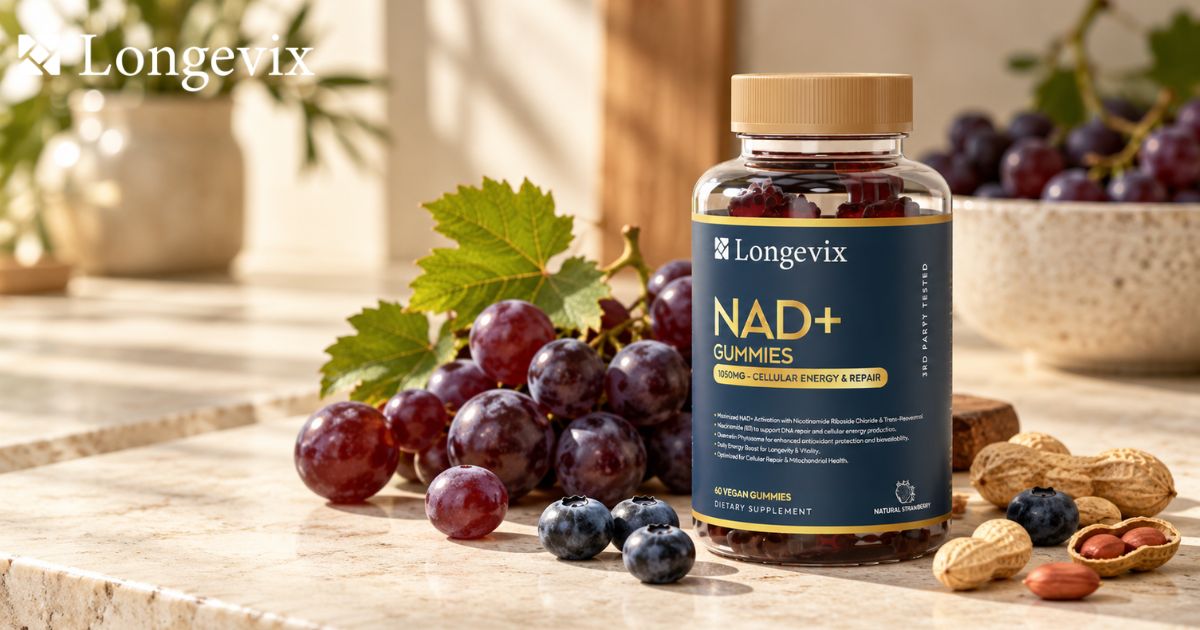
Product names often simplify complicated formulas. An item marketed for NAD+ support may contain NR instead of finished NAD+. It may also combine several active compounds. The current Longevix NAD+ Support Gummies, for example, contain NR alongside quercetin, trans-resveratrol, and nicotinamide.
Serving size deserves equal attention. A headline amount may refer to two capsules or two gummies rather than one. US shoppers should check the Supplement Facts panel. UK shoppers should review the recommended daily amount, ingredient list, warnings, and food-supplement wording. The physical label remains the final reference.
Direct NAD+, NR, and Other NAD Precursors
Direct NAD+, NR, NMN, and nicotinamide are chemically distinct. Research involving one shouldn’t be transferred to another without evidence. The same caution applies to liposomal formulations and injectable NAD+. Different delivery systems may change exposure, yet novelty alone doesn’t prove better absorption, safety, or outcomes.
A Real Longevix Label Example
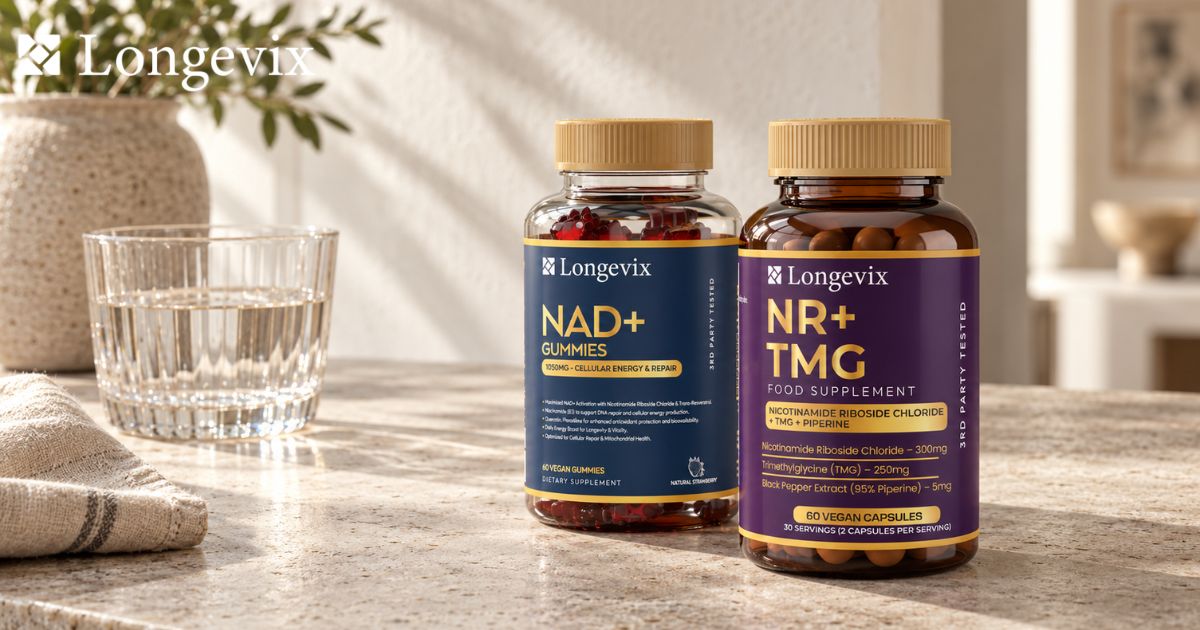
A two-gummy serving of Longevix NAD+ Support Gummies currently provides 300mg NR, 250mg quercetin, 250mg trans-resveratrol, and 250mg nicotinamide. The bottle contains 60 gummies, equal to 30 labelled servings. This makes the product a broader formula rather than a single-ingredient NR supplement.

“The ingredient panel matters more than the promise printed across the front.”
6. What Human Research Shows About NR and NAD+ Supplements
Several human clinical trials show that oral NR can raise blood NAD+ or related metabolites under tested conditions. Some trials also report dose-dependent effects. However, higher circulating NAD+ levels remain biomarker findings. They don’t automatically prove better memory, daily energy, physical performance, or lifespan.
Newer head-to-head trials add useful context. A 2026 study of 65 healthy adults found that 14 days of NR and NMN supplementation comparably increased circulatory NAD+ concentrations. Yet researchers still need more evidence on tissue NAD+ and long-term outcomes that matter in everyday life.
Case Study: Higher Blood NAD+ Without Better Cognition
A small placebo-controlled trial studied older adults with mild cognitive impairment. NR produced a 2.6-fold rise in blood NAD+ within the NR group, yet cognition remained unchanged during the study. This contrast shows why biomarkers and functional endpoints must be discussed separately. Larger and longer trials remain necessary.
What Has Research Found in Muscle?
A small crossover trial in overweight or obese adults found changes in muscle NAD-related metabolites after NR. However, muscle insulin sensitivity did not improve. Separate work in obese, insulin-resistant men also found no improvement in measured mitochondrial function after twelve weeks of NR supplementation.
What Has Research Found in the Brain?
The phase-one NADPARK trial studied 30 people with newly diagnosed Parkinson’s disease. Researchers observed variable brain NAD+ elevation after 30 days of NR. The study mainly examined safety and target engagement. It didn’t establish NR as a proven treatment, and larger clinical trials remain essential.
|
Human study |
Population and duration |
Main finding |
Important limitation |
|
Martens trial |
Healthy middle-aged and older adults, two six-week periods |
NR stimulated NAD+ metabolism |
Small crossover study |
|
MCI pilot trial |
20 older adults, ten weeks |
Blood NAD+ increased |
Cognition did not improve |
|
Muscle crossover trial |
13 overweight or obese adults, six weeks |
Muscle NAD-related metabolites changed |
Insulin sensitivity did not improve |
|
NADPARK phase-one trial |
30 people with Parkinson’s disease, 30 days |
Cerebral NAD increased variably |
Early safety and target-engagement study |
|
NR versus NMN trial |
65 healthy adults, 14 days |
Both raised circulatory NAD+ similarly |
Short, open-label intervention |
7. NR Powder, NR + TMG Capsules or NAD+ Gummies?
Format changes convenience, measurement, taste, and ingredient exposure. Powder allows measured servings. Capsules provide a fixed combination. Gummies create a chewable routine. However, the container doesn’t determine effectiveness. Formula quality, correct use, evidence, storage, and individual suitability matter more than whether a product looks modern.

Longevix currently offers three relevant approaches: pure NR powder, NR combined with TMG and piperine, and multi-ingredient NAD+ Support Gummies. The Longevix NR powder guide adds powder-specific context, while the shop shows current formats, ingredients, serving information, and availability.
Longevix Pure Nicotinamide Riboside Powder
The Pure Nicotinamide Riboside Powder page lists a 50g tin of nicotinamide riboside chloride. It includes a 1,000mg measuring scoop and provides approximately 50 servings. This streamlined format may suit readers who prefer one relevant active ingredient and flexible mixing rather than a pre-formulated blend.
Longevix NR + TMG Capsules
The current Longevix NR + TMG Capsules provide 300mg NR, 250mg trimethylglycine, and 5mg piperine per two-capsule serving. The bottle contains 60 capsules, equal to 30 servings. This fixed formula improves convenience, although it limits separate adjustment of each included ingredient.
Longevix NAD+ Support Gummies
The NAD+ Support Gummies provide a wider combination. Each two-gummy serving contains 300mg NR, 250mg quercetin, 250mg trans-resveratrol, and 250mg nicotinamide. Therefore, the gummies shouldn’t be described as pure NR. They suit shoppers who specifically want the listed multi-ingredient format.
|
Longevix product |
Current relevant ingredients |
Labelled serving |
Practical distinction |
|
Pure Nicotinamide Riboside Powder |
Nicotinamide riboside chloride |
a 1,000mg measuring scoop |
Streamlined powder format |
|
NR + TMG Capsules |
300mg NR, 250mg TMG, 5mg piperine |
Two capsules |
Fixed combined formula |
|
NAD+ Support Gummies |
300mg NR, quercetin, trans-resveratrol, nicotinamide |
Two gummies |
Broader chewable formula |
8. Can You Take NR and NAD Supplements Together?
The answer depends on what the NAD product contains. Many NAD-support products already supply NR. Combining one with NR powder or capsules may only increase your total NR intake. Different product names can conceal the same active compound, which makes careful serving calculations essential.
More ingredients don’t automatically create better results. Stacking products may duplicate NR, nicotinamide, TMG, quercetin, resveratrol, or piperine. It may also make unwanted effects harder to trace. Check every label and discuss complicated combinations with a qualified healthcare professional before use.
What Happens When You Take NAD+ and NR Together?
When the NAD-labelled product already contains NR, using both mainly increases NR exposure. When it contains direct NAD+ or another precursor, the evidence depends on that exact combination. Current research doesn’t establish that stacking NAD-support compounds produces stronger or more reliable health outcomes.
How Should You Calculate Ingredient Overlap?

Begin with the full recommended serving for each product. Then add repeated ingredients together. For example, a two-gummy serving containing 300mg NR plus a two-capsule serving containing 300mg NR totals 600mg. This calculation reveals exposure, but it doesn’t confirm that the combined amount suits you.
NR from Product A+NR from Product B=Total NR from both products9. Safety, Side Effects and How to Choose a Quality Product
Short-term NR studies generally report acceptable tolerability within their tested populations and doses. However, study length, participant health, and formulas vary. Brief trials can’t establish lifelong safety. Complex blends add another wrinkle, because an unwanted reaction may come from NR, another active ingredient, or an excipient.
Seek professional advice before supplementation when you’re pregnant, breastfeeding, taking medicines, managing a medical condition, or preparing for surgery. Stop use and seek guidance after an unexpected reaction. In Britain, food supplements also can’t legally claim to treat, prevent, or cure a disease.
How to Check Product Quality
Start with the exact ingredient, chemical form, amount per serving, batch number, expiry date, warnings, and manufacturer details. Then inspect available testing documents. The Longevix Certificates of Analysis page currently includes a product-specific record for Pure Nicotinamide Riboside Powder. Testing evidence shouldn’t be transferred between different products.

What UK and US Buyers Should Notice
US shoppers should read the Supplement Facts panel, including serving size and dietary ingredient quantities. UK shoppers should check the recommended daily intake, food-supplement description, warnings, and authorised claims. Availability doesn’t equal medicine approval, while dramatic promises deserve extra scrutiny in both markets.
Final Takeaway
NR and NAD+ aren’t rivals in the ordinary sense. NR supplies material that can support NAD+ production, while NAD+ participates directly in cellular reactions. Meanwhile, “NAD supplement” may describe several ingredients and formats. Reading beyond the front label remains the most useful first step.
Longevix currently offers pure NR powder, NR + TMG Capsules, and NAD+ Support Gummies. Each provides a different formula and routine. Explore the Longevix Science page, Best NAD Booster Supplement guide, product pages, and current physical labels before deciding.
Further Reading and Source Context
These external resources provide background or regulatory context. They do not prove that a particular Longevix product produces the health outcomes discussed above.
Frequently asked questions
What Is the Difference Between NR and NAD+?
NR is a vitamin B3-related precursor that your body can convert into NAD+. NAD+ is the coenzyme used in energy metabolism and other cellular reactions. NR supports production, whereas NAD+ performs downstream functions. They’re closely connected, but they aren’t chemically or functionally identical.
Is NR Better Than NAD Supplements?
NR has several oral human trials showing changes in NAD-related markers. However, “NAD supplement” describes too many formulas to judge as one category. No universal winner exists until you compare the actual ingredients, serving amounts, evidence, testing, and intended use.
Can You Take NAD+ Orally, and Is Oral NAD+ Effective?
Oral NAD+ products exist, but direct NAD+ requires formulation-specific human evidence. Findings from NR or NMN studies can’t prove that direct NAD+ works identically after swallowing. Claims about absorption and effectiveness should therefore match the exact compound, dose, delivery system, and measured outcome.
Which Is Better: NMN, NR, or NAD+?
No option is universally best. NR and NMN both act as precursors, and a 2026 trial found similar increases in circulatory NAD+ after 14 days. Direct NAD+ is chemically different and needs its own evidence. Product quality and realistic goals matter more than alphabet-based rankings.
Can You Take NR and NAD Together?
Combining them may be unnecessary when the NAD-support formula already contains NR. Check the complete ingredient panel and calculate repeated compounds across full servings. Seek professional advice before stacking products, particularly when you take medicines, manage a health condition, or use several supplements.