Feeling constantly drained can make a NAD supplement for fatigue sound like an easy answer, especially when low energy starts affecting work, exercise, sleep, and concentration. NAD+ plays a central role in cellular energy, ATP production, and normal energy metabolism, yet fatigue rarely comes from one pathway alone.
Editorial evidence note: This article discusses research and general information, not a diagnosis or a promise that a product will prevent, treat or cure a condition. Clinical questions and supplement suitability require individual professional advice.
Poor sleep, stress, nutrition, medicines, and health conditions can all contribute. That’s why choosing NAD+ precursors such as NMN or NR requires more than trusting bold promises on a label. Human research offers useful clues, but it also leaves important questions unanswered. Understanding that difference can lead to a safer, better-informed decision.
NAD Supplement for Fatigue: What Does the Evidence Really Say?
The evidence starts with an important distinction. NAD+, or nicotinamide adenine dinucleotide, works as a coenzyme in essential metabolic reactions. Certain NAD+ precursors can increase NAD-related biomarkers in human studies. However, research hasn’t established that these biochemical changes reliably translate into meaningful fatigue relief for everyone.
That gap matters when comparing a NAD supplement for tiredness. A blood marker can change without noticeable improvements in stamina, alertness, or motivation. A 2024 systematic review included ten NMN trials and 437 participants. Physical-performance measures showed non-significant overall improvement, while trial duration averaged fewer than ten weeks.
Does a NAD Supplement for Fatigue Work Like Caffeine?
NAD-related supplements shouldn’t be viewed as stimulants. Caffeine can alter nervous-system signalling relatively quickly, while NAD precursors enter metabolic pathways. Think of them as ingredients connected with cellular machinery rather than an instant ignition switch. That distinction helps set sensible expectations when considering supplements for fatigue symptoms.
Why NAD+ Matters for Cellular Energy—but Fatigue Is More Complex
Inside your cells, NAD+ participates in reactions that process carbohydrates, fats, and proteins. Those pathways ultimately support ATP production. ATP, or adenosine triphosphate, provides readily usable energy for muscle contraction, nerve signalling, and countless cellular processes. Normal cellular energy production therefore depends partly on healthy NAD+/NADH chemistry.
Much of this activity connects with the mitochondria, where nutrient-derived electrons feed pathways associated with electron transport and ATP generation. Yet healthy mitochondrial function doesn’t automatically make someone feel energetic. Sleep quality, iron status, hormones, inflammation, medicines, illness, mental health, and physical conditioning can all influence perceived fatigue.

Why Cellular Energy and Feeling Energetic Aren’t Identical
Imagine a city with a perfectly functioning power station but damaged cables elsewhere. Electricity exists, yet some buildings remain dark. NAD+ plays an important metabolic role, but fatigue can arise elsewhere in the system. Anaemia, insufficient sleep, infection, or severe stress may therefore leave someone exhausted despite functioning energy metabolism.
NAD+, NMN, NR and NADH: Know What You’re Actually Buying
“NAD supplement” often works as a broad marketing label. Chemically, however, NAD+, NADH, nicotinamide mononucleotide, and nicotinamide riboside aren’t interchangeable. NMN and NR participate in NAD+ biosynthesis pathways. NADH, meanwhile, represents the reduced partner in the NAD+/NADH redox pair used during normal metabolism.

That difference matters before buying. A prominent NAD+ phrase on packaging doesn’t necessarily tell you which compound the product contains. Longevix separates NMN, NR, TMG, and NAD+ terminology across its current range. Its Low NAD Symptoms guide similarly distinguishes mechanisms, biomarkers, and symptoms instead of treating them as equivalent evidence.
|
Term |
What it is |
Relationship with NAD+ |
What it does not prove |
|
NAD+ |
Oxidised form of nicotinamide adenine dinucleotide |
Participates directly in redox and metabolic reactions |
Taking more will relieve fatigue |
|
NADH |
Reduced form of the NAD+/NADH pair |
Carries electrons during metabolism |
NADH and NAD+ are identical |
|
NMN |
NAD+ precursor |
Participates in NAD+ biosynthesis |
NMN is proven superior for fatigue |
|
NR |
Vitamin B3-related NAD+ precursor |
Can enter NAD+ biosynthesis pathways |
Raising NAD+ guarantees more energy |
Why Bioavailability Needs Context
Bioavailability is useful pharmacological language, but it can easily become marketing shorthand. Higher absorption doesn’t automatically prove a better clinical result. Human metabolism transforms NAD-related compounds after consumption, and present evidence doesn’t establish powder, capsules, or gummies as universally superior for fatigue purely because of delivery format.
Can NAD+ Precursors Help With Fatigue? What Human Studies Show
Human studies offer intriguing signals rather than a settled verdict. One 12-week randomised trial studied 108 older Japanese adults receiving 250 mg NMN or placebo. Researchers assessed sleep, fatigue, and physical performance. Selected findings favoured afternoon NMN intake, particularly for lower-limb function and drowsiness, but the study cannot establish universal fatigue relief.
Another randomised trial involved 60 older adults taking 250 mg NMN daily for 12 weeks. Blood NAD+ increased, while four-metre walking time improved as a secondary outcome. However, the study’s primary stepping-test outcome showed no significant difference from placebo. That contrast illustrates why individual endpoints deserve careful interpretation.
NMN for Fatigue: What the Wider Evidence Shows
A 2024 review of ten randomized controlled trial studies included 437 participants receiving 150–1,200 mg NMN daily. The studies were generally short, averaging 9.6 weeks. Physical-performance measures improved only non-significantly overall. For a deeper NMN-specific discussion, see Longevix’s NMN for Tiredness guide.
|
Evidence |
Participants |
Intervention |
What researchers found |
Key limitation |
|
2022 older-adult trial |
108 |
250 mg NMN for 12 weeks |
Selected drowsiness and lower-body findings |
Specific older Japanese population |
|
2024 older-adult trial |
60 |
250 mg NMN for 12 weeks |
Higher NAD+ and selected secondary improvements |
Primary stepping outcome was not significant |
|
2024 systematic review |
437 across 10 trials |
150–1,200 mg NMN |
Physical outcomes improved non-significantly overall |
Short, heterogeneous studies |
|
2025 long-COVID trial |
58 |
2,000 mg NR daily |
NAD+ rose markedly |
Fatigue did not significantly improve versus placebo |
Research Case Study: Higher NAD+ Without Clear Fatigue Relief
A 2025 trial provides an unusually clear example. Participants with long COVID received 2,000 mg NR daily or placebo during a controlled phase. NR increased NAD+ roughly 2.6- to 3.1-fold, yet fatigue, sleep, cognition, and mood did not significantly improve versus placebo. The study also had substantial dropout.
What Kind of Fatigue Are You Trying to Solve?
Fatigue isn’t one uniform experience. Temporary tiredness after poor sleep differs from persistent chronic fatigue that restricts daily activity. MedlinePlus defines fatigue as weariness, tiredness, or lack of energy and distinguishes it from drowsiness. That distinction matters because excessive sleepiness may point towards a different underlying problem.
Finding the cause matters more than guessing. Anaemia, diabetes, thyroid disorders, infection, depression, medicines, and sleep apnea can contribute to fatigue. UK readers may recognise the spelling “sleep apnoea”. NHS guidance also recommends medical assessment when unexplained tiredness persists, particularly when other symptoms accompany it.
“Fatigue itself is not a disease; it’s a symptom.” — MedlinePlus
Chronic Fatigue, ME/CFS and Post-Viral Fatigue Need Care
Severe post-viral fatigue deserves greater caution than an ordinary afternoon slump. Myalgic encephalomyelitis/chronic fatigue syndrome is a long-term condition involving profound fatigue and other symptoms. Post-exertional malaise can worsen symptoms after physical or mental activity. Current evidence doesn’t justify reducing ME/CFS to a simple low-NAD+ theory.
Which Longevix NAD+ Support Products Fit Different Preferences?
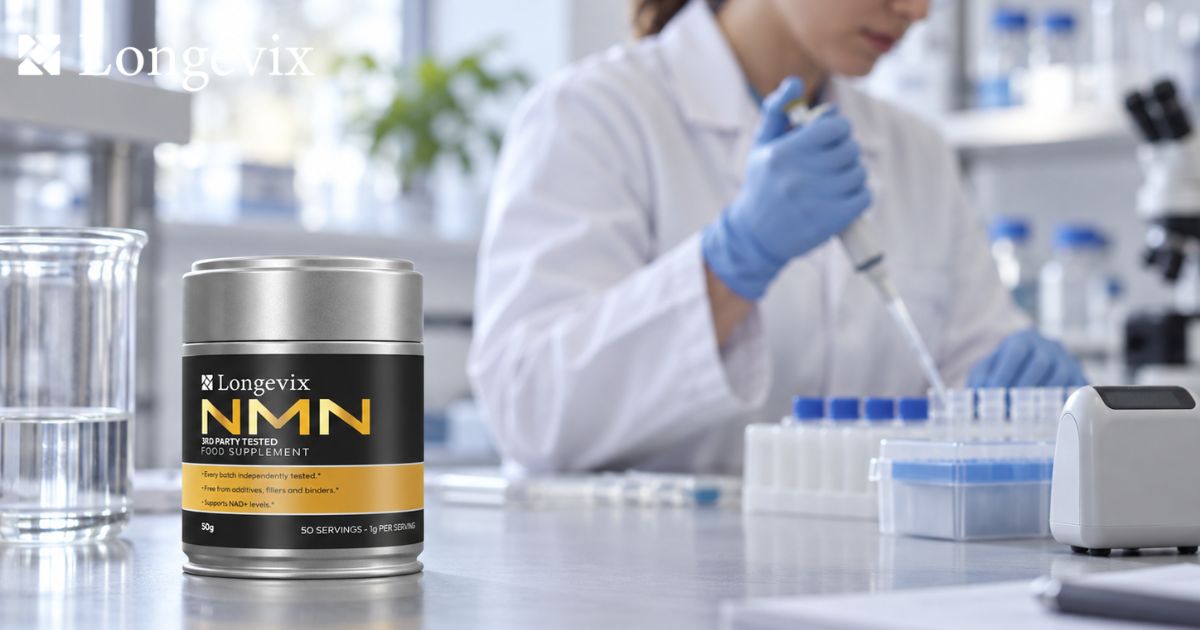
Longevix currently offers several NAD-related formats rather than one generic fatigue product. Pure NMN Capsules provide 500 mg NMN per capsule in a 30-capsule vegan format. Pure NMN Powder comes in a 50 g tin with a 500mg measuring scoop (1g labelled serving). Pure NR Powder contains nicotinamide riboside chloride.

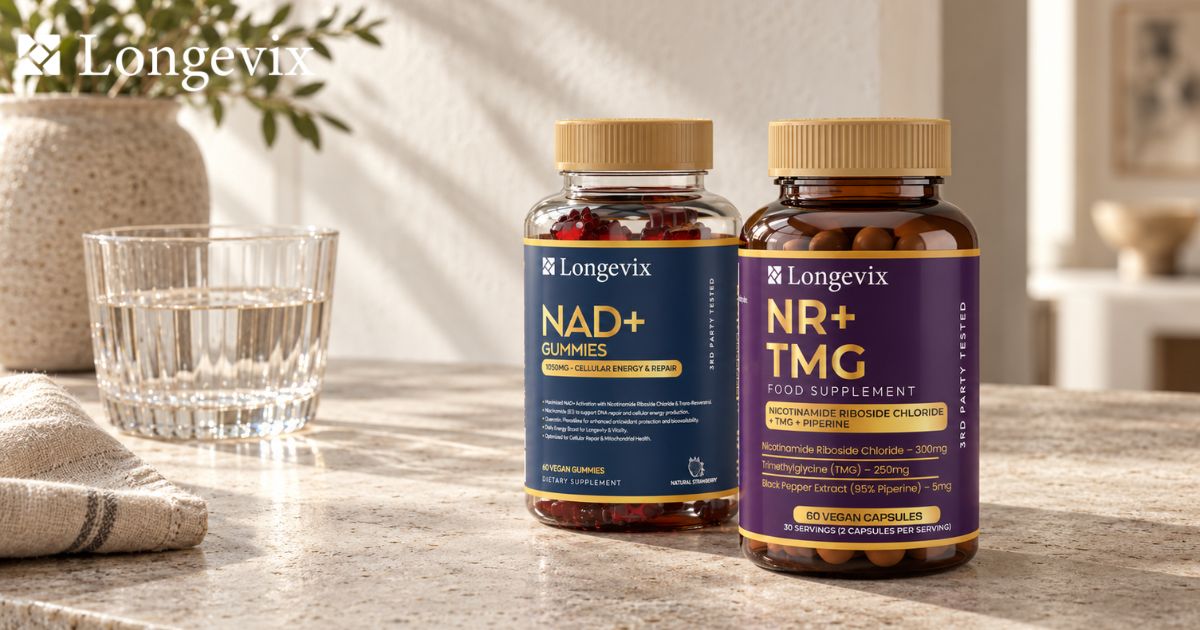
Combined formats offer a different approach. NR + TMG Capsules provide 300 mg NR, 250 mg TMG, and 5 mg piperine per two capsules. NAD+ Support Gummies provide 300 mg NR, 250 mg quercetin, 250 mg trans-resveratrol, and 250 mg nicotinamide per two gummies. Neither product is presented as a proven fatigue treatment.
|
Longevix product |
Current online information |
Format |
Practical distinction |
|
Pure NMN Capsules 500mg |
500 mg NMN per capsule; 30 capsules |
Vegan capsules |
Pre-measured format |
|
Pure NMN Powder 50g |
a 500mg measuring scoop (1g labelled serving); approximately 50 servings |
Powder |
Single-ingredient NMN format |
|
Pure Nicotinamide Riboside Powder 50g |
NR chloride; a 1,000mg measuring scoop |
Powder |
Standalone NR format |
|
NR + TMG Capsules |
300 mg NR, 250 mg TMG, 5 mg piperine per two capsules |
Capsules |
Fixed combination |
|
NAD+ Support Gummies |
300 mg NR plus quercetin, trans-resveratrol and nicotinamide per two gummies |
Gummies |
Multi-ingredient chewable |
Choosing Between NMN and NR Formats
The useful question isn’t simply which product looks strongest. Compare ingredient identity, current label directions, convenience, documentation, and your wider supplement routine instead. Neither nicotinamide mononucleotide nor nicotinamide riboside has established itself as a universally superior NAD supplement for fatigue. Format preference and clinical evidence remain separate questions.
How to Choose a NAD Supplement for Fatigue Before You Buy
Start with the ingredient panel rather than the largest words on the bottle. Establish whether the formula contains NMN, NR, NADH, nicotinamide, or several ingredients together. Some fatigue supplements also include compounds such as coenzyme Q10, but evidence concerning another ingredient cannot automatically strengthen an NAD-specific health claim.
Then examine serving information and documentation. A large bottle doesn’t necessarily provide more of the active ingredient per daily serving. Longevix publishes product-specific testing documents for several products. Such documentation can help establish what a particular report actually tested, but it cannot demonstrate improved quality of life or guaranteed fatigue relief.
Why Third-Party Documentation Needs Careful Reading
“Tested” sounds reassuring until you ask what was tested. Identity, assay, purity, and contaminant analyses answer different questions. One certificate may cover only selected measurements. Longevix’s testing-document library advises matching the product, batch, report date, tests, and results instead of assuming every certificate proves the same things.
UK and US Buyers Should Understand the Regulatory Difference
Regulatory frameworks also differ. Great Britain maintains an official register of authorised novel foods and their conditions of use. The United States FDA does not pre-approve dietary supplements for safety and effectiveness before sale. Regulation therefore shouldn’t be confused with proof that a product relieves fatigue or improves energy.
NAD Supplement Dosage, Timing and Expectations
There is no universally established NAD supplement dosage for fatigue. Human NMN and NR trials have used different quantities, durations, formulations, and participant groups. Their goals also vary. Some examine NAD metabolites or physical function rather than everyday tiredness. A dose studied in research therefore doesn’t become an individual recommendation automatically.
More doesn’t necessarily mean better. An eight-week NR trial tested 100, 300, and 1,000 mg daily and found dose-dependent increases in whole-blood NAD+. The highest amount produced the largest biomarker increase, but that result doesn’t prove the strongest improvement in perceived energy because fatigue relief wasn’t the trial’s established outcome.
Does Timing Matter for an NAD Supplement for Energy?
Timing evidence remains preliminary. In the 108-participant NMN trial, afternoon supplementation produced encouraging findings for certain measures. However, that result came from a specific older population and shouldn’t be turned into a universal timing rule. Consistency, sleep patterns, other supplements, and the current physical product label remain more practical considerations.
How Long Before You Know Whether Anything Changed?
Human trials usually measure changes across several weeks rather than several hours. That doesn’t create a guaranteed countdown to noticeable energy. Tracking sleep, caffeine, activity, illness, stress, and perceived fatigue can provide valuable context. Otherwise, ordinary day-to-day fluctuations may be mistaken for a dramatic supplement effect.
Safety, Side Effects and Who Should Be Cautious
Short-term studies provide some reassurance but shouldn’t be stretched into lifetime safety claims. One small trial tested 1,250 mg NMN daily for four weeks in 31 healthy adults without severe adverse events. Researchers described NMN as well tolerated under those study conditions. The trial cannot establish long-term safety across every population.
Formula complexity also changes the safety question. Longevix NAD+ Support Gummies contain NR, quercetin, trans-resveratrol, and nicotinamide. NR + TMG Capsules contain NR, TMG, and piperine. Medicines, other supplements, pregnancy, breastfeeding, and existing conditions therefore deserve consideration alongside NAD biology rather than being treated as afterthoughts.
Watch for Ingredient Duplication
Stacking supplements can quietly duplicate active ingredients. Someone using standalone TMG alongside NR + TMG Capsules receives TMG from both products. Longevix has highlighted this issue in its TMG guidance. Extra ingredients don’t automatically create greater cellular energy production, particularly when the combination hasn’t been clinically established as a fatigue treatment.

When Fatigue Should Come Before the Supplement
Medical assessment deserves priority when fatigue continues for weeks, worsens, or interferes with normal life. Breathlessness, palpitations, unexplained weight changes, excessive thirst, or disturbed breathing during sleep also deserve attention. In those situations, establishing the underlying cause is more important than experimenting repeatedly with another NAD-related product.
NAD Supplement for Fatigue: The Bottom Line Before You Buy
The science gives researchers good reasons to study NAD+ and fatigue. NAD+ supports redox reactions, normal metabolism, and pathways connected with ATP. NMN and NR can also alter NAD-related biomarkers in humans. However, current evidence doesn’t establish an NAD supplement as a reliable treatment for ordinary or chronic fatigue.
A better buying decision starts by understanding your tiredness. Then examine the actual ingredient, serving information, human evidence, safety, and available documentation. NAD research continues to develop, but one principle remains important: changing a biochemical marker and improving how energetic you feel are not necessarily the same outcome.
The Truth About NAD Supplements for Fatigue
NAD-related supplementation may interest informed adults who understand its limitations. It shouldn’t replace adequate sleep, nutrition, physical activity, appropriate medical assessment, or treatment for an underlying condition. Persistent tiredness deserves particular care because feeling exhausted, foggy, or unmotivated cannot establish that someone has “low NAD+”.
Important Information
This article provides general educational information and doesn’t replace personalised medical advice, diagnosis, or treatment. Food supplements shouldn’t replace a varied, balanced diet and healthy lifestyle. Follow the current physical product label and seek qualified healthcare advice when pregnant, breastfeeding, taking medicines, or managing a medical condition.
Further Reading and Source Context
These external resources provide background or regulatory context. They do not prove that a particular Longevix product produces the health outcomes discussed above.
Frequently asked questions
Does NAD+ Help With Fatigue?
NAD+ supports cellular energy metabolism, but current research doesn’t prove that NAD+ supplements consistently reduce fatigue. Trials involving NMN or NR show biological activity, while noticeable fatigue outcomes remain mixed and depend heavily on the population and outcome being studied.
Can NAD+ Supplements Give You More Energy?
NAD-related supplements such as NMN and NR can increase NAD-related biomarkers in some human studies. They don’t work like caffeine or other stimulants, and a higher NAD+ measurement doesn’t guarantee that you will notice greater alertness, endurance, or everyday energy.
Can Low NAD+ Actually Cause Fatigue?
NAD+ participates in normal energy pathways, so researchers have good reasons to study its relationship with fatigue. However, tiredness alone cannot diagnose low NAD+. Sleep loss, anaemia, infection, thyroid problems, medicines, stress, and many other factors can produce similar symptoms.
Does NAD+ Help With Chronic Fatigue Syndrome (ME/CFS)?
Current evidence is insufficient to recommend NAD+ supplements as a treatment for ME/CFS. The condition involves more than ordinary tiredness and commonly includes post-exertional malaise, sleep disturbance, and cognitive symptoms. Appropriate medical assessment and condition-specific management remain important.
How Long Does It Take for NAD Supplements to Work for Energy or Fatigue?
There is no proven timeframe for noticeable fatigue relief. Human NMN and NR studies usually assess biological or functional outcomes over several weeks. Some people may notice no meaningful change at all, even when a study or blood measurement shows an NAD-related biomarker increase.