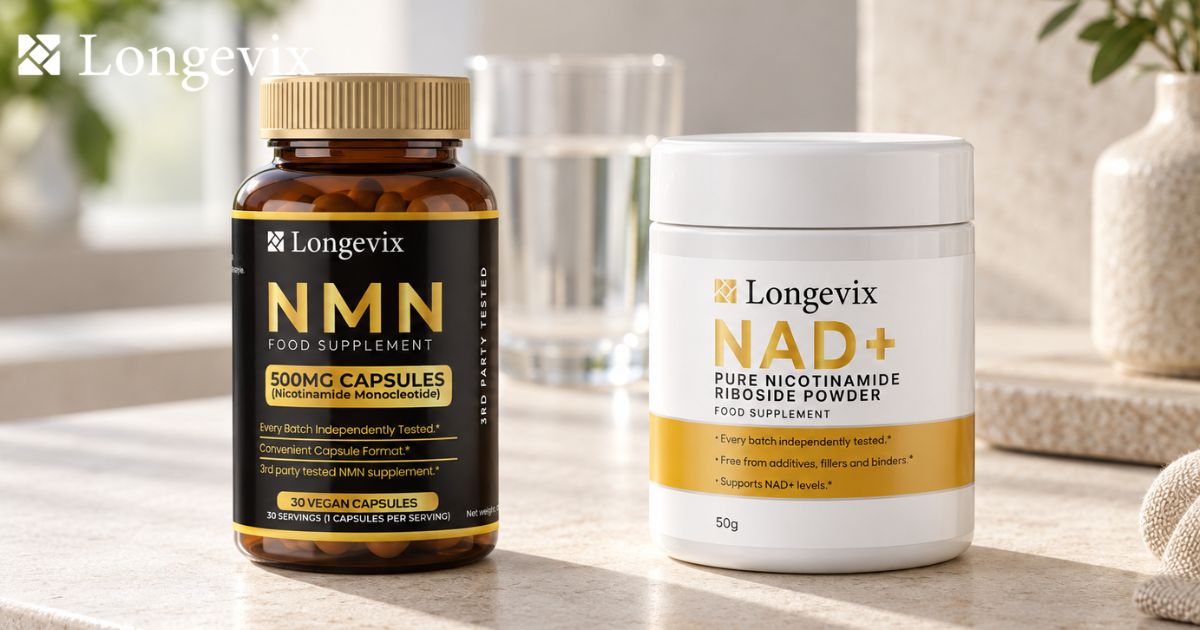
Searching for “mg and nr” often points to a more useful question: how do NMN and NR really compare before you choose a supplement? Both connect with NAD+, a coenzyme involved in cellular energy and normal metabolism. However, they are different molecules, and neither has been proven universally superior.
That distinction matters because bigger milligram numbers don’t automatically mean better results. Research, formulation, bioavailability, product quality, safety, and regional rules all deserve attention. This guide compares NMN with nicotinamide riboside using human evidence and the products currently available from Longevix, without turning promising biology into exaggerated longevity claims.
NMN and NR at a Glance: What You Really Need to Know
Here’s the clearest starting point. NMN means nicotinamide mononucleotide while NR means nicotinamide riboside. Both participate in pathways that can contribute to NAD+ production. However, they aren’t finished NAD+. They also shouldn’t be treated as interchangeable simply because their metabolic routes eventually converge.
Science hasn’t established one universal winner either. Human studies show biological activity for both precursors while broader outcomes remain inconsistent. Choosing NMN or NR therefore involves more than pathway diagrams. Ingredient identity, research quality, formulation, convenience, testing documentation, safety, and regional regulations all influence a sensible decision.
What Is NMN?
NMN is an intermediate in pathways that help maintain NAD+ levels. Researchers study it because NAD+ participates in redox reactions, cellular signalling, and metabolism. Human trials have reported changes in NAD-related measurements after supplementation. Still, those findings don’t prove that NMN reverses ageing, prevents disease, or extends human lifespan.
What Is Nicotinamide Riboside?
Nicotinamide riboside (NR) is a vitamin B3-related NAD+ precursor. Cells can convert NR through metabolic steps that contribute to NAD+ synthesis. Human trials show that NR can increase NAD-related blood measurements. However, its broader effects on cognition, metabolism, physical function, and other outcomes vary considerably between studies.
Are NMN, NR and NAD+ the Same Thing?
No. Think of them as connected parts of the same transport network rather than three names for one station. NMN and NR can contribute to NAD+ synthesis while NAD+ performs distinct biochemical roles. Longevix also separates these terms throughout its science guidance and current product descriptions.
“Mechanism is not an outcome.” — Longevix Science.
How Do NMN and NR Become NAD+ in the Body?
The pathway explains why these molecules receive so much attention. NR can undergo phosphorylation through nicotinamide riboside kinase activity to form NMN. NMN can then contribute to NAD+ synthesis. NAD+ supports redox reactions involved in energy metabolism while also acting as a substrate for several signalling enzymes.
However, human metabolism isn’t a straight conveyor belt. Digestion, conversion, transport, degradation, enzyme activity, tissue distribution, and recycling can all alter what happens after ingestion. Therefore, NMN sitting closer to NAD+ on a simplified pathway doesn’t automatically prove superior bioavailability, absorption, tissue delivery, or clinical effectiveness.
The NR → NMN → NAD+ Pathway
A simplified pathway reads NR → NMN → NAD+. That map helps explain the relationship without showing every metabolic branch. NAD+ is continually produced, consumed, and recycled. Several vitamin B3-related compounds contribute to this network, making NAD metabolism more like a busy interchange than a single one-way road.
Does Being Closer to NAD+ Make NMN Better?
Not automatically. Pathway proximity makes an attractive marketing argument because it sounds intuitive. Yet fewer biochemical steps don’t guarantee stronger effects in people. Head-to-head studies would need to compare equivalent doses, formulations, biomarkers, tissue responses, safety, and meaningful clinical outcomes before NMN could confidently be called superior to NR.
Why Cellular Energy and Mitochondria Matter
NAD+ helps transfer electrons during reactions used to produce ATP. This explains the connection with mitochondrial function and cellular energy. However, a higher blood NAD measurement doesn’t guarantee that someone feels more energetic. Sleep, nutrition, exercise, illness, medicines, hormones, and psychological health can all influence perceived energy.
What About Sirtuins and DNA Repair?
NAD+ also serves as a substrate for sirtuins and PARP enzymes involved in cellular regulation and DNA repair. These mechanisms make NAD biology scientifically interesting. They don’t prove that swallowing NMN or NR repairs DNA, slows ageing, or activates a guaranteed longevity programme in humans.
NMN vs NR: What Does Human Research Actually Show?
Human research provides a more restrained picture than many advertisements suggest. A 2026 systematic review identified 33 human intervention studies involving NAD-related compounds. NR and NMN consistently showed biochemical target engagement. However, effects on metabolic, vascular, functional, and healthspan-related outcomes were heterogeneous and often absent or outcome-specific.
That difference is crucial. Increasing NAD+ levels answers one biological question while improving health answers another. A 2026 NMN meta-analysis also found favourable short-term tolerability but no broad improvements across body weight, fasting glucose, HbA1c, lipid measurements, or systolic blood pressure.
What Have Human NMN Trials Found?
One randomised trial studied 80 healthy middle-aged adults receiving placebo or 300mg, 600mg, or 900mg NMN daily for 60 days. Blood NAD measurements increased in NMN groups, and six-minute walking results improved. HOMA-IR didn’t differ significantly. The findings support biological activity rather than universal metabolic benefit.
A Useful NMN Study Example
A separate trial in postmenopausal women with overweight or obesity and prediabetes reported improved muscle insulin sensitivity after NMN. The population was highly specific, however. Findings from a small clinical subgroup shouldn’t automatically become advice for healthy younger adults, men, athletes, or every person interested in healthy ageing.
What Have Human NR Trials Found?
NR also produces clear biochemical effects in several trials. Yet functional results don’t always follow. A randomised pilot study in 20 adults with mild cognitive impairment increased blood NAD+ about 2.6-fold. Cognitive measurements remained stable, meaning the sizeable biomarker change didn’t translate into demonstrated cognitive improvement.
Biomarkers Aren’t the Same as Benefits
A biomarker works rather like a dashboard gauge. It tells you something measurable has changed, but it doesn’t describe the entire engine. Improvements in energy metabolism, physical function, memory, cardiovascular health, or longevity require their own evidence. This distinction remains one of the strongest safeguards against overstating NAD+ research.
Animal Findings Need Human Confirmation
Animal studies have produced intriguing results involving metabolism, mitochondrial biology, inflammation, and ageing-related pathways. However, rodents differ from humans in lifespan, physiology, experimental doses, and disease models. Preclinical evidence can justify further research. It cannot establish human disease prevention, lifespan extension, or guaranteed cellular resilience.
NMN or NR: Which One Better Matches Your Priorities?
A practical decision starts with your preferred formulation rather than asking which molecule “wins”. Some people prefer one clearly identified ingredient. Others value capsules, powders, or combined formulations. These characteristics influence convenience and ingredient control. They don’t automatically establish superior absorption, effectiveness, or long-term outcomes.
Your wider supplement routine matters too. A standalone precursor makes ingredient tracking easier while a combined formula can reduce the number of separate products. Gummies can offer convenience but may include several active ingredients. The best format is therefore the one you can evaluate clearly and use appropriately.
Single-Ingredient or Combination Formula?
Single-ingredient products make attribution simpler. If something changes, fewer variables complicate interpretation. Combination products may suit people who specifically want their listed actives together. However, more ingredients don’t guarantee stronger results. A sophisticated-looking label can still lack evidence that the finished formula outperforms a simpler alternative.
Powder, Capsules or Gummies?
Powders require measuring while capsules provide fixed servings. Gummies may be easier to use but often contain additional active or inactive ingredients. No robust evidence shows that an ordinary powder, capsule, or gummy format automatically creates better bioavailability simply because of its physical form. Product-specific evidence would be required.
Longevix NMN and NR Options Compared
The current Longevix catalogue includes several genuine NMN and NR-related formats. These include Pure NMN Capsules 500mg, Pure NMN Powder 50g, Pure Nicotinamide Riboside Powder 50g, NR + TMG Capsules, and NAD+ Support Gummies. Their differences lie primarily in ingredient identity, format, serving information, and formulation complexity.
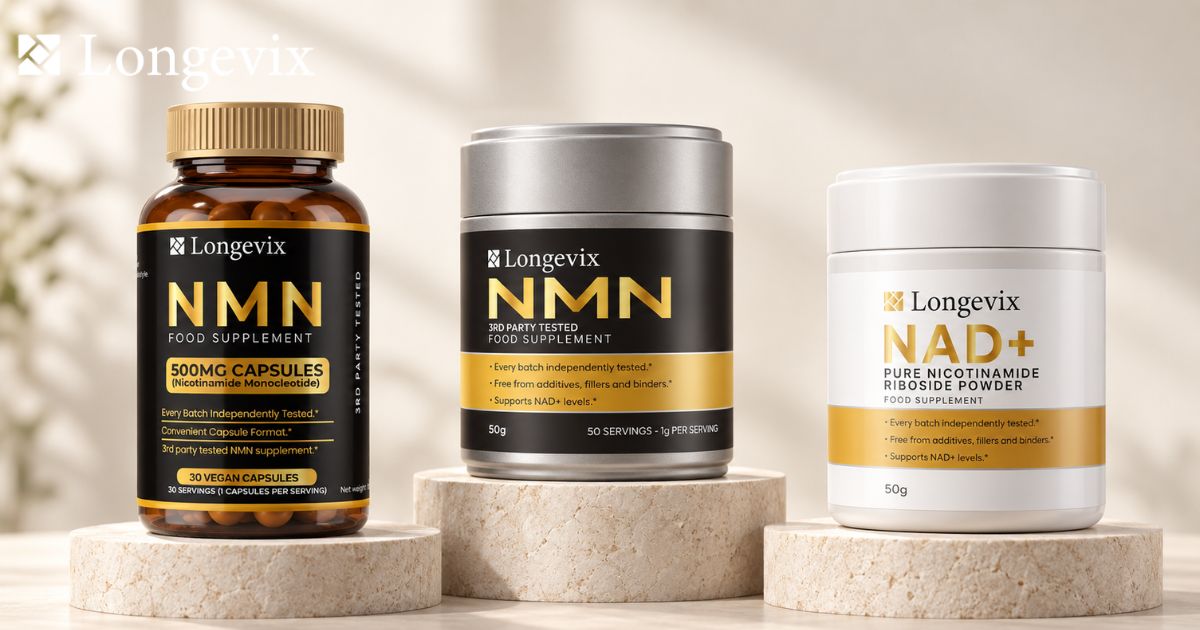
That approach matters because milligrams alone can mislead. A 500mg NMN capsule and a 1,000mg measuring scoop of NR powder contain different molecules. Likewise, a 300mg NR serving inside a combination formula tells you nothing about whether it works better than a standalone precursor. Compare the whole formulation before comparing headline numbers.
|
Longevix product |
Current labelled information |
Format |
Practical distinction |
|
Pure NMN Capsules 500mg |
500mg NMN per capsule; 30 capsules |
Capsules |
Pre-measured NMN |
|
Pure NMN Powder 50g |
50g NMN; a 500mg measuring scoop (1g labelled serving) included |
Powder |
Standalone NMN |
|
Pure Nicotinamide Riboside Powder 50g |
Nicotinamide riboside chloride; a 1,000mg measuring scoop |
Powder |
Standalone NR |
|
NR + TMG Capsules |
300mg NR, 250mg TMG, 5mg piperine per two capsules |
Capsules |
Fixed NR/TMG combination |
|
NAD+ Support Gummies |
300mg NR, 250mg quercetin, 250mg trans-resveratrol, 250mg nicotinamide per two gummies |
Gummies |
Multi-active formula |
Current catalogue details can be checked through the Longevix Shop.
Longevix Pure NMN Options
Longevix currently offers NMN as 500mg capsules and a 50g powder with a 500mg measuring scoop (1g labelled serving). The distinction is largely practical. Capsules provide a pre-measured amount while powder requires measuring. Neither format should be described as biologically superior without suitable comparative clinical evidence.
Longevix NR Options
The current range includes standalone NR powder, NR + TMG Capsules, and NAD+ Support Gummies. The capsules provide 300mg NR, 250mg trimethylglycine (TMG), and 5mg piperine per two-capsule serving. The gummies combine NR with quercetin, trans-resveratrol, and nicotinamide.
How Should You Compare mg and NR?
If your original search was “mg and nr”, focus on what the milligram figure actually describes. Net weight, scoop amount, capsule amount, and complete daily serving are different measures. More milligrams don’t automatically mean greater effectiveness. Compare the exact compound, full serving, research context, and applicable regulatory guidance.
Where Does TMG Fit When Choosing NMN or NR?
TMG enters this discussion through one-carbon metabolism rather than acting as another NAD+ precursor. Trimethylglycine is also known as betaine. It can donate a methyl group through the betaine-homocysteine methyltransferase pathway, helping convert homocysteine towards methionine. That gives it a genuine biological connection with methyl handling.
However, biological relevance isn’t proof of universal need. Online discussions sometimes present TMG as mandatory whenever NMN or NR is used. Current human evidence doesn’t establish that rule. Longevix’s science guidance similarly states that pairing TMG with NAD+ precursors shouldn’t be presented as necessary for every person.
TMG, Betaine and the Methylation Pathway
Within the methylation pathway, TMG can act as one of several methyl group donors. Folate-dependent processes, methionine metabolism, choline intake, diet, genetics, and health status also contribute. That redundancy matters because methylation cannot be reduced to one ingredient or one supplement pairing.
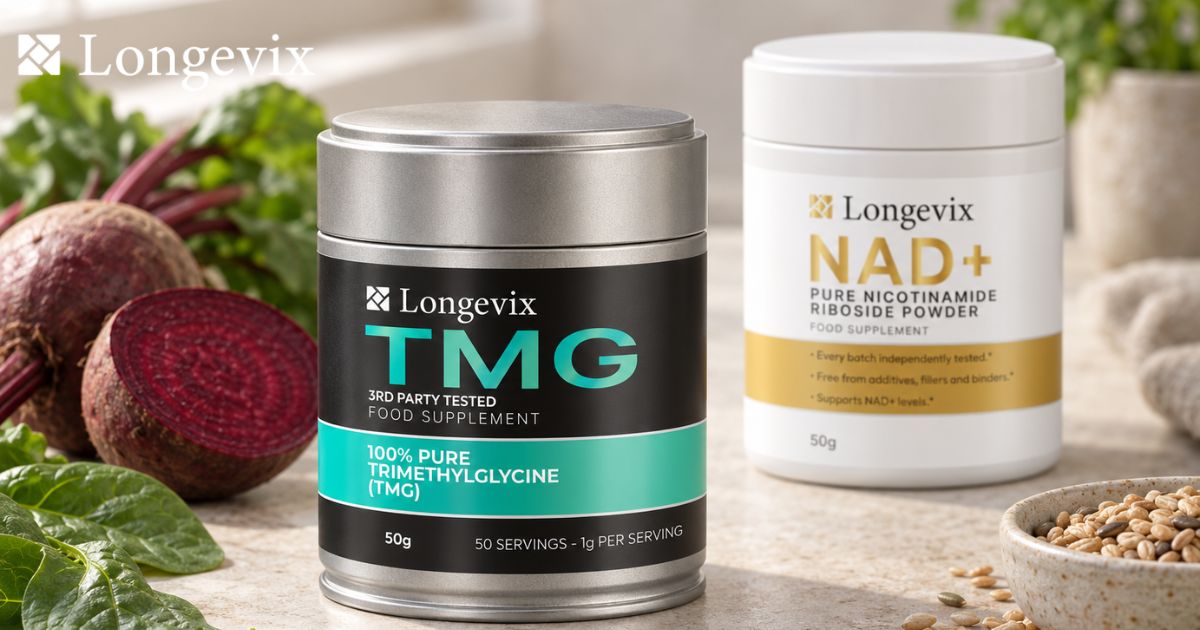
Does TMG Affect Homocysteine?
Human trials show that supplemental betaine can reduce circulating homocysteine in certain populations and doses. This supports discussions around healthy homocysteine levels. However, some higher-dose studies also reported increases in LDL cholesterol or triglycerides. Lowering a biomarker therefore shouldn’t automatically be presented as improved cardiovascular health.
Does NR Cause Methyl Depletion?
The concern arises because nicotinamide metabolism can use methyl groups. Yet clinically meaningful methyl depletion from ordinary NR use hasn’t been established as an inevitable outcome. In a high-dose NR Parkinson’s trial, researchers reported a slight initial homocysteine increase while the overall methyl-donor pool remained intact.
Does Everyone Taking NMN or NR Need TMG?
No universal requirement has been demonstrated. Dietary methyl donors, folate status, choline intake, genetics, health conditions, and total supplement use can all influence methyl metabolism. TMG may be relevant in particular circumstances, but mechanistic reasoning alone cannot establish that every NMN or NR user needs additional supplementation.
Can You Take NMN and NR Together—or Is That Overkill?
Taking both sounds logical at first. If NR and NMN both feed NAD+ pathways, combining them can feel like covering every possible route. Biology doesn’t always reward that arithmetic. Their pathways overlap, and current human evidence hasn’t established that routine combined supplementation produces greater meaningful benefits than using either precursor alone.
Stacking also makes your routine harder to interpret. More ingredients may increase cost, duplicate related compounds, or make unwanted effects harder to trace. Instead of assuming more precursor means more NAD+, examine the total formulation, labelled serving, research support, and other supplements already in use.
Does Combining NMN and NR Produce More Benefit?
Strong human head-to-head evidence remains lacking. Most controlled trials investigate NR or NMN separately rather than testing an NMN-plus-NR strategy against either ingredient alone. Until those comparisons exist, claims of synergy remain hypotheses. A plausible biochemical story should not be presented as a demonstrated clinical advantage.
Check Your Whole Supplement Routine
Ingredient duplication can hide behind different product names. Longevix NAD+ Support Gummies already contain NR while the NR + TMG Capsules also provide NR. Adding separate NR powder would create another source. The same principle applies to trimethylglycine, nicotinamide, quercetin, resveratrol, and other overlapping ingredients.
NMN and NR Safety: What Should You Consider Before Choosing?
Short-term clinical research provides useful safety information but cannot answer every long-term question. A 2026 meta-analysis covering 15 NMN trials found favourable short-term tolerability and no clear increase in overall or serious adverse events. Study durations ranged from 14 days to 24 weeks, leaving longer-term uncertainty.
NR has also generally been well tolerated in several short clinical trials. However, individual suitability can differ with age, medicines, health conditions, pregnancy, breastfeeding, and other supplements. Study participants also receive monitoring that ordinary consumers don’t. “Well tolerated in trials” is therefore more accurate than simply calling either precursor completely safe.
What Does Great Britain Say About NR?
The Food Standards Agency currently lists nicotinamide riboside chloride as an authorised novel food in England, Scotland, and Wales. Its conditions specify 300mg per day for the general adult population and 230mg per day for pregnant and lactating women. Regulatory limits shouldn’t be confused with personalised dosage advice.
What Is NMN’s Current Great Britain Status?
The position differs for β-NMN. The current FSA register shows application RP-2116 for β-nicotinamide mononucleotide as “in progress” at the risk-assessment stage. The record was last modified on 7 August 2026. This status should be checked again immediately before publication or future article updates.
A UK Caveat for Longevix NR Powder
Longevix currently lists its NR powder with a 1,000mg measuring scoop. That describes the scoop and website serving information. It shouldn’t be converted into unrestricted UK dosage advice because the Great Britain authorisation currently specifies different maximum conditions for nicotinamide riboside chloride. The current physical label and applicable regulations should guide product use.
What Should US Readers Know?
The United States uses a different framework. FDA doesn’t pre-approve dietary supplements for safety and effectiveness before marketing. In September 2025, FDA concluded that NMN wasn’t excluded from the legal definition of a dietary supplement under the drug-preclusion provision. That still doesn’t make NMN an “FDA-approved” supplement or treatment.
What About NR in the United States?
FDA’s GRAS inventory includes nicotinamide riboside chloride notice GRN 635. FDA responded that it had no questions regarding the notifier’s GRAS conclusion for specified intended food uses. That response isn’t equivalent to approval of NR supplements for effectiveness, longevity, disease prevention, or anti-ageing benefits.
How to Choose a Quality NMN or NR Supplement With Confidence
A glossy label reveals less than you might think. Start with the precise ingredient, amount per complete serving, pack size, directions, warnings, storage information, and batch details. Then examine testing documentation. Broad phrases such as “premium purity” or “maximum absorption” provide little value unless suitable evidence explains exactly what was measured.
Testing also needs context. Longevix publishes product-specific documents and advises customers to match the report with the correct product and batch. A certificate may cover identity, assay, purity, or selected contaminants. It doesn’t automatically prove every possible quality characteristic or demonstrate clinical effectiveness.
Check Identity Before Comparing Strength
NMN, nicotinamide, nicotinamide riboside, nicotinamide riboside chloride, and NAD+ are different terms. Always confirm which ingredient a product actually contains before comparing milligrams. Front-label phrases such as “NAD support” can describe a precursor formulation rather than a serving of finished NAD+ itself.
Understand What Testing Can Prove
Identity testing can help confirm what a sample contains while an assay can quantify a target compound. Contaminant panels may examine selected heavy metals or microbes. “Tested” doesn’t mean every possible analysis occurred. The strongest approach is to inspect the report, method, result, specification, unit, and batch yourself.
Match the Certificate to Your Product
A laboratory report becomes useful only when traceability makes sense. Compare the product name, batch or lot number, sample reference, laboratory, report date, methods, units, and specifications. Longevix’s testing-document library specifically advises customers not to assume that one report validates unrelated products or batches.

Be Cautious With Anti-Ageing Claims
NAD biology connects with sirtuins, metabolic processes, and cellular regulation. That doesn’t prove a supplement reverses ageing or extends lifespan. Likewise, claims about superior absorption require comparative pharmacokinetic evidence. Longevix’s own science framework explicitly separates biological mechanisms from demonstrated consumer outcomes.
Powder, Capsules or Gummies?
No delivery format wins by default. The most useful comparison is practical rather than promotional.
|
Format |
Practical advantage |
Main consideration |
|
Powder |
Straightforward ingredient measurement |
Requires careful scooping |
|
Capsule |
Fixed, portable amount |
Less flexible than loose powder |
|
Combination capsule |
Several listed actives together |
Individual ingredients cannot be adjusted separately |
|
Gummy |
Convenient chewable format |
May contain several active and inactive ingredients |
The current Longevix range includes powder, capsule, and gummy options.
NMN or NR? A Practical Framework for Choosing With Confidence
A confident choice begins with verifiable facts. Identify the exact precursor. Read the full serving information. Check other active ingredients. Compare current human evidence, testing documents, safety considerations, and regional rules. Only then consider convenience. This sequence keeps NAD+ science in perspective while preventing milligram numbers from dominating the decision.
Most importantly, don’t force science to produce a winner it hasn’t produced. NMN and NR both show biological activity in human studies. Neither has established reliable human lifespan extension. An evidence-led choice therefore values transparency, formulation, realistic expectations, and personal suitability above aggressive anti-ageing promises.
Choose Evidence Before Marketing Language
Words such as “ultimate”, “advanced”, or “maximum strength” sound impressive but don’t establish effectiveness. Check whether the underlying ingredient, amount, and formulation match the evidence being discussed. Where the research studies a different population, dose, duration, or compound, its relevance to the retail product may be limited.
Review Your Existing Supplements
A crowded supplement cupboard can hide substantial overlap. NR, NMN, nicotinamide, trimethylglycine (TMG), resveratrol, and quercetin may appear across different products. Comparing complete ingredient panels side by side often provides more useful information than comparing the boldest number printed on the front of each bottle.
Review Testing Before Trusting Purity Claims
Longevix maintains a testing-document index covering several current products. The report should match the relevant product and batch before you rely on it. Laboratory transparency can strengthen confidence in identity or measured quality. It cannot prove better cellular resilience, more energy, slower ageing, or longer life.
Check UK or US Rules Before Relying on Dosage Advice
Regulations differ across markets and can change. Great Britain currently has specific novel-food conditions for nicotinamide riboside chloride while β-NMN remains under risk assessment. The United States follows a different dietary-supplement framework. Research quantities, commercial serving sizes, and legal maximum conditions shouldn’t be treated as interchangeable concepts.
Don’t Choose Solely by Milligram Strength
A higher number can look reassuring while saying little about practical benefit. Milligrams describe quantity. They don’t prove purity, absorption, effectiveness, or personal suitability. Even within clinical research, increasing the amount doesn’t consistently improve every endpoint. Biology rarely behaves like a volume control where twice the dose means twice the result.
Final Takeaway
The strongest NMN versus NR decision starts with evidence rather than excitement. Both precursors interact with NAD-related biology while both have meaningful research limitations. TMG adds legitimate methylation biology to the discussion, but current evidence doesn’t make it compulsory for every NAD+ precursor user.
For Longevix customers, the practical approach is straightforward. Compare ingredient identity, labelled serving, formulation, product format, applicable regulations, and the relevant testing document. Then consider whether that product suits your needs. Evidence-based confidence may sound less dramatic than an anti-ageing promise, but it gives you a far firmer foundation.
For current product information, use the Longevix Shop, Longevix Science page, and Certificates of Analysis library.
This article provides general educational information. It does not replace personalised medical advice, diagnosis, or treatment.
Further Reading and Source Context
These external resources provide background or regulatory context. They do not prove that a particular Longevix product produces the health outcomes discussed above.
Frequently asked questions
Do I Need to Take TMG With NR?
Not necessarily. TMG isn’t universally required with NR, and available human evidence doesn’t establish that every NR user needs additional methyl donors. TMG has genuine methyl-donor biology, but individual diet, health status, formulation, and total supplement intake affect whether additional supplementation is relevant.
Why Take TMG With Nicotinamide Riboside (NR)?
TMG supplies methyl groups and participates in methylation and homocysteine metabolism. Some people therefore pair it with NR because nicotinamide metabolism can involve methyl-group use. However, that biochemical connection doesn’t establish that TMG is necessary for every person who takes NR.
Does NR Deplete Methyl Groups?
NR metabolism can interact with pathways that use methyl groups, but clinically significant methyl depletion hasn’t been clearly established as an inevitable effect. A high-dose NR safety trial reported that the methyl-donor pool remained intact despite a small early change in homocysteine.
What Is the Best Ratio of TMG to NR?
There is no scientifically established ideal TMG-to-NR ratio for the general population. Clinical studies use different protocols while diet, health, methyl-donor intake, medicines, and supplement combinations vary between individuals. A fixed commercial ratio shouldn’t be presented as a universal biological optimum.
Can I Take TMG and NR Together?
TMG and NR can appear together in supplement formulations, including Longevix NR + TMG Capsules. However, combining them doesn’t automatically produce better results. The current Longevix formula provides 300mg NR, 250mg TMG, and 5mg piperine per two-capsule serving.