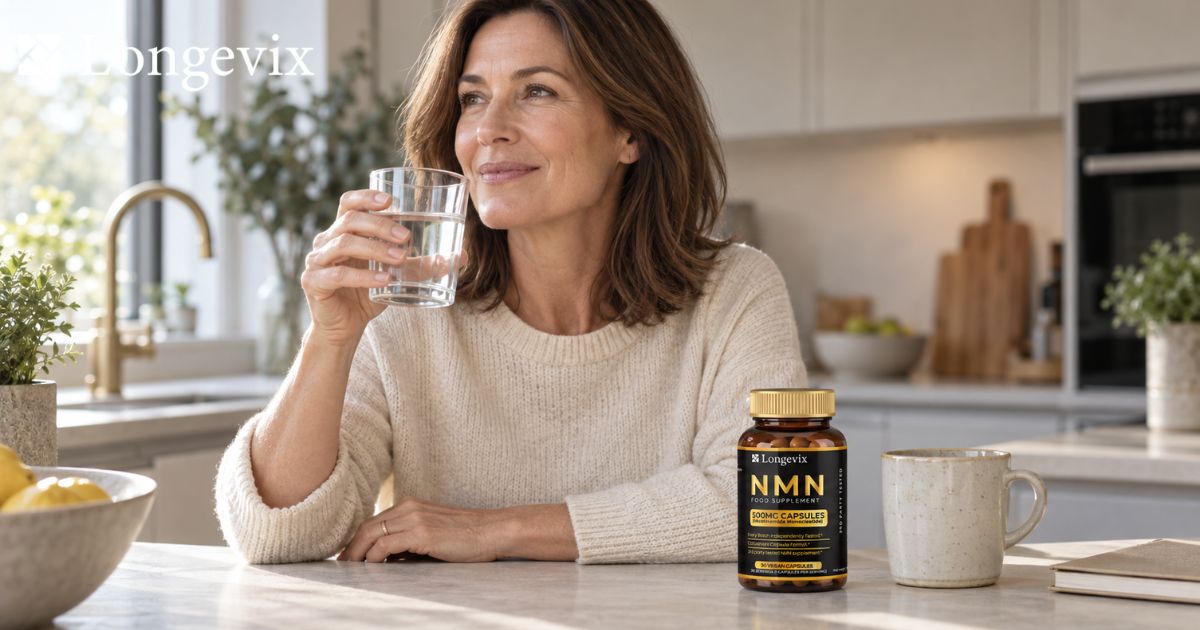
Resveratrol with NMN has become an intriguing pairing for people exploring healthy ageing and cellular function. NMN, or nicotinamide mononucleotide, participates in pathways that produce NAD+, while resveratrol is a plant-derived antioxidant compound studied for cellular signalling and metabolic responses. Together, they form a potentially synergistic combination, but the science needs careful interpretation.
Human studies show that NMN can influence NAD-related biomarkers, while direct evidence for taking both compounds together remains largely preclinical. Understanding that distinction helps you avoid exaggerated longevity claims. This guide explores how the pairing may work, what research actually shows, how safety fits into the picture, and how the subject relates to current Longevix products.
What Are Resveratrol and NMN—and Why Pair Them?
The story begins with NAD+. NMN is a precursor involved in pathways that produce nicotinamide adenine dinucleotide, commonly called NAD+. This coenzyme participates in energy metabolism, redox reactions, DNA-related processes, and enzyme activity throughout the body. Human trials show that NMN supplementation can increase blood NAD-related measurements under selected conditions.
Resveratrol approaches the ageing discussion differently. This plant polyphenol has been investigated for metabolic signalling, cellular stress responses, and sirtuin-related mechanisms. Researchers therefore explore resveratrol with NMN because the compounds affect connected biological pathways. However, complementary mechanisms alone don’t prove that the pairing improves healthspan or prevents age-related diseases.
What Is NMN and How Does It Relate to NAD+?
NMN, or nicotinamide mononucleotide, is involved in NAD+ biosynthesis. Several controlled human trials show that NMN boosts NAD+ or related metabolites in blood. Yet higher blood measurements don’t necessarily reveal what occurs in the brain, liver, muscle, or other tissues. Biomarkers provide useful clues, not complete answers.
What Is Resveratrol?
Resveratrol is a naturally occurring polyphenol found in foods including grapes and some berries. Research often focuses on trans-resveratrol. Although resveratrol is commonly described as an antioxidant compound, its biology extends into cellular signalling. A 2025 meta-analysis found no significant overall improvement in measured human SIRT1 outcomes across included trials.
Why Do People Take NMN and Resveratrol Together?
The rationale appears straightforward. NMN supports pathways involved in NAD+ production, while resveratrol has been researched around processes involving NAD-dependent enzymes. That makes the pairing biologically interesting. Still, describing it as a proven synergistic combination would overstate current human research. A plausible mechanism gives researchers a question worth testing, not a guaranteed answer.
“Mechanism is not an outcome.” — Longevix Science
Longevix uses this principle to distinguish plausible pathways from measurable human benefits. Its evidence framework also separates animal results, biomarkers, and clinical outcomes instead of treating them as equivalent.
How Resveratrol With NMN May Work Together in the Body
Think of NAD+ as biochemical currency rather than bottled energy. Cells need it for reactions involved in processing nutrients and maintaining normal metabolism. NMN contributes to pathways that replenish NAD+, while resveratrol has been studied for signalling effects. Their proposed relationship therefore involves connected biology rather than two ingredients performing identical jobs.

However, human metabolism resembles a network more than a light switch. Increasing one precursor doesn’t guarantee improved function everywhere. Likewise, changing a signalling pathway doesn’t automatically improve wellbeing. A supplement may alter NAD+ levels without producing noticeable changes in mobility, cognition, glucose control, energy, or other outcomes that genuinely matter to you.
NMN, NAD+ and Cellular Energy Metabolism
NAD+ helps transfer electrons during important metabolic reactions. It also participates in processes involving sirtuins and PARP enzymes. NMN supplies material that can contribute to the NAD+ pool. However, NMN doesn’t directly provide dietary energy. Food supplies energy, while NAD-related pathways help cells process and use that energy.
Resveratrol, Sirtuins and Cellular Stress Signalling
Sirtuins require NAD+ to function, which partly explains interest in pairing NAD+ precursors with resveratrol. Yet human evidence remains mixed. The 2025 systematic review of randomised trials found no significant overall effect of resveratrol on SIRT1 gene expression, protein expression, or serum measurements, although some subgroup patterns differed.
The Proposed NMN and Resveratrol Synergy
The proposed model sounds elegant: NMN may support NAD+ availability while resveratrol influences related signalling pathways. However, claims that the combination synergistically increases meaningful human benefits go beyond available evidence. The strongest direct combination findings currently come from experimental animals rather than long-term trials measuring human function, disease outcomes, or survival.
Does Resveratrol With NMN Work Better Than Either Alone?
This question has an interesting experimental study behind it. Researchers compared NMN alone with NMN plus resveratrol in mice. The combination produced higher NAD+ concentrations in the heart and skeletal muscle than NMN alone. Researchers reported approximately 1.59-fold higher heart NAD+ and 1.72-fold higher skeletal-muscle NAD+.

Those numbers sound impressive until context enters the room. The experiment was a mouse study using 500 mg/kg NMN and 50 mg/kg resveratrol. Researchers measured tissue NAD+, not human energy, mobility, disease prevention, or longevity. Therefore, the experiment supports further investigation but cannot establish that people benefit more from the combination.
Research Case Study: The NMN Plus Resveratrol Mouse Experiment
The 2022 experiment examined organ-specific effects after researchers administered NMN with resveratrol or selected ginsenosides. Resveratrol produced notable differences in heart and muscle NAD+. Meanwhile, the ginsenoside combination created the larger change in lung tissue. This finding illustrates why results from one tissue shouldn’t be generalised across the entire body.
|
Experimental comparison |
Research model |
Main reported finding |
What it does not prove |
|
NMN alone |
Mice |
Increased NAD+ in selected tissues |
Longer human life |
|
NMN + resveratrol |
Mice |
About 1.59× higher heart NAD+ and 1.72× higher muscle NAD+ versus NMN alone |
Superior human healthy-ageing outcomes |
|
NMN + ginsenosides |
Mice |
About 1.97× higher lung NAD+ versus NMN alone |
A resveratrol effect or human lung treatment |
|
Human NMN trials |
Humans |
Increased blood NAD-related measurements in several trials |
Proven NMN-resveratrol synergy |
Why Animal Synergy Is Not Human Proof
Mice and humans differ in size, metabolism, physiology, diet, lifespan, and disease development. Researchers may also use doses designed for experimental questions rather than everyday supplementation. Findings from specific organs can identify promising mechanisms, but they cannot establish that the same magnitude of response will occur throughout a human body.
What Human Evidence Is Still Missing?
A convincing human trial would compare NMN alone, resveratrol alone, both compounds together, and placebo. Researchers would also need meaningful outcomes beyond biomarkers. Strength, mobility, metabolic function, quality of life, cardiovascular outcomes, and frailty would tell readers far more than a single biochemical measurement.
Potential Benefits of Resveratrol With NMN for Healthy Ageing
The pairing attracts attention because both ingredients intersect with biological processes that change across adulthood. NAD+ participates in cellular metabolism, while resveratrol appears throughout metabolic and vascular research. These connections make combination research worthwhile. They don’t establish prevention of age-related diseases, reversal of ageing, or guaranteed improvements in vitality.
The word “benefit” also needs precision. Raising a biomarker differs greatly from preventing cardiovascular disease. Improving insulin signalling in a selected study population doesn’t prove universal protection against metabolic illness. Good longevity content should show where evidence sits on that spectrum rather than turning every statistically significant result into a lifestyle promise.
Cellular Energy and Mitochondrial Function
NAD+ participates in reactions linked with mitochondrial metabolism. This explains why NAD+ precursors feature prominently in ageing research. Yet higher NAD availability doesn’t automatically create noticeable energy. Mitochondrial function also depends on nutrition, physical activity, oxygen delivery, sleep, hormones, genetics, and general health. One nutrient cannot manage that orchestra alone.
Metabolic Health Research
A notable randomised trial involved postmenopausal women with overweight or obesity and prediabetes. Ten weeks of NMN improved insulin-stimulated glucose disposal and insulin signalling in skeletal muscle compared with placebo. The finding is important, yet the study population was narrow. Results shouldn’t automatically be generalised to healthy younger adults.
Physical Function and Healthy Ageing Research
A 2024 double-blind trial followed 60 older adults taking 250 mg NMN or placebo for 12 weeks. The primary stepping-test outcome didn’t differ significantly between groups. However, secondary findings included higher blood NAD+ and a shorter four-metre walking time. These mixed results show why endpoint selection matters.

Cardiovascular and Circulatory Research
NAD biology and resveratrol both appear in cardiovascular research. However, neither NMN nor an NMN-resveratrol pairing has been shown to prevent cardiovascular disease in humans. Experimental evidence also suggests resveratrol can influence platelet activity, making medication context important when someone uses anticoagulant or antiplatelet treatment.
Lung Research Needs Especially Careful Interpretation
Preclinical discussions sometimes connect NAD+ biology with lung tissue fibrosis or cardiopulmonary failure. The NMN-resveratrol experiment did not show treatment of either condition. In fact, its larger lung NAD+ change came from NMN plus ginsenosides. Translating that result into a respiratory-treatment claim would stretch the evidence far beyond its limits.
Healthy Ageing Is Not the Same as Anti-Ageing
The phrase anti-aging cocktails can make complex biology sound like a recipe. Healthy ageing is more grounded. It concerns maintaining function and reducing established risks over time. No completed human trial has shown that taking resveratrol with NMN reverses ageing, prevents age-associated illness, or extends lifespan.
Resveratrol With NMN vs NMN Alone: Which Approach Makes Sense?
Sometimes simplicity has genuine value. Taking NMN alone makes ingredient exposure easier to understand and compare with NMN-specific research. Combining products introduces more variables, potential interactions, extra expense, and greater difficulty identifying which ingredient caused a change. More compounds don’t automatically create a better longevity routine.
Still, people may consider resveratrol with NMN because the biological pathways appear complementary. That decision should follow evidence rather than supplement maximalism. A complicated stack can quickly become biochemical guesswork. Before adding another ingredient, ask whether research supports the exact formulation, dose, outcome, and population relevant to your situation.
When a Single-Ingredient NMN Product Keeps Things Simple
Single-ingredient NMN allows a cleaner comparison with NMN research. Longevix currently offers Pure NMN Capsules 500mg and NMN powder through its current supplement range. The capsule supplies 500 mg NMN, while the powder comes in a 50 g tin with a 500mg measuring scoop (1g labelled serving).

Why Some People Explore NMN With Resveratrol
The attraction lies in complementary biology rather than established superiority. NMN participates in NAD+ synthesis, while resveratrol has been investigated across sirtuin and cellular-stress pathways. This makes the combination scientifically interesting. However, resveratrol isn’t proven necessary for NMN to function, and researchers haven’t established a universal stacking requirement.
Does Adding Resveratrol Automatically Improve NMN?
Current human evidence doesn’t support that conclusion. A higher tissue NAD+ measurement in an animal experiment cannot prove better cognition, mobility, metabolic health, or longevity in people. It resembles increasing one dashboard reading without knowing whether the entire vehicle performs better. The measurement matters, but it cannot answer every practical question.
NMN vs NR When Resveratrol Is Included
NMN and nicotinamide riboside, or NR, both participate in pathways related to NAD+ production. They aren’t interchangeable names. This distinction matters for Longevix because its standalone products contain NMN, while its current resveratrol-containing gummies use NR. Longevix also states that evidence doesn’t establish one precursor as universally superior.
How to Take Resveratrol With NMN: Dose, Timing and Practical Considerations
Search online and countless longevity protocols appear. Clinical research is less tidy. Human NMN studies use different oral doses, durations, populations, and formulations. Resveratrol studies show similar variation. Consequently, no universally validated NMN-to-resveratrol ratio currently exists for healthy ageing, energy, healthspan, or any other broad consumer goal.
Practical supplementation should begin with the current product label. Check serving size, ingredients, medicines, and other supplements already in your routine. Longevix advises readers not to exceed the stated amount and recommends professional guidance during pregnancy, breastfeeding, medicine use, or management of a health condition.
Is There a Proven NMN-to-Resveratrol Ratio?
No validated human ratio currently defines the ideal combination. The frequently cited animal experiment used 500 mg/kg NMN and 50 mg/kg resveratrol. That ten-to-one relationship answered an experimental question in mice. It shouldn’t become a human dosing formula because body-weight conversion alone cannot resolve metabolic and pharmacokinetic differences.
Can NMN and Resveratrol Be Taken at the Same Time?
Taking two ingredients simultaneously isn’t equivalent to proving they work better together. Human trials haven’t established an optimal separation period or same-time schedule for NMN with resveratrol. When combining supplements, follow the relevant labels and consider professional advice. Precise internet timing rules often sound more certain than the evidence behind them.
Should Resveratrol Be Taken With Food?
Resveratrol absorption and metabolism are complex, and study formulations vary considerably. Meal composition may influence exposure, but evidence doesn’t establish one universal food rule for every product. Follow the directions supplied with the exact supplement rather than assuming that advice for one capsule, powder, or formulation applies to all resveratrol products.
What Is the Best Time to Take NMN and Resveratrol?
No robust human evidence establishes one universally superior morning or evening schedule for the combination. A separate NMN trial has explored time-of-day intake in older adults, but that doesn’t establish an ideal NMN-resveratrol schedule. Consistency, tolerance, label directions, medicines, and food requirements may matter more than chasing a perfect hour.
Safety, Side Effects and Interactions of NMN and Resveratrol
Short human NMN trials have generally reported acceptable tolerability at studied amounts. One randomised study evaluated 1,250 mg daily for four weeks in 31 healthy adults and found no clinically important changes outside expected physiological variation across its measured safety parameters. However, four weeks cannot establish long-term safety.
Resveratrol deserves similar dose-aware caution. A small crossover study found gastrointestinal symptoms more frequently during resveratrol treatment than placebo. Experimental research also suggests platelet-related effects. Supplement decisions therefore require more care when medicines, surgery, pregnancy, breastfeeding, or a metabolic disorder creates additional clinical context.
Possible NMN Side Effects and Safety Limits
Current short-duration human trials haven’t revealed a consistent pattern of serious toxicity at studied oral doses. That is reassuring but incomplete. Small trials can miss uncommon reactions, while short studies cannot reveal problems that might appear after prolonged use. Study participants also meet eligibility criteria that may not resemble every supplement user.
Possible Resveratrol Side Effects
Resveratrol tolerability depends on dose, formulation, and study design. Gastrointestinal symptoms have appeared in human research, especially at substantial intakes. That doesn’t mean everyone will experience problems. However, “natural” doesn’t mean automatically harmless. Combining several supplements can also make it harder to identify which ingredient caused an unwanted response.
Resveratrol and Medication Interactions
Research indicates that resveratrol can influence platelet-related pathways, although much mechanistic evidence comes from laboratory work. People taking anticoagulant or antiplatelet medicines should therefore discuss supplementation with a qualified healthcare professional. This cautious approach reflects potential interaction risk rather than proof that every resveratrol dose causes a clinically significant interaction.
UK and US Regulatory Context
In Great Britain, the Food Standards Agency currently lists β-NMN novel-food application RP-2116 as “in progress” at the risk-assessment stage, last modified 1 July 2026. In the USA, FDA records show β-NMN NDI notification 1444 and a response dated 28 January 2026. Neither listing alone proves broad product approval.
Which Longevix Products Are Relevant to NMN and Resveratrol?
Longevix currently offers NMN in two standalone formats. Pure NMN Capsules provide 500 mg per capsule in a 30-capsule vegan format. Pure NMN Powder comes in a 50 g tin with a 500mg measuring scoop (1g labelled serving) and approximately 50 servings. Neither product is a pre-made NMN-resveratrol formula.
Resveratrol appears elsewhere in the range. Longevix NAD+ Support Gummies provide, per two gummies, 300 mg NR, 250 mg quercetin, 250 mg trans-resveratrol, and 250 mg nicotinamide. They contain NR rather than NMN, making precise ingredient language essential.
Longevix Pure NMN Capsules 500mg
Each capsule contains a labelled 500 mg of NMN, and each bottle contains 30 vegan capsules. The fixed format avoids daily measuring. However, a 500 mg serving shouldn’t be presented as guaranteeing a specific result. For wider context, readers can explore Does NMN Really Work? alongside the current product label.
Longevix Pure NMN Powder 50g
Longevix Pure NMN Powder comes in a 50 g tin with a 500mg measuring scoop (1g labelled serving). At that labelled serving, the tin provides approximately 50 servings. Powder gives you a different delivery format rather than proven greater effectiveness. Accurate measuring and adherence to current label directions remain important.
Longevix NAD+ Support Gummies With Trans-Resveratrol

The gummies provide 300 mg NR, 250 mg quercetin, 250 mg trans-resveratrol, and 250 mg nicotinamide per two-gummy serving. They show why product names require careful reading. “NAD+ support” doesn’t mean NMN. Readers can also explore Longevix’s NR Gummies guide for formulation context.
|
Longevix product |
NAD+ precursor |
Resveratrol included? |
Format |
Current labelled serving information |
|
Pure NMN Capsules 500mg |
NMN |
No |
Vegan capsules |
500 mg per capsule |
|
Pure NMN Powder 50g |
NMN |
No |
Powder |
a 500mg measuring scoop (1g labelled serving); approximately 50 servings |
|
NAD+ Support Gummies |
NR |
Yes |
Gummies |
Two gummies provide 300 mg NR and 250 mg trans-resveratrol, plus quercetin and nicotinamide |
Does Longevix Sell a Combined NMN and Resveratrol Product?
At the time of writing, the current Longevix shop doesn’t list a single product containing both NMN and resveratrol. Its standalone NMN products contain NMN, while its current resveratrol-containing gummies use NR. This distinction prevents readers from confusing an NMN stack with an NR-based formulation.
How to Choose a Quality NMN or Resveratrol Supplement
Good supplement selection starts with details rather than dramatic promises. Check the precise ingredient, amount per serving, formulation, directions, warnings, batch information, and available testing. Phrases such as “maximum longevity” or advanced combination therapy may sound impressive, but they don’t replace transparent labelling or research relevant to the actual formulation.
Testing also needs careful interpretation. Longevix maintains a Certificate of Analysis library and recommends matching documents to the relevant product and batch. A COA may verify selected aspects of identity, purity, potency, or contaminants. It cannot prove disease prevention or longer life.
Check the Exact Ingredient Rather Than the Front Label
NMN, NR, nicotinamide, and NAD+ aren’t interchangeable terms. Trans-resveratrol should also be identified accurately rather than hidden behind vague wording. Exact ingredient names let you compare products with appropriate research. Without that precision, even a high-quality clinical study may have little relevance to the formulation you are considering.
Compare Amount Per Serving, Not Container Size
Sixty capsules and sixty gummies can represent very different amounts and routines. Longevix NMN capsules provide 500 mg per capsule, while its 60 NAD+ Support Gummies represent 30 two-gummy servings. Bottle size therefore tells you surprisingly little. The amount per labelled serving gives a far more meaningful comparison.
Look for Batch-Specific Testing
A useful testing document should identify the relevant product or material, laboratory details, results, and specifications. Where batch or lot information is available, match it carefully. One purity result cannot automatically prove potency, heavy-metal status, microbiological quality, identity, and every other quality characteristic unless those tests actually appear in the report.
Be Careful With Disease and Longevity Claims
Research papers may discuss NAD biology alongside age-related diseases, cardiovascular disease, or experimental lung tissue fibrosis. That doesn’t mean a supplement treats those conditions. Similarly, mentions of cardiopulmonary failure in preclinical discussion shouldn’t become consumer medical claims. Scientific context matters just as much as the headline result.
Resveratrol With NMN: Smart Pairing or More Hype Than Evidence?
The fairest answer sits between dismissal and hype. Human trials show that NMN can influence NAD-related biomarkers, while resveratrol remains scientifically interesting. Animal research also suggests organ-specific effects when NMN and resveratrol are combined. Yet direct human trials haven’t demonstrated superior healthy-ageing outcomes from the pairing itself.
Smart pairing therefore means asking better questions. Was the research performed in humans? Did the formulation match your supplement? Was the measured change clinically meaningful? Those checks stop promising mechanisms from turning into unsupported guarantees about frailty, youthful energy, disease prevention, or lifespan. Evidence should guide expectations rather than decorate them.
Further Reading and Source Context
These external resources provide background or regulatory context. They do not prove that a particular Longevix product produces the health outcomes discussed above.
Frequently asked questions
Can You Take NMN and Resveratrol Together?
The compounds have been administered together experimentally, but human evidence doesn’t establish an optimal pairing protocol. Suitability also depends on dose, medicines, health conditions, and formulation. If you plan to combine supplements, follow current product directions and seek professional advice when medication use or a health condition makes the decision more complex.
Should You Take NMN With Resveratrol?
Resveratrol isn’t required for NMN to participate in NAD+ metabolism. The combination has a plausible biological rationale, but human trials haven’t established that adding resveratrol produces better healthy-ageing outcomes than NMN alone. Your decision should consider evidence, product quality, existing supplements, medicines, and personal health circumstances.
How Much Resveratrol Should You Take With NMN?
There is no clinically established NMN-to-resveratrol ratio for healthy ageing. Studies have used widely different amounts and formulations, while the commonly cited combination experiment involved mice. Follow the labelled serving for each product rather than converting animal doses or copying an online longevity protocol into a personal regimen.
Does Resveratrol Interact With NMN?
Research hasn’t established a harmful direct NMN-resveratrol interaction, but human combination data remain limited. Resveratrol may also influence platelet-related pathways and could matter when medicines are involved. Consequently, the relevant question isn’t simply whether the ingredients “mix”; it is whether the complete routine suits the individual using it.
Is NMN Better Than Resveratrol?
Neither ingredient is universally better because they aren’t performing the same job. NMN primarily contributes to pathways involved in NAD+ production, whereas resveratrol is studied across cellular-signalling and metabolic pathways. The stronger choice depends on the question being asked, the quality of evidence, and the exact outcome that matters to you.