Choosing a TMG supplement shouldn’t depend on glossy packaging or sweeping purity promises. With third party tested TMG, you can look beyond marketing and examine evidence about product quality. Independent laboratory testing can investigate trimethylglycine, its measured content, and selected contaminants when those analyses appear on the report.
A clear certificate of analysis adds another layer of transparency. It helps you connect laboratory findings with a specific product or batch. For anyone comparing betaine anhydrous supplements, that traceability matters. It makes quality easier to assess while keeping laboratory evidence separate from promises about health outcomes or clinical effectiveness.
What Does Third Party Tested TMG Actually Mean?
Third party tested TMG means an external laboratory has analysed a submitted sample for specified characteristics. The important word is “specified”. Third-party tested doesn’t automatically tell you which tests were conducted, which batch was sampled, or whether every conceivable contaminant was investigated.
For buyers, good testing should work like a paper trail. You should be able to connect the report with the relevant product and understand its scope. Even an independent laboratory document cannot confirm every manufacturing standard, ingredient characteristic, or future batch unless the supporting information specifically covers those points.
Third Party Tested TMG vs In-House Quality Claims
Manufacturers can conduct internal quality checks while also using outside laboratories. These approaches aren’t mutually exclusive. Independent testing provides useful separation between the seller and testing provider. However, the laboratory name alone isn’t enough. The sample identity, batch details, analytical methods, results, and limitations still determine how much the report can establish.
Does “Lab Tested TMG” Automatically Mean High Quality?
Not always. “Lab tested” could describe one assay or a broader testing panel. One report might examine content while another checks selected metals or microorganisms. Therefore, don’t treat the phrase pure TMG as proof of every quality characteristic unless the supporting evidence actually demonstrates those characteristics.
Why Product and Batch Traceability Matter
Traceability helps turn a vague quality claim into evidence you can examine. Longevix tells customers to match available documentation with the product and batch shown on their packaging. This matters because one laboratory report shouldn’t automatically be treated as evidence for every past or future production batch.
What Should Third Party Testing for TMG Actually Verify?
Useful testing can answer several different questions. Depending on the laboratory panel, testing may examine ingredient content, microbial quality, selected heavy metals, moisture, or other specifications. A certificate of analysis should therefore be read test by test rather than treated as a single guarantee covering everything.
These distinctions matter because identity, assay, purity, potency, and contamination aren’t interchangeable concepts. Likewise, GMP standards relate to manufacturing controls rather than one laboratory sample. Good quality assessment brings together accurate labelling, production controls, traceability, appropriate testing, and careful interpretation of the resulting evidence.
|
Testing term |
What it can help show |
What it doesn’t automatically prove |
|
Assay or content |
Measured amount of a target compound |
Every contaminant has been tested |
|
Microbial testing |
Results for named microorganisms |
Chemical purity |
|
Heavy-metal testing |
Results for specified metals |
Absence of every possible contaminant |
|
Moisture or ash |
Defined quality or composition parameters |
Clinical effectiveness |
|
Third-party testing |
External laboratory involvement |
Every batch received identical testing |
Ingredient Identity: Is the Sample Really Trimethylglycine?
Identity sits at the heart of meaningful testing. The material examined should correspond with the ingredient presented to consumers as trimethylglycine. Product names, laboratory sample descriptions, and batch information should align closely enough to establish traceability rather than forcing the reader to make assumptions.
Purity, Assay and Potency Aren’t Interchangeable
Numbers can look convincing without context. An assay may measure the amount of a target compound while moisture, ash, or contaminant analyses answer different questions. A percentage shouldn’t automatically become a blanket purity promise. You need to read the result beside its method, unit, specification, and any laboratory notes.
What About Heavy Metals and Microbial Testing?
Heavy metals and microorganisms require their own analyses. Testing for lead doesn’t automatically establish results for mercury or arsenic. Likewise, testing for one microorganism doesn’t prove every microbial risk was assessed. This is why an accessible testing panel often tells you more than broad words such as “clean”, “premium”, or “tested”.
Be Careful With “No Fillers No Binders” Claims
The phrase no fillers no binders may sound attractive, yet it should only appear when the complete ingredient statement supports it. Longevix currently lists Trimethylglycine (TMG/Betaine Anhydrous) online while directing customers to the physical product label for the complete ingredient and allergen information.
How to Read a TMG Certificate of Analysis Before You Buy
A laboratory report becomes far easier to understand when you read it systematically. Start with the product or sample name. Then examine the batch reference, laboratory details, dates, tests, methods, units, results, and explanatory notes. A TMG certificate of analysis should function as traceable evidence rather than a decorative marketing badge.

Longevix follows a useful principle here: customers should match the report with the product and relevant batch. Its Certificates of Analysis page also states that testing documentation is published for its products. That approach encourages readers to examine the evidence rather than simply accepting a front-label testing claim.
Step One: Match the Product or Sample Name
Begin with the simplest check. A document intended to support TMG quality should clearly relate to TMG or the corresponding material. Testing performed on NMN, NR, creatine, or another supplement cannot establish the quality characteristics of a different TMG product.
Step Two: Find the Batch or Sample Reference
Batch information gives laboratory evidence a real-world anchor. Without traceability, a report can become disconnected from the container in your hand. Longevix specifically tells buyers to check that the available testing document matches the product and batch shown on their pack.
Step Three: Check Dates and the Testing Provider
Dates help you understand when the sample entered the testing process. The laboratory identity also matters because it tells you who performed the work. However, a recognisable laboratory name shouldn’t replace careful reading. You still need to inspect the test scope, sample details, methods, results, and qualifications.
Step Four: Read the Test, Unit and Result Together
A laboratory number means little on its own. Read the test name, method, unit, specification, and result together. Terms such as “ND” generally mean not detected under the stated analytical conditions. Reporting limits also matter because laboratory instruments measure substances within defined technical boundaries.
Step Five: Notice Footnotes and Limitations
Footnotes are easy to skip yet they can change how a result should be described. Accreditation notes, reporting limits, client-supplied methods, and sample-specific statements can all affect interpretation. A careful reader should ask exactly what was tested before repeating a laboratory result as a wider product claim.
Longevix Pure TMG Powder: Testing and Product Facts
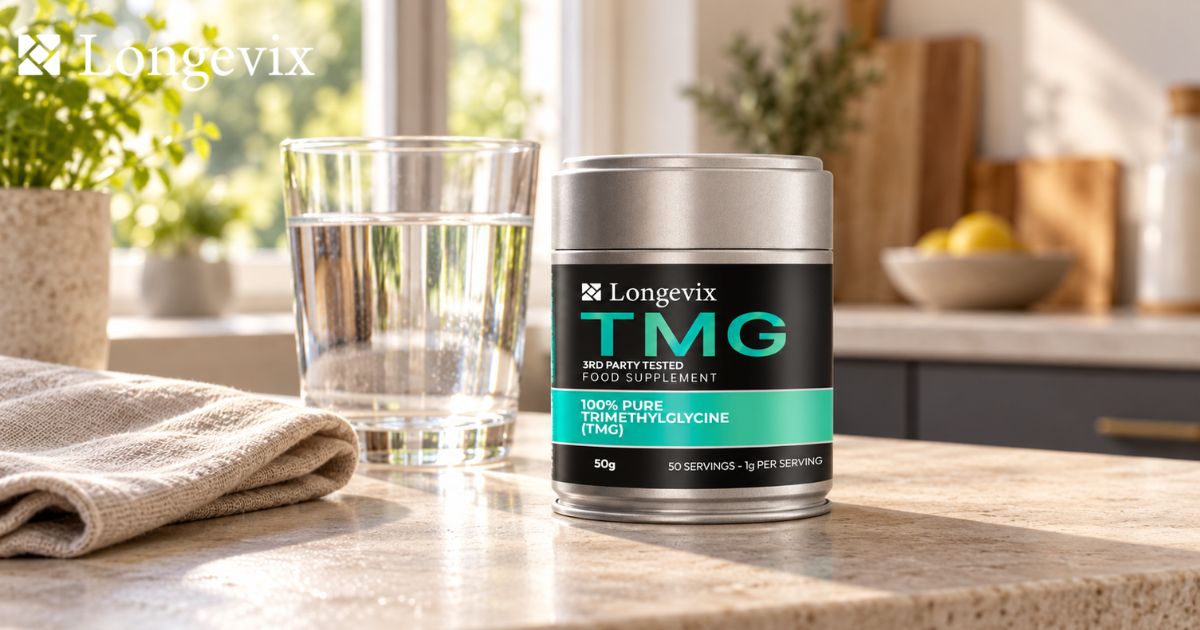
Longevix currently offers Pure Trimethylglycine (TMG) Powder in a 50g format. The product page lists a 1,000mg serving using two included scoops, providing approximately 50 servings. Its ingredient field identifies betaine anhydrous as Trimethylglycine (TMG/Betaine Anhydrous).

The product record also links to an available batch-specific testing document. Longevix’s Certificates page currently lists the TMG certificate under ID QDF25-0098434-02. That transparency is useful, but the report should still be interpreted according to the sample, tests, and limitations it actually records.
What Is in Longevix Pure TMG Powder?
The current online ingredient information names Trimethylglycine (TMG/Betaine Anhydrous). At website-description level, this presents a straightforward single-ingredient formula. However, buyers should still check the physical packaging because Longevix directs customers to the product label for the complete ingredient statement and allergen information.
Why a Product-Specific Testing Link Matters
A testing document placed directly beside a product gives shoppers a practical route to examine evidence. It reduces the distance between a testing claim and its supporting documentation. Longevix currently provides this option on its TMG product page and reminds customers to check the corresponding batch.
Why “Not Detected” Doesn’t Mean Absolute Zero
Laboratory instruments work with detection and quantification limits. When a report states that a substance was not detected, the result generally relates to the stated analytical method and threshold. It doesn’t mean science has demonstrated the absolute absence of every molecule. This distinction prevents technically accurate results from becoming exaggerated claims.
TMG, Trimethylglycine and Betaine Anhydrous Explained
Terminology can make a simple ingredient seem confusing. TMG stands for trimethylglycine. Betaine is another established name for trimethylglycine while betaine anhydrous describes the anhydrous form commonly used in supplement products. Longevix uses TMG and Betaine Anhydrous together in its current ingredient description.

Chemically, trimethylglycine carries three methyl groups attached to glycine. This structure explains why it can act as a methyl donor within one-carbon metabolism. Yet chemistry alone cannot tell you whether taking more TMG will improve a particular outcome. Human responses depend on dose, population, nutritional status, and study conditions.
What Is Methyl Group Donation?
During methyl group donation, a small carbon-and-hydrogen group transfers between molecules. Think of it as a tiny biochemical parcel changing hands. TMG can donate a methyl group within the pathway that helps convert homocysteine towards methionine through betaine-homocysteine methyltransferase.
What Does the BHMT Enzyme Do?
The BHMT enzyme, meaning betaine-homocysteine methyltransferase, uses betaine during the remethylation of homocysteine to methionine. This reaction forms one part of wider methylation pathways. It would be misleading to describe TMG as controlling methylation because numerous enzymes, nutrients, pathways, and regulatory processes interact within one-carbon metabolism.
Where Does S-Adenosylmethionine Fit?
Methionine contributes to the formation of S-adenosylmethionine (SAM), an important methyl-group donor involved in many biochemical reactions. This relationship helps explain why TMG appears in discussions about methylation support. However, participation in a pathway doesn’t prove that additional TMG improves every methylation-dependent process in healthy people.
What Does the Science Actually Say About TMG?
Human research paints a more measured picture than supplement advertising sometimes suggests. Betaine has been investigated for effects on homocysteine levels, exercise outcomes, and related metabolic markers. However, trials use different doses, populations, durations, and endpoints. Results from one protocol shouldn’t automatically become promises about another product.
Biomarker findings also need careful interpretation. Human studies have documented homocysteine reduction with particular betaine intakes, yet lowering a biomarker doesn’t automatically establish fewer cardiovascular events or longer life. That distinction matters when discussing TMG and cardiovascular health, especially within health-related content.
TMG as a Methyl Donor in Homocysteine Metabolism
Betaine can function as a methyl donor during BHMT-dependent remethylation of homocysteine. Human trials have reported reductions in plasma homocysteine at certain intakes. For example, one six-week study observed dose-related reductions with 1.5g, 3g, and 6g daily, although this didn’t establish prevention of cardiovascular disease.
Research Case Study: Betaine and Homocysteine
A randomised study involving 42 adults examined 6g of betaine daily during a 12-week dietary intervention. Plasma homocysteine fell in the betaine group, while body composition didn’t improve beyond the diet alone. The study also reported higher total and LDL cholesterol in the betaine group, showing why balanced interpretation matters.
What Counts as a Clinical Dose?
There isn’t one universal clinical dose of TMG for every purpose. Research has examined different amounts, including 1g, 3g, and 6g daily in dose-response work. Therefore, phrases such as clinically meaningful dose need context. A dose used in research isn’t automatically an appropriate personal recommendation.
TMG and Athletic Performance: What Does Current Evidence Show?
Evidence around athletic performance remains mixed and outcome-specific. A meta-analysis covering 17 studies and 317 participants reported an effect on maximal strength, particularly lower-body strength. However, significant benefits weren’t found across several other performance measures, including cycling sprint power and muscular endurance.
Does Third Party Testing Mean a TMG Supplement Will Work Better?
No. Laboratory quality testing and clinical effectiveness answer different questions. Testing can provide evidence about characteristics measured in the submitted sample. It cannot establish that a third-party tested product works faster, absorbs better, produces stronger biological effects, or suits every person better than another supplement.

Think of laboratory testing like checking the quality of fuel before a journey. The analysis can describe aspects of the fuel. It cannot guarantee how every car will perform. Likewise, a TMG report doesn’t prove that a particular clinically meaningful dose will create a specific clinical result.
Quality Verification and Clinical Evidence Answer Different Questions
Product testing asks what a laboratory found in a particular sample. Clinical research asks what happened when defined participants received a defined intervention under controlled conditions. Both types of evidence can matter, but they aren’t interchangeable. Strong health content keeps those questions separate instead of allowing a laboratory certificate to masquerade as a clinical trial.
Does Greater Purity Guarantee Better Results?
Not by itself. A stronger assay result doesn’t automatically produce greater absorption or more powerful biological effects. Human outcomes depend on many factors beyond ingredient percentage. Purity belongs within quality assessment. Claims about superior physiological performance require appropriate comparative evidence rather than assumptions based on a single laboratory number.
Testing Doesn’t Turn a Supplement Into Medicine
UK guidance is clear that food supplements aren’t medicines and shouldn’t be marketed with claims to prevent, treat, or cure medical conditions. Therefore, laboratory testing may support transparency and quality information, but it doesn’t transform TMG into an approved treatment for elevated homocysteine levels or any disease.
Pure TMG Powder or TMG in a Combined Formula?
The better format depends on what you want from the product. Standalone pure TMG powder provides TMG without combining several listed active ingredients. A combined formula offers fixed amounts of multiple compounds together. Neither format should be described as universally superior without appropriate evidence comparing them.

Longevix currently offers both approaches. Its Pure TMG Powder lists 1,000mg TMG per two-scoop serving. Its NR + TMG Capsules provide 300mg nicotinamide riboside, 250mg TMG, and 5mg piperine per two-capsule serving. These products therefore serve different practical preferences.
|
Feature |
Longevix Pure TMG Powder |
Longevix NR + TMG Capsules |
|
Format |
Powder |
Capsules |
|
Pack size |
50g |
60 capsules |
|
Labelled serving |
1,000mg TMG |
2 capsules |
|
TMG per serving |
1,000mg |
250mg |
|
Other listed active ingredients |
None listed in the online ingredient field |
300mg NR and 5mg piperine |
|
Labelled servings |
Approximately 50 |
30 |
When a Standalone TMG Powder Makes Sense
A standalone powder can simplify ingredient tracking because its labelled serving gives you a defined amount of TMG without several listed active compounds. That simplicity may suit people who prefer flexible supplement routines. However, powder shouldn’t be assumed to work better than capsules simply because the formulation appears less complicated.
TMG, NR and NAD+ Metabolism
TMG often appears beside NR or NMN in online longevity protocols, partly because discussions connect methylation with NAD+ metabolism. However, that association doesn’t establish that every person taking an NAD+ precursor needs additional TMG. Longevix’s NR + TMG Capsules provide one fixed combination rather than evidence of universal necessity.
Watch for Accidental TMG Duplication
Using several products at once can make total intake surprisingly easy to overlook. Someone taking standalone TMG alongside an NR + TMG formula would receive TMG from both products. Always compare serving information across your entire routine instead of treating each container in isolation. More isn’t automatically better.
How to Choose a High-Quality Third Party Tested TMG Supplement
Smart shopping starts with information you can inspect. Check the ingredient name, serving amount, formula complexity, physical label, testing document, laboratory details, batch information, methods, and results. A trustworthy third party tested TMG supplement should make these details easier to examine rather than hiding behind impressive-sounding marketing language.
Regulation also deserves context. In the United States, dietary supplement manufacturers must comply with applicable current good manufacturing practice requirements. However, the FDA generally doesn’t approve dietary supplements for safety and effectiveness before marketing. Testing, manufacturing controls, and FDA approval are therefore very different concepts.
Check the Ingredient Before the Marketing Language
Start with precise ingredient identification. Terms such as trimethylglycine and betaine anhydrous provide more useful information than vague phrases about wellness or vitality. Next, examine the serving size and additional ingredients. Clear labelling helps you understand what you’re actually consuming before you consider broader marketing claims.
Check the Testing Document Before Trusting the Badge
A testing badge becomes more meaningful when it leads to evidence. Look for a report that identifies the product or sample, relevant dates, laboratory, testing scope, and reported results. Longevix publishes its available documents through its Certificates of Analysis page and advises buyers to match them with the relevant product and batch.
Don’t Confuse GMP Standards With Third-Party Product Testing
GMP standards concern controls around manufacturing, packaging, labelling, and product handling. Laboratory testing examines specified characteristics of a particular sample. These concepts can support the same quality system, but they don’t mean the same thing. A single COA cannot prove every aspect of an entire manufacturing operation.
Compare Evidence Before Comparing Claims
Bold superlatives can make every supplement sound exceptional. Better comparisons ask practical questions instead. Can you find the testing document? Does it identify the sample? Are relevant methods or results shown? Is the serving clear? Do health statements match credible human evidence? Those details often reveal more than words such as “ultimate” or “medical grade”.
Put Safety Before Supplement Stacking
A clean laboratory report doesn’t guarantee personal suitability. Supplements can interact with medicines or complicate existing health circumstances. FDA guidance advises consumers to discuss supplement use with a doctor, pharmacist, or another healthcare professional. Longevix gives similar advice for pregnancy, breastfeeding, medication use, and medical conditions.
The Practical Takeaway on Third Party Tested TMG
Trustworthy TMG shopping isn’t about finding the loudest purity slogan. It means following the evidence from label to batch and from batch to laboratory documentation. Longevix’s current Pure TMG Powder 50g product page provides serving information and an available testing-document link, helping readers inspect quality evidence without confusing it with guaranteed health outcomes.
Further Reading and Source Context
These external resources provide background or regulatory context. They do not prove that a particular Longevix product produces the health outcomes discussed above.
Frequently asked questions
What Is the Best TMG Supplement in the UK in 2026?
There isn’t one universally “best” TMG supplement. Compare transparent serving information, ingredient clarity, accessible testing documents, batch traceability, and evidence-based claims rather than relying on rankings or exaggerated purity language.
Is TMG the Same as Betaine Anhydrous?
TMG stands for trimethylglycine. Betaine anhydrous is the anhydrous form of betaine, or trimethylglycine, commonly used in supplement products. Longevix currently uses Trimethylglycine (TMG/Betaine Anhydrous) in its product description.
How Much TMG Should I Take Per Day?
There is no single ideal dose for everyone. Research protocols vary considerably while the Longevix TMG product currently labels a 1,000mg serving using two scoops. Follow the product directions and seek professional advice where medicines or medical conditions are involved.
Can I Take TMG Without NMN?
Yes. TMG exists as a standalone supplement and doesn’t require NMN to function as a methyl donor within its relevant biochemical pathway. Whether supplementation is appropriate for you is a separate question that depends on your circumstances and intended use.
What Does Third-Party Tested Mean for Supplements?
It means an external laboratory has tested a submitted sample for specified characteristics. The phrase becomes most useful when you can inspect the report, identify the relevant product or batch, and see exactly what was tested rather than relying on the testing claim alone.