The relationship between TMG and exercise performance is attracting growing interest among athletes and active adults. Also known as trimethylglycine (TMG), this compound has been studied for possible effects on muscle strength, power output, and exercise-related adaptations. Researchers have also explored its roles in methylation, creatine metabolism, and cellular water balance.
However, promising biology doesn’t guarantee better results in the gym. Human studies produce a more nuanced picture. Strength findings look encouraging in some settings, while endurance and sprint results remain inconsistent. This guide examines betaine supplementation through human research, explains its place in sports nutrition, and separates credible findings from claims that current evidence cannot yet support.
Does TMG Improve Exercise Performance? The Quick Answer
TMG may improve selected measures of muscle strength, particularly maximal lower-body strength. A 2024 systematic review and meta-analysis covering 17 studies and 317 participants found a significant overall effect on maximal strength. However, researchers didn’t find consistent improvements across upper-body strength, muscular endurance, cycling sprint power, or every power test. 2024 systematic review and meta-analysis on betaine and exercise performance
That distinction matters because athletic performance isn’t one outcome. A stronger squat, faster sprint, higher jump, and longer endurance effort place different demands on your body. For that reason, TMG shouldn’t be described as a universally proven exercise performance enhancer. Current evidence supports a narrower and more cautious interpretation.
Is TMG an Exercise Performance Enhancer?
The evidence is promising rather than conclusive. The strongest pooled analysis supports maximal strength and suggests possible vertical-jump benefits under certain analytical conditions. Yet several performance measures remained unchanged. TMG therefore fits better as a potential ergogenic aid under investigation than as a supplement guaranteed to improve every athlete’s results.
Why the Meaning of Performance Matters
Researchers measure one-repetition maximums, repetitions to fatigue, jump height, sprint watts, oxygen consumption, and sport-specific tests. Each measures something different. A supplement that changes power output during one cycling protocol may not improve a 10-kilometre run. Reading the measured outcome is more useful than reading a dramatic headline.
What Is TMG and Why Are Athletes Interested in It?
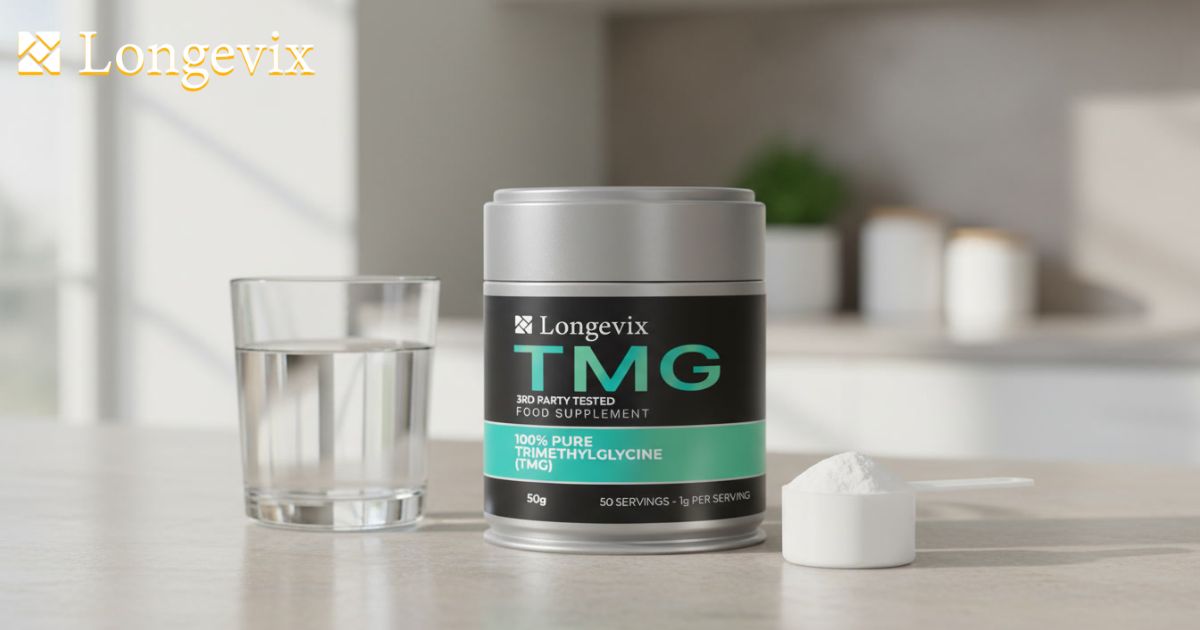
TMG stands for trimethylglycine and is commonly called betaine. In nutritional supplements, betaine anhydrous refers to the same core compound. Longevix Pure TMG Powder 50g contains trimethylglycine, described on the current product page as TMG/betaine anhydrous. Betaine HCl is a different form with a different use.

Athletes became interested because TMG performs two notable biological roles. It acts as a methyl donor and as an osmolyte that contributes to cellular water balance. These functions create plausible links with creatine metabolism, homocysteine metabolism, and exercise physiology. However, none independently proves improved training capacity in humans.
TMG, Betaine and Betaine Anhydrous Explained
Terminology can muddy the water. TMG means trimethylglycine while betaine anhydrous is the form commonly discussed in supplementation research. Betaine hydrochloride isn’t interchangeable. Longevix explains the distinction further in its Betaine Anhydrous Powder guide, which provides useful background for UK and US readers.
TMG, Methylation and Plasma Homocysteine
TMG donates methyl groups within one-carbon metabolism and supports conversion of homocysteine towards methionine through the BHMT pathway. Human studies show betaine can reduce plasma homocysteine under certain conditions. However, lower plasma homocysteine concentrations shouldn’t automatically be interpreted as improved athletic performance or reduced cardiovascular risk because those are separate clinical questions.
Readers seeking deeper methylation information can explore the Longevix Best Methylation Supplement guide. Keeping that discussion separate allows this article to focus on exercise outcomes instead of repeating Longevix’s broader methylation coverage.
How Could TMG Influence Exercise Performance?
TMG attracts sports researchers because several mechanisms could plausibly influence exercise. These include methyl-group metabolism, endogenous creatine synthesis, cellular hydration, and muscle-related signalling. Such pathways help scientists develop hypotheses. They don’t prove that swallowing TMG will automatically make somebody stronger, faster, or able to train for longer.

Think of exercise performance like a racing car. Improving one component may help, although the final lap depends on the whole machine. Your programme, nutrition, genetics, sleep, technique, recovery, and motivation all matter. Effective sports nutrition guidelines therefore rely on measurable human outcomes rather than attractive biochemical theories alone.
TMG and the Body's Natural Creatine Synthesis
Your body synthesises creatine through reactions that require methyl groups. TMG can contribute methyl groups within that wider metabolic network. This provides a credible biochemical connection between betaine and creatine metabolism. However, TMG doesn’t supply creatine directly. Taking TMG therefore isn’t equivalent to supplementing with creatine monohydrate.
Cellular Hydration and High-Intensity Exercise
TMG acts as an osmolyte, meaning it helps cells regulate water and solute balance. Researchers have considered whether this property could influence muscle function during high-intensity exercise. The idea remains biologically plausible. However, human performance studies don’t consistently show that osmolyte activity translates into better hydration-related exercise outcomes.
Mechanisms Don't Guarantee Better Results
A metabolic change becomes practically valuable only when it produces a meaningful outcome. Better methyl donation doesn’t automatically add kilograms to your squat. Likewise, changes inside muscle cells don’t automatically shorten sprint times. This gap between mechanism and outcome is why controlled human trials remain central to evidence-based sports nutrition.
What Does Human Research Say About TMG and Performance?
The strongest recent evidence comes from a 2024 systematic review and meta-analysis. Researchers included 17 studies with 317 participants and reported a significant pooled effect on maximal strength, particularly lower-body strength. Importantly, only 21% of included participants were female. That limits how confidently researchers can generalise every finding across sexes.
Earlier evidence was more cautious. A 2017 systematic review found that only two of seven qualifying studies reported improvements in strength or power while five reported no change. Newer research has strengthened the case for selected outcomes, although inconsistency remains. Scientific conclusions become stronger through replication rather than one impressive experiment. 2017 systematic review of betaine, strength and power
What the Latest TMG Meta-Analysis Found
The 2024 authors concluded that chronic supplementation significantly enhanced muscular strength, particularly lower-body strength. Context remains essential. Pooled results didn’t show significant benefits for upper-body strength, cycling sprint power, bench-throw power, or muscular endurance. Vertical-jump performance became significant after researchers excluded a lower-quality study.
Why TMG Studies Sometimes Disagree
Studies use different participants, doses, training backgrounds, exercise tests, diets, and supplementation periods. Sample sizes are often small. Those differences can change results substantially. Consequently, one experiment may report improved muscle strength and power while another finds little difference. Evidence synthesis helps place isolated findings into a more reliable overall picture.
TMG Exercise Research at a Glance
|
Evidence |
Participants or design |
TMG approach |
Main finding |
|
2024 systematic review and meta-analysis |
17 studies; 317 participants |
Chronic supplementation for at least seven days |
Maximal strength improved overall, especially lower-body strength; several other outcomes did not |
|
2017 systematic review |
Seven qualifying studies |
Varied protocols |
Two studies reported strength or power benefits; five found none |
|
Six-week resistance-training trial |
23 experienced strength-trained men |
2.5 g/day |
Investigated performance and body composition with some favourable composition findings |
|
Seven-day cycling study |
16 recreationally active adults |
About 2.5 g/day |
Selected sprint-power measures improved |
|
2025 endurance systematic review |
Five eligible studies |
Varied protocols |
Evidence remained sparse and all included studies had high risk of bias |
The table highlights a central point: “TMG works” is too broad a conclusion. Strength, jumping, sprinting, endurance, and muscular endurance tell different stories.
TMG for Muscle Strength, Power and Explosive Performance
Strength currently provides the most convincing exercise-related case for betaine supplementation. The latest pooled evidence favoured maximal strength and lower-body strength. Explosive power showed a less consistent pattern. That difference matters because muscle strength and power overlap physiologically, although they aren’t identical abilities or measured through identical tests.
Power combines force with speed. Researchers therefore examine jumps, throws, sprints, and cycling tests. Current evidence doesn’t demonstrate a uniform improvement in power output across those activities. Claims that TMG automatically makes an athlete faster or more explosive would therefore go beyond what the current research can reliably establish.

TMG and Lower-Body Muscle Strength
The 2024 meta-analysis found a significant effect on lower-body maximal strength. This gives TMG a credible performance signal, especially for research involving strength-based exercise. Still, pooled averages can’t predict your personal response. Training age, exercise selection, sleep, programme quality, nutrition, and baseline ability remain major influences on strength development.
Does TMG Improve Jumping Power?
Vertical-jump performance became statistically significant after researchers removed one low-quality study during sensitivity analysis. That is encouraging, although it also demonstrates why evidence quality matters. A potential ergogenic aid should earn confidence through repeated, high-quality results instead of relying on one favourable statistical outcome or isolated experiment.
What About Upper-Body Performance?
Upper-body evidence remains less convincing. The recent meta-analysis found no significant pooled improvement in upper-body maximal strength. Some individual studies have produced favourable repetition or training-volume findings, though these haven’t translated into a consistent overall effect. TMG may therefore influence particular tasks without producing a universal upper-body performance benefit.
Does TMG Help Endurance, Sprints or Muscular Endurance?
Endurance presents a weaker case. A 2025 systematic review found only five eligible studies examining endurance exercise performance. Some studies reported changes in physiological or performance measures. However, the reviewers rated every included study as having a high risk of bias, leaving the overall evidence too uncertain for a confident endurance claim.
That limitation matters because endurance isn’t interchangeable with sprint performance. Long-distance running, cycling, repeated football sprints, and a Wingate test place different demands on the body. Evidence from a brief anaerobic test cannot automatically establish better long-duration performance. The exercise protocol always shapes what a study can genuinely tell you.
TMG and Endurance Exercise Performance
Current evidence for endurance exercise performance remains insufficient for a firm conclusion. The 2025 review highlighted both the small number of studies and their methodological weaknesses. This doesn’t prove that TMG has no endurance effect. Instead, it means stronger, better-controlled human trials are needed before dependable recommendations become possible. 2025 systematic review of betaine and endurance performance
Study Case: Seven Days of TMG and Cycling Sprints
A double-blind crossover study involved 16 recreationally active adults who consumed approximately 2.5 grams of betaine daily for seven days. Researchers reported improvements in selected sprint-power measures. However, the later 2024 meta-analysis found no significant pooled effect on cycling sprint power. One positive trial therefore needs broader context.
TMG and Repeated Sprint Performance
Sports such as football, rugby, hockey, and basketball depend heavily on repeated sprint performance. That makes TMG an interesting research candidate. Yet available studies remain too heterogeneous to establish a reliable, sport-wide advantage. Good conditioning, adequate carbohydrate, recovery, and sport-specific training still have much stronger practical roles in repeated high-intensity efforts.
TMG and Muscular Endurance
Muscular endurance describes the ability to sustain repeated contractions against resistance. Individual trials have reported favourable repetition results. For example, a small study involving ten adolescent handball players found more repetitions after 14 days of supplementation. However, the larger 2024 pooled analysis didn’t establish a significant muscular-endurance effect overall.
Can TMG Affect Body Composition, Training Adaptation or Recovery?
TMG has also attracted claims involving fat loss, muscle gain, and recovery. Human studies have investigated body composition, fat mass, muscle size, and lean body mass. Some findings appear interesting, although the results aren’t consistent enough to describe TMG as a proven muscle-building or fat-loss supplement.
Training itself complicates interpretation. When every participant follows a structured resistance programme, both supplemented and placebo groups may improve. Researchers must determine whether TMG adds something beyond training. Similar caution applies when discussing resting energy expenditure, lipid metabolism, soreness, hormonal changes, or recovery because each is a separate biological outcome.
Study Case: Six Weeks of Resistance Training
A six-week trial followed 23 experienced strength-trained men during a periodised resistance programme. The supplemented group received 2.5 grams of betaine daily. Researchers assessed strength, training volume, jumping, and body composition. Some favourable composition findings emerged, although the small sample and single study design limit how broadly they should be applied. Six-week betaine resistance-training study
TMG, Recovery and Training Capacity
Recovery can mean muscle soreness, lower fatigue, restored performance, hormone changes, or improved biochemical markers. Those outcomes aren’t interchangeable. Current evidence doesn’t justify claiming that TMG reliably accelerates recovery after every workout. Better training capacity has appeared in selected experiments, although sleep, nutrition, and programme design remain far more established foundations.
Does TMG Raise Testosterone?
Some human studies have reported changes in testosterone after betaine supplementation. A 2022 crossover study involved only ten adolescent handball players while another trial involved CrossFit participants. These findings are interesting, but they don’t prove sustained testosterone elevation or greater long-term muscle growth. Acute hormonal responses shouldn’t become broad testosterone-boosting promises.
What About Resting Energy Expenditure?
Evidence doesn’t support treating TMG as a metabolic shortcut. In a 12-week trial involving 42 adults with obesity consuming a hypoenergetic diet, six grams of betaine daily didn’t improve resting energy expenditure or body composition beyond the control diet. Different populations and doses limit direct comparison with athletes, but the finding remains useful context.
How Much TMG Have Exercise Studies Used?
Many performance studies have investigated approximately 2.5 grams of betaine per day, although protocols vary. Some interventions lasted seven or fourteen days while others continued for several weeks or a competitive season. A research quantity answers a controlled scientific question. It shouldn’t automatically become personalised dosage advice for every athlete.

This distinction is particularly important for Longevix customers. The current Longevix Pure TMG Powder 50g product page lists a 1,000 mg serving using two included scoops and approximately 50 servings per tin. Its directions should not be replaced by quantities copied from unrelated research protocols.
Research Dose vs Product Serving
Research protocols and retail directions answer different questions. A trial may deliberately test a particular amount under controlled conditions. That doesn’t make the same amount suitable for personal use. Longevix currently lists a 1,000 mg labelled serving for its standalone TMG powder and instructs customers to follow the directions on the product label.
Does TMG Need to Be Taken Before Exercise?
Current evidence doesn’t establish a universal pre-workout timing window for TMG. Most relevant research investigates regular daily supplementation rather than a single dose taken moments before training. Claims such as taking TMG precisely 30 minutes before exercise therefore lack enough evidence to become a dependable timing rule.
How Long Before TMG Might Affect Performance?
The 2024 meta-analysis considered chronic supplementation lasting at least seven days. Individual trials have extended from roughly one week to several weeks or longer. TMG therefore differs from a fast-acting stimulant. Current performance research mainly evaluates repeated supplementation rather than an immediate increase after a single pre-workout serving.
TMG vs Creatine for Exercise Performance
TMG and creatine sometimes appear in the same conversation, although they aren’t equivalent. Creatine supplementation directly increases creatine availability while TMG participates in methyl metabolism connected with endogenous creatine synthesis. That biochemical relationship doesn’t give the two ingredients equal evidence for exercise performance or make one a substitute for the other.
Creatine has a considerably larger research base. A 2024 meta-analysis found that creatine combined with resistance training improved upper- and lower-body strength compared with placebo in adults under 50. Another 2024 analysis reported additional gains in lean body mass during resistance training. This evidence base currently exceeds that available for TMG.

Which Has Stronger Exercise Evidence?
Creatine monohydrate currently has stronger performance evidence. Numerous controlled studies and meta-analyses support its role alongside resistance training and short-duration, intense exercise. TMG remains an emerging candidate. Describing both as equally established ergogenic aids would therefore blur an important difference in the depth, consistency, and maturity of their research bases.
Can TMG and Creatine Be Used in the Same Formula?
Both ingredients can appear in one formula, although co-formulation doesn’t prove synergy. Longevix Creatine Vitality Gummies currently list creatine monohydrate alongside taurine, TMG, and vitamin B12. The website advises readers to check the latest physical label for individual active quantities rather than assuming unpublished amounts.
Readers comparing gummy formats can explore the Longevix Creatine Monohydrate Gummies guide. The guide explains why evidence for an ingredient doesn’t automatically verify every finished product containing it.
TMG vs Creatine Comparison
|
Question |
TMG / Betaine |
Creatine monohydrate |
|
Current performance evidence |
Emerging and mixed |
Large and comparatively established |
|
Strongest current signal |
Selected maximal-strength outcomes |
Strength and resistance-training adaptations |
|
Direct source of creatine |
No |
Yes |
|
Endurance evidence |
Limited and uncertain |
Not primarily used as an endurance supplement |
|
Current Longevix format |
Pure TMG Powder plus combination products |
Creatine Vitality Gummies |
|
Can both appear together? |
Yes |
Yes, although combination alone doesn’t prove synergy |
Creatine therefore has the stronger evidence base for exercise performance. TMG remains scientifically interesting and may fit into a broader supplement discussion, although present evidence doesn’t support treating it as a direct creatine replacement.
Is TMG Safe for People Who Exercise Regularly?
Being physically active doesn’t automatically make every supplement suitable. Dose, medicines, health history, diet, and other products still matter. Research has reported digestive tolerance issues in some settings, while higher-dose studies have investigated changes in blood lipids. Safety deserves the same evidential care as performance claims.
Stacking deserves particular attention. Longevix currently lists TMG in standalone Pure TMG Powder, NR + TMG Capsules, and Creatine Vitality Gummies. Using several products could therefore increase total intake without the user noticing. More ingredients don’t automatically produce better sports nutrition. Read every current label before combining supplements.
TMG, Homocysteine and Lipids
A 21-day trial in physically active men found lower homocysteine without significant changes in measured blood lipids at 2.5 or 5 grams daily. However, older higher-dose studies and a meta-analysis involving at least four grams daily raised concerns about total cholesterol. Dose, duration, and participant characteristics therefore matter.
Who Should Take Extra Care?
People who are pregnant, breastfeeding, taking medicines, or managing a medical condition should seek individual professional advice before using supplements. This is particularly sensible when lipid or metabolic concerns already exist. Copying a dose from an athletic study ignores personal circumstances and turns research methodology into advice it was never designed to provide.
For more detail, see the Longevix TMG Supplement Side Effects guide. It provides broader safety context without forcing that material into an exercise-focused article.
Is TMG Worth Taking for Exercise Performance?
TMG deserves scientific interest without exaggerated expectations. The strongest current evidence suggests a modest potential benefit for selected maximal-strength outcomes, particularly lower-body strength. Evidence remains less convincing for upper-body strength, cycling sprint power, muscular endurance, and endurance exercise. Calling it universally effective would therefore oversimplify a genuinely mixed research picture.
Training fundamentals still carry most of the weight. Progressive programming, adequate energy, protein, hydration, sleep, and recovery shape performance every day. Supplements sit around those foundations rather than replacing them. TMG may be considered a possible adjuvant for exercise performance, but current evidence supports realistic expectations rather than promises of dramatic results.
Where Longevix Pure TMG Powder Fits
Longevix currently offers Pure Trimethylglycine TMG Powder 50g as a standalone powder. The live product page lists TMG/betaine anhydrous, a 1,000 mg serving using two scoops, and approximately 50 servings. A testing document is also linked and should be matched with the product and batch on the pack.
The Evidence-Based Verdict on TMG and Exercise Performance
TMG isn’t merely hype, although it isn’t proven to enhance every athletic outcome. Current evidence gives its strongest support to selected strength measures. Describing it as a potential adjuvant for exercise performance is therefore more accurate than presenting it as a guaranteed performance booster. Good evidence leaves room for uncertainty when uncertainty genuinely exists.
For athletes in the USA and UK, the practical message remains simple. Follow the current product label, consider the full supplement stack, and keep expectations realistic. Judge TMG through controlled human outcomes rather than appealing biochemical theories. A careful answer may sound less dramatic, yet it gives readers far more useful information.
Frequently asked questions
Does TMG Improve Exercise Performance?
TMG may support some measures of muscle strength, particularly lower-body maximal strength. However, evidence for sprinting, muscular endurance, upper-body strength, and overall athletic performance remains mixed. The best description is therefore “promising for selected outcomes” rather than “proven to improve all exercise performance”.
How Much TMG Should I Take for Performance?
Many exercise studies have investigated approximately 2.5 grams daily, although protocols differ. Research doses are not personalised recommendations. Longevix Pure TMG Powder currently has a labelled serving of 1,000 mg using two scoops. Follow the current product label and seek professional advice when individual health considerations apply.
What Are the Benefits of TMG for Muscle Strength and Power?
The strongest current pooled evidence suggests a modest improvement in maximal strength, particularly lower-body strength. Evidence for explosive power is less consistent. Vertical jumping shows some promise, while several other power measures haven’t improved significantly. TMG should therefore not be presented as a guaranteed strength or power output booster.
Is TMG the Same as Betaine Anhydrous?
Yes, in this nutritional context. Trimethylglycine (TMG) is commonly called betaine, while betaine anhydrous refers to the supplement form discussed here. It shouldn’t be confused with betaine hydrochloride, or betaine HCl, which is a different compound used for a different nutritional purpose.
Does TMG Increase Testosterone or Help with Muscle Recovery?
Small studies have reported testosterone or exercise-response changes after betaine supplementation. However, those trials cannot establish reliable long-term testosterone enhancement or faster recovery for everyone. Recovery also includes soreness, fatigue, restored performance, and other outcomes. Current evidence is too limited to promise a consistent recovery or hormonal benefit.