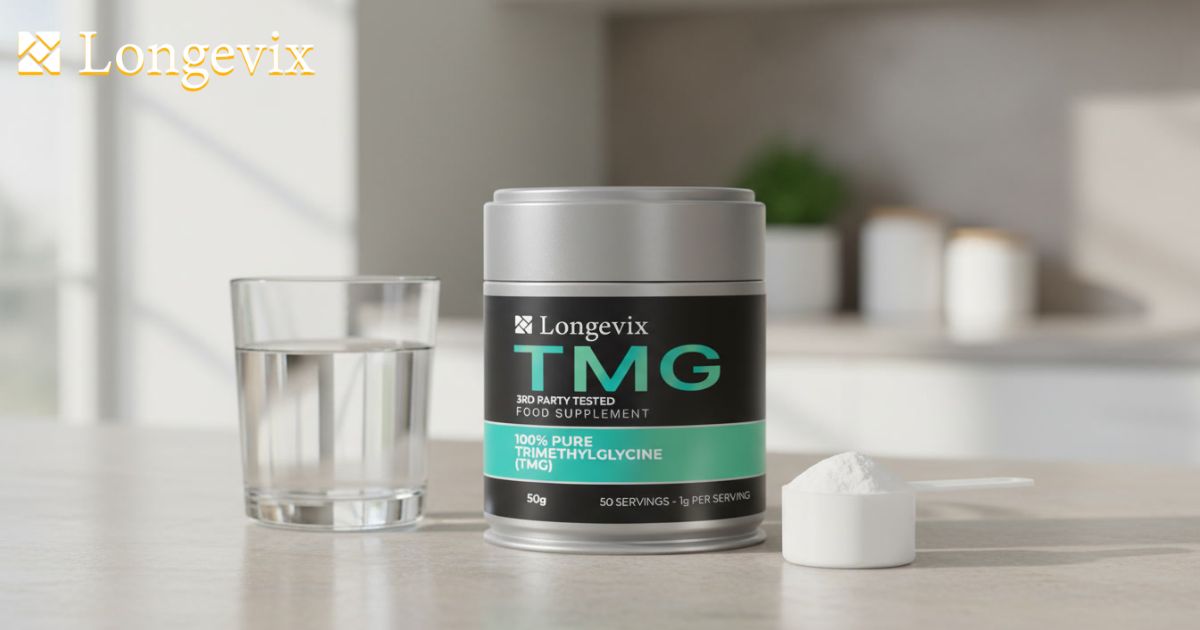
TMG supplement benefits sound impressive, but the strongest evidence is narrower than many headlines suggest. TMG, or trimethylglycine, is also called betaine or glycine betaine. It acts as a methyl donor, helping move methyl groups through pathways involved in normal metabolism. Human research most consistently supports its effect on homocysteine, while findings for exercise, liver health, body composition, mood, and longevity remain less certain.
This guide separates established biology from emerging claims, explains food and supplement sources, and shows how Longevix TMG formats differ. You’ll also learn about dosage research, UK claim rules, safety, testing, and supplement quality, so you can make an evidence-led choice without falling for marketing hype.
What Is TMG and Why Does It Matter?
TMG is a naturally occurring compound that your body can obtain from food or make from choline. Chemically, it resembles glycine carrying three methyl groups. That seemingly small detail gives TMG an important biochemical role because those groups can move between molecules during methylation reactions involved in normal cellular chemistry.
Food supplies TMG naturally, while supplements provide a measured amount in powders, capsules, tablets, or blends. That distinction matters. A concentrated TMG supplement can produce intakes different from an ordinary balanced diet, so research findings, product directions, and individual health circumstances deserve consideration before supplement use.
TMG, Betaine Anhydrous, and Betaine HCl
In nutrition research, trimethylglycine, betaine, and betaine anhydrous generally describe the same core compound. Betaine HCl is different and shouldn't be treated as interchangeable. Longevix's current Pure TMG Powder lists “Trimethylglycine (TMG/Betaine Anhydrous)” as its ingredient. Its dedicated betaine guide explains this distinction further. Read the Longevix Betaine Anhydrous Powder guide
How TMG Works in Methylation and Homocysteine Metabolism
TMG participates in one-carbon chemistry by donating a methyl group. This reaction helps convert homocysteine back towards methionine through betaine-homocysteine methyltransferase, usually shortened to BHMT. This biochemical pathway contributes to normal metabolism. However, demonstrating a pathway doesn't automatically prove every marketed TMG health benefit.
That distinction protects you from a common supplement trap. Interesting biology may explain why researchers investigate something, yet clinical outcomes require separate evidence. TMG's role in methylation is established chemistry. Claims involving longevity, cognition, weight loss, disease prevention, or broad improvements in cell function require their own properly controlled human studies.
The BHMT Pathway in Plain English
Picture homocysteine at a metabolic crossroads. TMG gives away one methyl group through BHMT, helping remethylate homocysteine towards methionine. TMG becomes dimethylglycine during that process. This mechanism helps explain why human trials repeatedly examine betaine supplementation and blood homocysteine rather than treating methylation as an abstract wellness buzzword.
TMG Supplement Benefits: What Human Evidence Supports
The strongest evidence behind TMG supplement benefits concerns homocysteine metabolism. A 2013 meta-analysis of five randomised placebo-controlled trials found a pooled reduction of 1.23 µmol/L in plasma homocysteine. Those studies used at least 4g daily for six to 24 weeks, which describes research protocols rather than personal dosage advice.
Researchers have also investigated exercise performance, strength, endurance, body composition, and metabolic outcomes. The picture is considerably less uniform. That matters when comparing search-result headlines. A benefit observed for one biomarker or strength test shouldn't silently become a promise covering heart health, endurance, fat loss, recovery, cognition, or longevity.
Homocysteine: The Best-Established Effect
The evidence for reducing plasma homocysteine is more consistent than evidence for most other proposed TMG outcomes. The authorised European betaine claim states, “Betaine contributes to normal homocysteine metabolism.” Its conditions matter just as much as the wording itself, especially when discussing supplements for UK readers.
Exercise Performance: Promising but Mixed
A 2024 systematic review and meta-analysis included 17 studies and 317 participants. It found an overall effect on maximal strength, particularly lower-body strength. However, no significant effect appeared for upper-body strength, cycling sprint power, bench-throw power, or muscular endurance. Longevix explores these nuances separately in its exercise-focused guide.

Research Case Study: What the Meta-Analyses Found
Two pooled analyses tell a useful story. Homocysteine fell consistently across older controlled trials, while modern sports research produced outcome-specific effects rather than universal performance gains. A 2025 endurance review found only five eligible studies and judged all included studies at high risk of bias. Evidence strength therefore depends heavily on the question being asked.
|
Research area |
What human evidence currently suggests |
Important limitation |
|
Homocysteine |
Consistent reductions appear in controlled supplementation studies |
A biomarker change doesn't itself prove fewer cardiovascular events |
|
Maximal strength |
A 2024 meta-analysis found a modest positive effect |
Several other performance outcomes were unchanged |
|
Endurance |
Some individual signals have appeared |
Only five studies qualified for a 2025 review and all had high risk of bias |
|
Blood lipids |
Higher-dose research raises a safety consideration |
Effects vary by dose, population and study design |
|
Longevity |
Biochemical hypotheses exist |
No convincing evidence establishes longer human lifespan |
What TMG Does Not Yet Prove
Good supplement science becomes more useful when it says where evidence ends. Reducing homocysteine doesn't prove that a TMG supplement prevents heart attacks or extends life. Similarly, a possible change in muscle strength doesn't establish superior health, faster recovery, sustained fat loss, or better athletic results across every sport.
The same restraint applies to liver metabolism. Betaine has attracted significant research interest in liver biology, yet mechanistic, animal, observational, and small human studies shouldn't be blended into one sweeping clinical promise. UK food-supplement guidance also prohibits presenting supplements as products that prevent, treat, or cure medical conditions.
Heart Disease, Weight Loss, Longevity, Mood and Sleep
TMG remains scientifically interesting across several areas, but interest isn't proof. Current research doesn't justify treating ordinary TMG supplementation as a proven therapy for cardiovascular disease, obesity, depression, insomnia, or biological ageing. Separating plausible mechanisms from demonstrated human outcomes produces less dramatic copy, yet it gives you far better information for a real decision.
TMG Food Sources vs Supplements
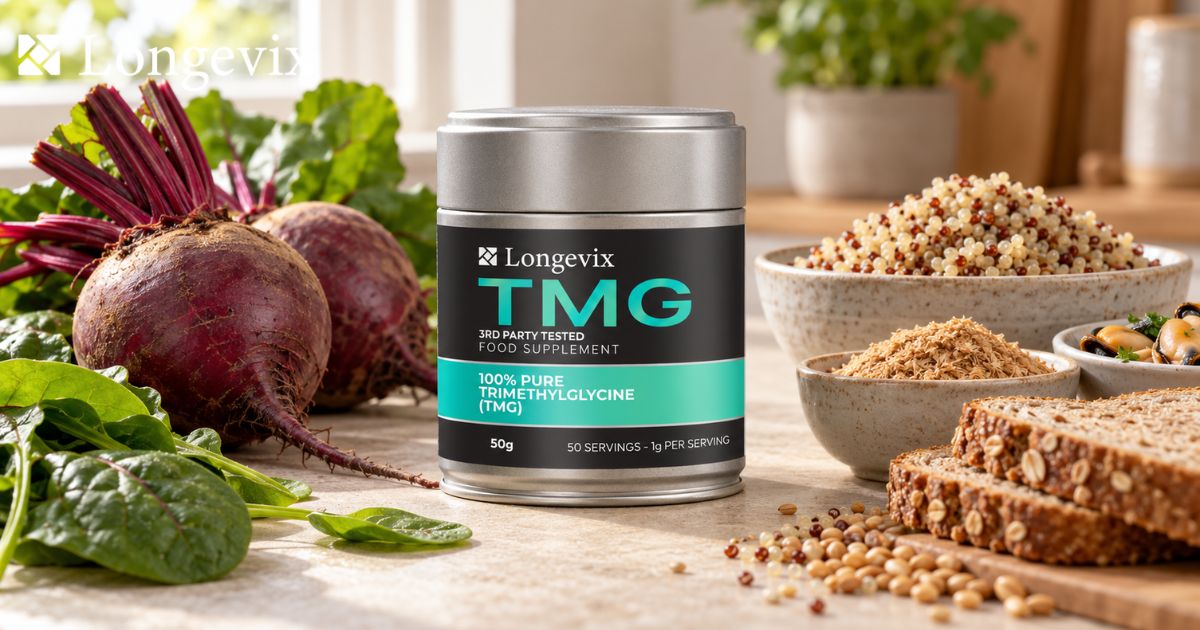
You don't need a supplement to encounter TMG. Natural sources include beetroot, spinach, cereals, grains, and several animal foods. Your body can also form betaine from choline. Food therefore remains part of the picture even when supplements offer a simpler way to know approximately how much TMG a labelled serving provides.
Processing can alter food betaine content, while individual diets vary enormously. Foods also provide nutrients beyond TMG. This makes the choice less like “food versus supplement” and more like comparing two different nutritional contexts. Supplements provide concentration and convenience; whole foods contribute TMG within a broader dietary matrix.
Beetroot, Whole Grains, Shellfish and Other Sources
Common dietary sources include whole grains, shellfish, wheat bran, wheat germ, and quinoa alongside beetroot and spinach. That range explains why TMG intake can differ substantially between eating patterns. Someone eating varied plant and animal foods may already encounter meaningful dietary betaine without consciously seeking it.
|
Source |
Form of exposure |
Practical distinction |
|
Beetroot and spinach |
Whole food |
TMG comes with the wider food matrix |
|
Wheat bran and wheat germ |
Grain-based food |
Intake depends on portion and processing |
|
Quinoa and whole grains |
Dietary source |
Useful within an overall varied diet |
|
Shellfish |
Animal-food source |
Amount depends on species and serving |
|
TMG powder or capsules |
Concentrated supplement |
Label provides a defined serving |
TMG Dosage: Research Amounts vs Product Directions
Research doses aren't ready-made personal prescriptions. Human TMG studies have used different quantities, populations, durations, and endpoints. Copying the largest number from a study ignores those differences. For a commercial supplement, the sensible starting point remains the current product label and professional advice when medical circumstances make supplementation more complex.
This distinction is especially important with Longevix. Its current lists a 1,000mg serving using two included scoops. The product provides approximately 50 labelled servings. Those directions should not be replaced with amounts borrowed from unrelated clinical or sports studies.
The UK Homocysteine Claim and Its 1.5g Condition
The authorised betaine claim requires at least 500mg per quantified portion and says the beneficial effect comes with 1.5g daily. It also requires a warning that intake above 4g daily may significantly increase blood cholesterol. This cholesterol condition is regulatory context, not permission to exceed a product's labelled directions.
TMG Safety, Side Effects and Who Should Take Extra Care
TMG isn't automatically risk-free because it occurs naturally. Reported problems can include digestive discomfort, nausea, diarrhoea, bloating, or stomach upset, particularly as intake rises. Higher-dose research also makes blood lipids relevant. A 2021 meta-analysis found that at least 4g daily for six weeks or longer moderately increased total cholesterol.
Another cardiovascular-marker meta-analysis found increases in total and LDL cholesterol alongside lower homocysteine. That combination shows why one favourable biomarker shouldn't be viewed in isolation. If you're pregnant, breastfeeding, using medication, or managing a medical condition, Longevix itself advises consulting an appropriately qualified healthcare professional before use.
Cholesterol, Digestion and Personal Health Factors
Your existing diet, medication, medical history, other supplements, and total daily intake all influence context. People using prescription treatment for homocystinuria need medical management rather than retail-supplement experimentation. For ordinary supplement use, persistent adverse effects deserve attention rather than the assumption that “natural” automatically means harmless.
How Longevix TMG Products Fit Different Routines
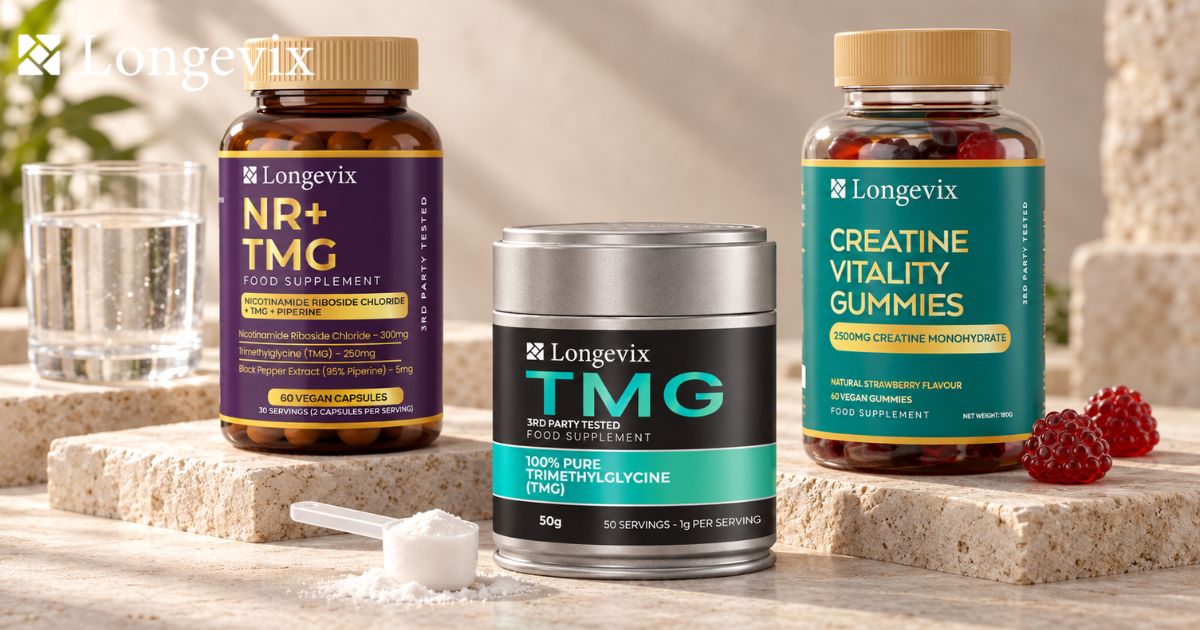
Longevix currently offers TMG in three different contexts: a standalone powder, fixed NR + TMG capsules, and Creatine Vitality Gummies containing TMG among other ingredients. Those formats differ in composition and convenience. They shouldn't be presented as clinically equivalent or as proven to deliver identical outcomes.
Choosing between them starts with reading the formulation rather than chasing the biggest-looking claim. A standalone powder provides TMG without NR or creatine. The capsule combines TMG with NR and piperine. The gummy combines TMG with creatine monohydrate, taurine, and vitamin B12. Each therefore occupies a different practical role.
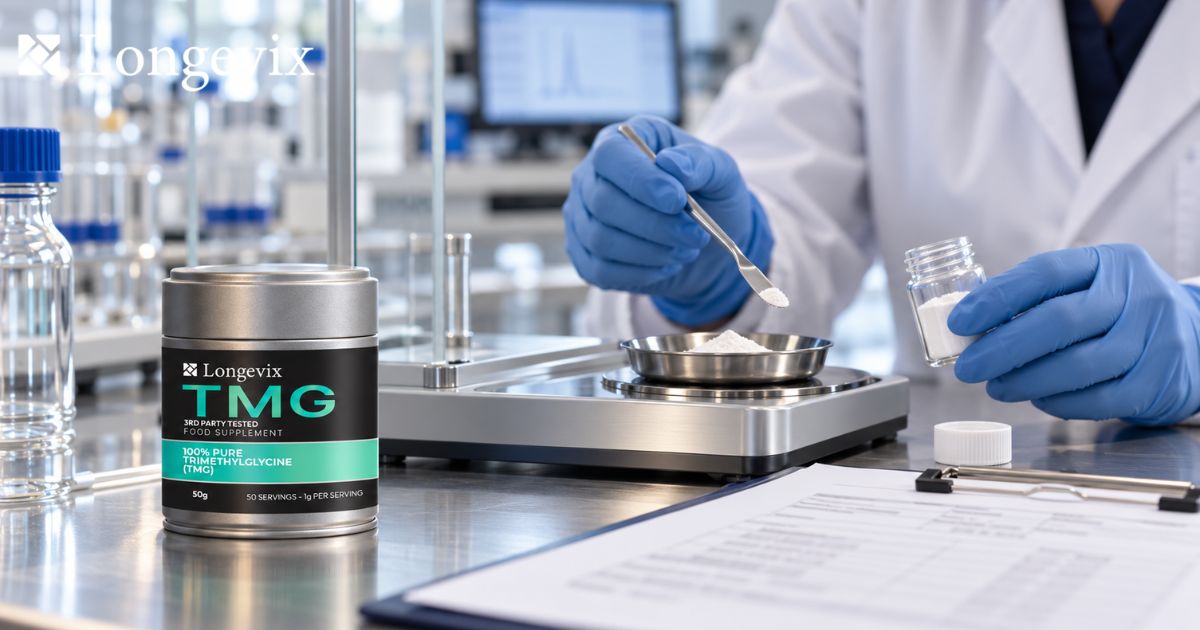
Longevix Pure TMG Powder 50g
contains TMG/betaine anhydrous. The current page lists a 1,000mg serving using two scoops and approximately 50 servings. A batch-specific testing document is linked from the product record, giving buyers another source of product-specific information beyond marketing copy.
Longevix NR + TMG Capsules
contain 300mg nicotinamide riboside, 250mg TMG, and 5mg piperine per two-capsule serving. The bottle contains 60 capsules, providing 30 labelled servings. For the evidence behind combining these ingredients, Longevix has a dedicated .
Longevix Creatine Vitality Gummies
list creatine monohydrate, TMG, taurine, and vitamin B12. The bottle contains 60 gummies, equal to 15 four-gummy servings. Because the webpage directs readers to the physical label for complete quantities, unsupported ingredient amounts shouldn't be invented or borrowed from another product.
|
Longevix format |
Verified TMG context |
Labelled serving information |
|
Pure TMG Powder 50g |
Standalone TMG/betaine anhydrous |
1,000mg TMG using two scoops |
|
NR + TMG Capsules |
TMG with NR and piperine |
Two capsules provide 250mg TMG |
|
Creatine Vitality Gummies |
TMG with creatine, taurine and B12 |
Four-gummy serving; check label for complete ingredient quantities |
How to Choose a High-Quality TMG Supplement
A polished label can't replace traceable product information. Start by checking the exact ingredient name, amount per serving, directions, warnings, and complete product label. Strong supplement quality assessment also asks whether testing information actually belongs to the product and batch you have, rather than assuming one certificate covers every item indefinitely.
Longevix makes testing documentation available for relevant products, including its Pure TMG Powder. However, a laboratory document only proves what its reported tests actually examined. It doesn't automatically prove clinical effectiveness. The Longevix guide to explains that distinction in greater depth.
Labels, Third-Party Testing and Traceability
Useful third-party testing should create a traceable paper trail. Check the product identity, batch or lot information, tests performed, reported values, units, specifications, and laboratory details. Longevix specifically advises customers to match testing documents with the product and batch printed on their own pack.
Can TMG Be Taken with NR, NMN, Creatine or B Vitamins?
TMG is frequently discussed beside NR, NMN, creatine, folate, B12, and other methylation-related nutrients. Biochemical relationships can explain why researchers or formulators consider those combinations. However, a plausible pairing doesn't prove clinical synergy. Each combination needs evidence for the particular outcome being claimed.
That caution is especially useful with longevity stacks. Taking more products doesn't automatically create a stronger result. Instead, review the full ingredient list and total TMG exposure. Longevix already places TMG with NR in capsules and alongside creatine in its gummies, while its standalone powder provides a separate format.
Avoiding Duplicate TMG Across a Supplement Stack
Stacking products can quietly duplicate the same ingredient. Someone using standalone TMG plus an NR/TMG formula and another TMG-containing product should calculate their complete intake from current labels. The relevant question isn't simply whether two supplements “work together.” It is also how much of each ingredient the combined routine actually provides.
Further Reading and Source Context
These external resources provide background or regulatory context. They do not prove that a particular Longevix product produces the health outcomes discussed above.
Frequently asked questions
What are TMG supplements used for?
TMG supplements provide concentrated trimethylglycine. Research most clearly supports TMG's role in homocysteine metabolism, while strength, endurance, metabolic, liver, mood, and longevity outcomes have different and generally less certain levels of evidence.
Is TMG anti-inflammatory?
Research has explored relationships between betaine and inflammatory markers, but that doesn't establish an authorised general anti-inflammatory benefit for ordinary TMG supplements. Treat inflammation claims cautiously and distinguish experimental findings from approved health claims.
Does TMG affect sleep?
Evidence isn't strong enough to recommend TMG as a sleep supplement. Some observational or emerging research has explored betaine and sleep-related outcomes, but that cannot establish that taking a TMG supplement reliably improves sleep.
Should you take TMG in the morning or night?
Current evidence doesn't establish one universally superior time of day. Follow the directions on the specific product you use rather than assuming a morning or evening rule applies to every formulation.
Is betaine the same as TMG?
Yes, when discussing nutritional betaine or betaine anhydrous, the terms usually refer to trimethylglycine. Betaine HCl is different and shouldn't be treated as interchangeable with the TMG/betaine anhydrous used in nutritional research.