Nicotinamide riboside side effects are an important consideration for anyone exploring NR supplements. Human clinical trials have generally found nicotinamide riboside (NR) to be reasonably well tolerated over the periods studied, although some participants have reported nausea, muscle discomfort and other unwanted symptoms. Importantly, these symptoms have not always been shown to be caused by NR itself.
The longer-term picture is more complicated. Recent research provides valuable new safety information, but it does not establish that NR is suitable for everyone or that increasing NAD+ levels improves health.
This guide examines reported side effects, major clinical trials, potential interactions, long-term uncertainties and the UK regulations that matter when considering NR supplements.
What Are the Possible Side Effects of Nicotinamide Riboside?
Nicotinamide riboside is a vitamin B3-related compound that the body can use to produce nicotinamide adenine dinucleotide (NAD+). NAD+ participates in cellular energy metabolism and other essential biochemical processes.
NR supplements have attracted attention because several human trials have demonstrated increases in blood NAD+ concentrations following supplementation. However, changes in these biological markers do not automatically establish wider health benefits or long-term safety.
Most published clinical studies suggest that NR is reasonably well tolerated in selected participants during relatively short periods. Nevertheless, adverse events have been recorded, and individual responses can vary.
Digestive Discomfort, Nausea and Other Reported Symptoms
Nausea and gastrointestinal discomfort are among the symptoms recorded in NR research.
In an eight-week randomised controlled trial published in 2019, researchers investigated daily NR chloride amounts of 100 mg, 300 mg and 1,000 mg alongside placebo.
Some participants reported nausea, muscle pain or soreness. However, adverse-event patterns were broadly similar across groups, and the researchers did not identify a significant difference in overall adverse-event incidence between NR and placebo.
The findings suggest reasonable tolerability under the study conditions, rather than proving that NR cannot cause digestive symptoms.
Read the 2019 clinical trial in Scientific Reports.

Headaches, Muscle Discomfort and Other Symptoms
Headaches are sometimes mentioned in discussions of NR supplementation, but controlled clinical evidence does not establish a reliable general-population frequency for NR-caused headaches.
Muscle discomfort has been documented more specifically.
In the 2019 study, investigators classified some reports of leg pain, muscle pain, muscle soreness and nausea as possibly related to NR. These events were mild and resolved during the study period.
Blood pressure changes have also been recorded in clinical investigations. However, the evidence does not establish that NR consistently increases blood pressure in otherwise healthy adults.
An isolated symptom should not be treated as proof of causation. Medical history, medicines, other supplements and unrelated health problems can influence how someone feels.
Reported Adverse Events Versus Proven Side Effects
There is an important distinction between an adverse event and a confirmed side effect.
An adverse event is an unwanted medical occurrence reported during a study. It may happen because of the treatment, but it may also arise independently.
For example, if participants taking NR and participants taking placebo report nausea at similar rates, researchers cannot simply attribute every case to NR.
This distinction matters when reading supplement reviews, clinical trial results and claims about ingredient safety.
|
Reported concern |
What the human evidence indicates |
Important limitation |
|---|---|---|
|
Nausea or digestive discomfort |
Reported during NR trials |
Not consistently more frequent than placebo |
|
Muscle pain or soreness |
Some mild events assessed as possibly related to NR |
No established general-population frequency |
|
Headaches |
Discussed as a possible complaint |
Causation and frequency remain uncertain |
|
Blood pressure changes |
Recorded in clinical studies |
No consistent effect established across populations |
|
Serious adverse events |
Reported in longer trials involving clinical populations |
An event occurring during treatment does not necessarily mean NR caused it |
The most useful conclusion is that NR has demonstrated reasonable tolerability in several controlled trials, while individual adverse reactions and uncommon risks cannot be ruled out.
What Do Human Clinical Trials Tell Us About NR Safety?
Clinical trials provide more reliable information than testimonials because they can compare participants receiving NR with those receiving an inactive placebo.
However, study duration, participant characteristics and the outcomes measured all affect how confidently the findings can be applied to everyday supplement use.

Short-Term Placebo-Controlled Trials
A 2018 study published in Nature Communications investigated NR supplementation in 30 healthy middle-aged and older adults.
Participants received NR or placebo during six-week treatment periods in a crossover study.
The researchers observed increased NAD+ concentrations and generally favourable tolerability. No serious adverse events were reported during the intervention.
However, the study was small, and six weeks cannot establish long-term safety.
Read the Martens et al. clinical study.
The larger 2019 study involving 140 participants provided additional information about different research amounts over eight weeks.
Researchers found no statistically significant differences in adverse-event incidence between the NR groups and placebo. They also reported no flushing events.
The study offers useful evidence about short-term NR chloride tolerability, although the participants were selected according to eligibility criteria that excluded several medical conditions.
High-Dose Research and Its Limitations
A 2023 study called NR-SAFE examined NR in 20 participants with Parkinson's disease.
Ten participants received 3,000 mg daily, divided into two doses, while ten received placebo for four weeks.
The investigators did not identify a significant difference in moderate or severe adverse-event frequency between the groups.
However, this was a small, short phase I trial involving people with a specific medical condition.
It cannot establish that the same amount is appropriate for consumer supplementation or that taking high amounts for years is safe.
The 2026 NOPARK Study: Important New Evidence
One of the most significant recent developments is the NOPARK randomised clinical trial, published in JAMA on 8 October 2026.
The researchers enrolled 410 participants with early Parkinson's disease. Participants received either 1,000 mg of NR daily or placebo for 52 weeks.
The findings deserve attention for two separate reasons.
First, the overall frequency of reported adverse events was similar between groups:
· NR group: 54.6% of participants experienced at least one adverse event.
· Placebo group: 53.7% experienced at least one adverse event.
Serious adverse events were recorded in 8.3% of the NR group and 14.1% of the placebo group. The study did not find a statistically significant difference in overall adverse-event rates.
Second, the trial did not demonstrate the expected clinical benefit. Participants receiving NR had modestly worse outcomes on the primary Parkinson's assessment than those receiving placebo.
The difference was smaller than commonly used thresholds for a clinically important change, but it was statistically significant.
This is an important reminder that a supplement can influence biochemical markers without improving the clinical outcomes researchers are trying to measure.
The results do not prove that NR produces equivalent effects in healthy adults. They also do not establish that NR causes a particular common side effect in the general population.
However, the study challenges overly confident claims about NR effectiveness and provides valuable longer-duration safety evidence.
Read the NOPARK trial in JAMA.
Is Nicotinamide Riboside Safe for Long-Term Use?
Long-term safety remains an area of uncertainty.
Many earlier NR studies lasted between several weeks and three months. Those investigations help researchers understand short-term tolerability but cannot reliably identify every effect associated with repeated supplementation over several years.
The 52-week NOPARK study substantially extends the available human evidence. Nevertheless, its participants had early Parkinson's disease, and its findings cannot automatically be applied to otherwise healthy adults.
Long-term questions include whether NR supplementation affects metabolic regulation, how sustained changes in NAD-related compounds influence different tissues, and whether uncommon adverse effects become apparent after prolonged exposure.
Researchers also need to distinguish the effects of NR itself from those of accompanying ingredients in commercial formulations.
A supplement being described as well tolerated in clinical trials should therefore be understood within the circumstances studied.
It does not mean that the product has been proven safe for every age group, medical condition, medicine combination or duration of use.
Why Changes in NAD+ Levels Do Not Prove Health Benefits
NAD+ is essential for normal cellular functions, including energy metabolism and pathways involved in cellular maintenance.
NR can contribute to NAD+ production, and some clinical studies have measured increases in blood NAD+ following supplementation.
However, blood NAD+ concentrations are biochemical measurements rather than direct evidence of improved wellbeing.
An increase does not automatically mean better memory, greater physical energy, improved DNA repair, slower biological ageing or increased lifespan.
Each proposed benefit requires separate, appropriately designed human research.
For a wider examination of these findings, read Longevix's guide to nicotinamide riboside benefits.
Does the Amount of NR Affect Side-Effect Risk?
The amount of NR being studied is relevant when interpreting adverse events, although the relationship between intake and side-effect risk is not fully understood.
Researchers have investigated different amounts of NR, sometimes substantially higher than those authorised for general supplement use in Great Britain.
The 2019 eight-week trial did not find a clear dose-dependent pattern in adverse-event incidence across the tested groups.
However, this does not prove that progressively larger amounts carry no additional risks.
Smaller trials may not detect uncommon problems, and short investigations cannot establish the consequences of prolonged exposure.
Research Amounts Are Not Consumer Recommendations
Clinical researchers may investigate high amounts under controlled conditions involving participant screening, medical supervision and specified safety assessments.
These research protocols are designed to answer scientific questions.
They should not be interpreted as recommendations for people purchasing supplements.
For example, a study reporting reasonable tolerability at 1,000 mg does not demonstrate that this amount is authorised for general daily supplement use in Great Britain.
The distinction between research amounts and regulatory conditions is particularly important for NR because Great Britain has specific novel-food authorisation requirements.
Readers looking for more detail can consult the Longevix nicotinamide riboside dosage guide.
Who Should Be Especially Careful With NR Supplements?
Although several studies suggest reasonable tolerability under controlled conditions, certain people need additional care before considering supplementation.
This is particularly relevant when medical conditions, prescription medicines or multiple supplements may influence the overall risk.

People Taking Prescription Medicines
The potential interactions between NR and prescription medicines have not been systematically investigated across all major medication categories.
A lack of established interactions should not be interpreted as proof that none exist.
People using medicines for blood pressure, blood glucose management or other chronic conditions should discuss supplement use with a pharmacist or healthcare professional.
This is particularly important when the product contains additional active compounds.
For example, a formula containing NR and piperine cannot be assessed solely using research on NR chloride. Piperine may affect the handling of some medicines, and the relevance depends on the particular medicine, formulation and amount.
Do not stop, reduce or change prescribed medication simply because you are considering an NR supplement.
Pregnancy and Breastfeeding
Evidence about NR supplementation during pregnancy and breastfeeding remains limited.
Great Britain's novel-food authorisation includes specific conditions relating to nicotinamide riboside chloride in these populations, but regulatory inclusion should not be interpreted as a recommendation for individual use.
Pregnant or breastfeeding individuals should obtain advice from an appropriately qualified healthcare professional before considering NR supplements.
The same caution applies when the product contains multiple active ingredients whose combined safety has not been adequately investigated.
People With Existing Medical Conditions
Individuals with liver disease, kidney disease, significant metabolic disorders or other ongoing medical conditions should seek professional advice before using NR supplements.
Some trials have excluded participants with particular health problems, which limits how widely their findings can be generalised.
Clinical studies involving people with a defined medical condition also do not automatically establish safety for people with a different condition.
Individual medical circumstances matter more than broad statements that an ingredient is suitable for everyone.
Nicotinamide Riboside Versus Niacin: Are the Side Effects the Same?
NR, nicotinic acid and nicotinamide are related to vitamin B3 metabolism, but they are chemically distinct.
This distinction matters because their adverse-effect profiles should not be assumed to be identical.
Nicotinic acid, commonly called niacin, can produce flushing at higher supplemental amounts. This may involve warmth, redness, itching or tingling.
NR is not typically associated with the characteristic flushing produced by nicotinic acid. In the 2019 NR trial, researchers reported no flushing events.
Nicotinamide, also known as niacinamide, likewise does not typically cause nicotinic-acid-style flushing, although high supplemental intakes can produce other adverse effects.
|
Compound |
Relationship to vitamin B3 |
Important safety distinction |
|---|---|---|
|
Nicotinamide riboside (NR) |
NAD+ precursor |
Human evidence suggests generally reasonable short-term tolerability; long-term uncertainties remain |
|
Nicotinic acid (niacin) |
Established form of vitamin B3 |
Higher supplemental amounts can produce flushing and other dose-related adverse effects |
|
Nicotinamide (niacinamide) |
Form of vitamin B3 |
Usually does not cause characteristic nicotinic-acid flushing; high intakes have separate safety considerations |
It would therefore be misleading to claim that NR routinely causes every side effect associated with high-dose nicotinic acid.
For a more detailed ingredient comparison, see nicotinamide riboside vs niacinamide.
Understanding NR Safety in Different Supplement Formulas
Not every supplement marketed for NAD+ support contains the same ingredients.
Some products contain a single NR compound, while others combine NR with additional substances.
Understanding the difference is essential because clinical studies involving isolated NR cannot establish the safety of every commercial formulation containing it.

Pure Nicotinamide Riboside Powder
Longevix Pure Nicotinamide Riboside Powder 50g is listed as a powder containing nicotinamide riboside chloride.
The website currently specifies a 1,000 mg serving.
This listing requires particular regulatory attention because the Great Britain authorisation for nicotinamide riboside chloride specifies a maximum of 300 mg/day for the general adult supplement category, excluding pregnant and breastfeeding women.
The higher listed serving should not be treated as a UK-compliant consumer recommendation without formal product and regulatory verification.
NR With TMG and Piperine
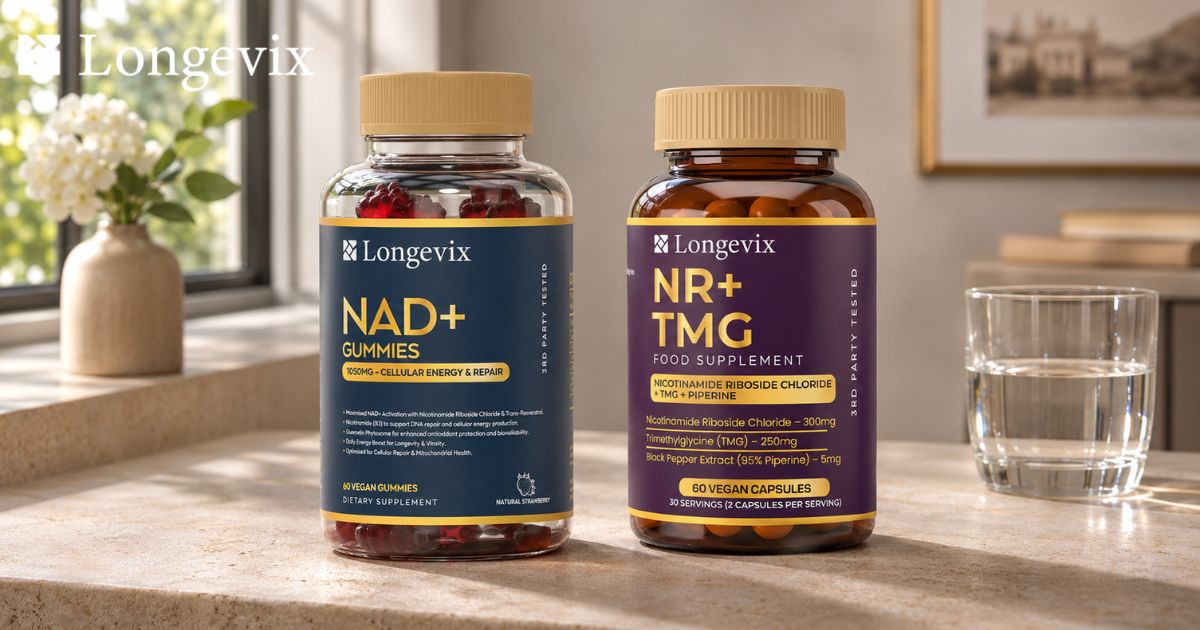
Longevix NR + TMG Capsules contain three listed active ingredients.
According to the product page, two capsules provide:
· 300 mg nicotinamide riboside
· 250 mg trimethylglycine (TMG)
· 5 mg piperine
The presence of additional compounds makes the complete formulation relevant to safety assessment.
TMG participates in methyl-group metabolism, while piperine has been investigated for its effects on the absorption and metabolism of certain compounds.
Neither characteristic proves that this combination delivers superior health benefits.
The exact NR chemical form and complete product label should be verified when assessing the formulation against applicable requirements.
NR Gummies With Additional Active Ingredients
Longevix NAD+ Support Gummies contain several active compounds.
The current product page lists the following amounts per two gummies:
|
Listed ingredient |
Amount per two gummies |
|---|---|
|
Nicotinamide riboside |
300 mg |
|
Quercetin |
250 mg |
|
Trans-resveratrol |
250 mg |
|
Nicotinamide |
250 mg |
This provides a useful example of why a product's full ingredient list matters.
A person experiencing digestive discomfort after taking the gummies cannot assume that NR is responsible.
Other active ingredients, excipients, individual sensitivities or unrelated factors may contribute.
Similarly, research showing tolerability for isolated NR chloride does not establish the safety of the complete gummy formulation.
The exact NR form, complete physical label and relevant market requirements should be confirmed before assessing product suitability.
For more formulation-specific information, read Longevix's NAD+ gummies side effects guide.
What Are the UK Rules for Nicotinamide Riboside?
NR supplement safety is not solely a question of clinical research.
Consumers and businesses also need to consider whether a particular ingredient form, amount and product use meet applicable regulatory requirements.
Great Britain Novel-Food Authorisation
The Food Standards Agency maintains an official register of authorised novel foods for Great Britain.
Nicotinamide riboside chloride is listed as an authorised novel food under defined conditions.
For food supplements, the register specifies:
· 300 mg/day for the general adult population, excluding pregnant and breastfeeding women.
· 230 mg/day under the separate conditions for pregnant and breastfeeding women.
These conditions apply to the specified nicotinamide riboside chloride ingredient and its authorised uses in England, Scotland and Wales.
The separate pregnancy and breastfeeding condition is a regulatory limit, not individual advice to take the ingredient during those periods.
Check the official FSA nicotinamide riboside chloride authorisation.
Research Amounts Versus Authorised Supplement Conditions
Scientific studies may use amounts that exceed the levels permitted under Great Britain's general adult supplement authorisation.
That does not make the studies invalid.
It means clinical research and commercial food-supplement use operate under different conditions.
A high amount used in a controlled research setting should not be presented as automatically suitable for ordinary daily supplementation.
Authorisation also concerns the specified ingredient and conditions of use. It does not independently certify every finished supplement sold by a retailer.
The product's exact chemical form, ingredient quantities, label and claims must be assessed separately.

Northern Ireland and United States Considerations
Northern Ireland follows a regulatory framework that may differ from the Great Britain novel-food regime, so the applicable rules need separate verification.
In the United States, dietary supplements operate under a different regulatory system overseen by the Food and Drug Administration.
The FDA generally does not approve dietary supplements for safety and effectiveness before they are marketed.
US regulatory treatment should therefore not be used as proof that a particular NR product meets UK requirements.
Commercial claims are another important consideration.
Great Britain permits nutrition and health claims only where the relevant requirements are met. Claims about reversing ageing, preventing disease or producing guaranteed health improvements should not be made without appropriate scientific support and legal authorisation.
The Great Britain Nutrition and Health Claims Register provides the official framework.
What Should You Do if You Experience a Possible Reaction?
If you develop an unwanted symptom after taking an NR supplement, avoid assuming that the ingredient is definitely responsible.
However, do not ignore a symptom simply because studies describe NR as generally well tolerated.
For mild discomfort, stop taking the supplement while seeking appropriate advice. Check the full ingredient list, the amount taken and whether you have used any other supplements or medicines.
It may help to record when the symptoms began, when the supplement was taken and whether the symptoms changed afterwards.
A pharmacist or healthcare professional can use this information to assess the situation more accurately.
Persistent symptoms, repeated vomiting, fainting or other concerning changes warrant prompt medical assessment.
Severe breathing difficulty, sudden swelling of the lips or throat, collapse or suspected anaphylaxis require emergency help. Call 999 in the UK.
The NHS guidance on anaphylaxis explains the symptoms and appropriate emergency response.
If you are uncertain whether urgent care is needed, NHS 111 can help assess non-emergency symptoms.
Do not restart a supplement that appears to have caused a serious reaction without professional advice.
The Bottom Line on Nicotinamide Riboside Safety
Current human evidence suggests that nicotinamide riboside is generally reasonably well tolerated under the conditions examined in several clinical trials.
Mild symptoms, including nausea and muscle discomfort, have been reported, but their presence during a study does not automatically establish that NR caused them.
The 2026 NOPARK trial adds important longer-duration evidence. It found similar overall adverse-event rates between NR and placebo while also identifying a lack of clinical benefit and modestly worse outcomes in people with early Parkinson's disease.
These findings illustrate why tolerability, biochemical activity and actual health benefits must be evaluated separately.
For UK consumers, ingredient identity, complete product formulation and applicable novel-food conditions are equally important.
Before considering an NR supplement, review the complete label, avoid relying on experimental research amounts as consumer guidance and seek personalised professional advice where appropriate.
For further background, explore Longevix's NR dosage and safety research guide before making an informed decision.
Important information: This article provides general educational information and is not a substitute for individual medical advice, diagnosis or treatment. Product formulations, regulations and clinical evidence may change. Consult an appropriately qualified healthcare professional for advice relating to your personal circumstances.
Great Britain regulatory note: For current Great Britain regulatory context, consult the FSA nicotinamide riboside chloride authorisation and its conditions of use. A research dose is not a permitted daily amount for every marketed product; verify ingredient identity, category and the actual labelled serving.
References
Frequently asked questions
What Are the Most Commonly Reported Side Effects of Nicotinamide Riboside?
Nausea, digestive discomfort and muscle pain have been recorded in human NR studies. However, clinical trials have not established that these symptoms are consistently caused by NR or determined a reliable frequency for the general population.
Does Nicotinamide Riboside Cause Liver Damage?
Available human trials have not established NR as a cause of liver damage at the studied amounts and durations. However, this does not exclude uncommon or long-term risks, particularly with higher intakes or existing liver disease.
Is Taking Nicotinamide Riboside Every Day Safe?
Some human studies have reported reasonable tolerability with daily NR supplementation, including a 52-week clinical trial. Nevertheless, long-term safety across different populations remains uncertain, and daily use must be considered alongside individual health circumstances and applicable UK regulations.
Can Nicotinamide Riboside Interact With Medication?
NR-specific medicine interactions have not been comprehensively studied. Additional ingredients in combined supplements may introduce separate concerns, so anyone taking prescription medication should seek advice from a pharmacist or healthcare professional.
Is Nicotinamide Riboside Safe to Take in the UK?
Nicotinamide riboside chloride is authorised for food-supplement use in Great Britain under specified conditions, including a 300 mg/day maximum for the general adult population, excluding pregnant and breastfeeding women. This does not establish that every NR product, formulation or amount is compliant or suitable for every individual.