
Human research suggests that nicotinamide riboside (NR) can change certain NAD+ blood markers within hours, with sustained increases measured within approximately one to two weeks in some clinical trials. However, that does not mean you will notice more energy, better concentration or other health improvements within the same period.
The important distinction is between a measurable biological response and a meaningful benefit you can actually experience.
This guide examines the evidence behind the NR results timeline, explains what human studies reveal about NAD+ levels, and explores the safety and regulatory considerations that matter when choosing an NR supplement in the UK.
How Long Does Nicotinamide Riboside Take to Work? The Short Answer
Nicotinamide riboside can affect NAD+ metabolism relatively quickly. Early human studies detected changes in NAD-related blood markers after a single oral dose, while controlled trials have demonstrated more sustained increases following daily supplementation.
For example, a 2019 randomised clinical trial found that daily NR supplementation increased whole-blood NAD+ levels within two weeks. These increases were generally maintained during the remainder of the eight-week study.
But there is an important qualification: increasing blood NAD+ does not automatically mean improving health, energy or physical performance.
Researchers have not established a reliable timeline for when someone should expect to feel different after taking NR. Some studies have reported changes in selected clinical measures, while others have found little or no meaningful improvement compared with a placebo.
Therefore, two questions must be considered separately:
· When does NR affect NAD+ measurements? Changes have been demonstrated within hours to weeks, depending on the biomarker and study.
· When does NR produce noticeable benefits? Current human evidence does not establish a predictable timetable.
Understanding this difference is essential when evaluating supplement claims.
Nicotinamide Riboside Results Timeline: Hours, Days and Weeks
The most useful way to understand how quickly NR works is to examine when researchers actually measured changes.
Clinical studies do not all use the same dose, participant group or testing method. Their results therefore describe specific research conditions rather than a universal schedule.
|
Time after supplementation |
Findings from human research |
What this means |
|---|---|---|
|
Within hours |
Certain NAD-related metabolites changed after single NR doses |
NR can influence NAD-related metabolism relatively quickly |
|
Around 7 days |
Early repeated-dose studies and clinical assessments have detected changes in NAD-related markers |
Biological responses may emerge during the first week |
|
Around 14 days |
Controlled trials demonstrated sustained increases in whole-blood NAD+ |
Two weeks is an important research observation point |
|
Around 4 weeks |
Small exploratory research examined NAD changes in blood and brain |
Evidence about tissue responses is developing |
|
5–12 weeks |
Longer studies assessed NAD+ and selected clinical outcomes |
Increased NAD+ does not consistently translate into noticeable benefits |
|
Beyond 12 weeks |
Some clinical studies continued for several months |
Long-term health and longevity benefits remain uncertain |
These are research observation periods, not recommended supplementation schedules or guaranteed times to experience benefits.
Within Hours: Early Changes in NAD-Related Biomarkers
A 2016 study published in Nature Communications investigated how oral nicotinamide riboside affected NAD+ metabolism in humans.
Researchers examined single doses of 100 mg, 300 mg and 1,000 mg, measuring changes in NAD-related compounds over the following 24 hours.
The study demonstrated that NR could influence the blood NAD+ metabolome after oral administration. However, the different compounds did not all respond in the same way or at the same time.
This early research was primarily designed to explore absorption and metabolism, not improvements in mood, stamina or cognitive performance.
Consequently, evidence of biochemical activity within hours should not be interpreted as evidence that NR delivers noticeable benefits after the first dose.
Days 7–14: What Human Trials Measured
The first two weeks are particularly relevant because several human trials have examined changes during this period.
In a 2019 randomised, double-blind, placebo-controlled study, researchers investigated three daily NR amounts over eight weeks.
By day 14, average whole-blood NAD+ concentrations had increased from baseline by:
· 22% in the 100 mg/day group.
· 51% in the 300 mg/day group.
· 142% in the 1,000 mg/day group.
The increases were generally maintained throughout the study, although the magnitude differed between groups.
These findings provide evidence that daily NR supplementation can increase whole-blood NAD+ concentrations within approximately two weeks.
Importantly, the percentages describe laboratory measurements in a particular study. They do not represent percentages of improvement in energy, wellbeing or biological age.
A 2026 study published in Nature Metabolism also investigated NAD+ precursor supplementation over 14 days. In this study, NR and NMN increased circulating NAD+ concentrations compared with placebo.
Together, these studies strengthen the evidence for measurable blood responses while leaving the question of everyday health benefits open.
Weeks 2–4: Sustained Blood Changes and Exploratory Tissue Research
Researchers are also investigating whether changes in blood NAD+ reflect changes elsewhere in the body.
A 2026 Phase I pharmacokinetic study examined oral NAD+ precursors in a small group of healthy individuals and people with Parkinson's disease.
Participants received NR or NMN under defined research protocols, with investigators measuring responses in blood and brain.
The study reported that blood NAD levels approached a plateau after approximately two weeks. Changes in cerebral NAD measurements were also investigated over four weeks.
However, the study involved only 12 participants overall and included both NR and NMN research.
These results are preliminary. They do not establish that ordinary NR supplementation improves memory, concentration or neurological health.
Beyond Four Weeks: What Longer Trials Can and Cannot Tell Us
Longer NR studies have examined outcomes over several weeks or months.
Some have measured cardiovascular, metabolic, inflammatory or neurological parameters. Others have investigated specific patient populations.
Although NR frequently affects NAD-related biomarkers, the results for clinically meaningful outcomes have been less consistent.
A longer study period does not automatically mean that benefits become stronger or more noticeable.
The central question remains whether a measured biological change leads to a meaningful improvement compared with a suitable control group.
How Does Nicotinamide Riboside Affect NAD+?
Nicotinamide riboside is a vitamin B3-related compound involved in pathways that produce nicotinamide adenine dinucleotide, commonly called NAD+.
NAD+ is a coenzyme found throughout the body. It participates in important chemical reactions, including those involved in cellular energy metabolism.
Cells continually use and regenerate NAD+ through interconnected biochemical pathways.
NR is one of several compounds that can contribute to this process.
NR, NMN and NAD+: What Is the Difference?
Although these names are often mentioned together, they describe different molecules.
Nicotinamide riboside (NR) is a precursor that can enter pathways leading to NAD+ production.
Nicotinamide mononucleotide (NMN) is another NAD+ precursor. NR can be converted into NMN through reactions involving nicotinamide riboside kinases.
NAD+ is the coenzyme that participates directly in numerous cellular reactions.
The relationship is sometimes simplified as:
NR → NMN → NAD+
This represents one relevant biochemical route, rather than the complete picture of how orally consumed NR is absorbed and metabolised.
Human metabolism also involves other vitamin B3 compounds, alternative pathways and interactions with the digestive system.
You can explore the broader scientific context in the Longevix guide to longevity ingredients and research.
Why Blood NAD+ Is Not the Same as a Proven Health Benefit
NAD+ has essential biological functions, but this does not mean that increasing its concentration through supplements necessarily improves those functions.
Consider the difference between measuring a substance in the blood and measuring a person's actual performance.
A blood test might show that NAD+ concentrations have increased. That result alone cannot demonstrate that the person has better concentration, greater endurance or improved metabolic health.
To establish a clinical benefit, researchers need to measure relevant outcomes and determine whether changes are meaningfully different from those seen in an appropriate comparison group.
This distinction is emphasised in a 2023 critical review of human NR supplementation studies.
The authors found that changes in NAD-related biomarkers were more consistently demonstrated than clinically relevant benefits.
Understanding this distinction helps prevent biological explanations from being mistaken for proven treatment outcomes.
What Do Human Trials Show After Two to Twelve Weeks?
Several controlled trials provide useful evidence about what happens during repeated NR supplementation.
However, their designs and endpoints differ. A study measuring blood NAD+ is answering a different question from one investigating fatigue or cognitive performance.
The Eight-Week NR Trial and Blood NAD+
The 2019 Conze and colleagues study remains an important reference for understanding the NR timeline.
Researchers enrolled otherwise healthy adults who were overweight and randomly assigned them to receive placebo or different NR amounts for eight weeks.
Blood and other biological measurements were taken at several points during the trial.
The study found dose-dependent increases in whole-blood NAD+ within two weeks, with sustained elevations over the remaining observation period.
It also reported no significant differences in adverse-event rates between the treatment and placebo groups under those study conditions.
These results contribute to our understanding of short-term biological responses and tolerability.
Nevertheless, the study did not establish that the observed increases would lead to greater vitality, improved cognition or slower ageing.
Why Other Trials Do Not Establish a Universal Results Timeline
A particularly useful comparison comes from a 2025 randomised controlled trial published in eClinicalMedicine.
Researchers investigated NR supplementation in 58 people with long COVID. The intervention used 2,000 mg daily under clinical research conditions.
Blood NAD+ concentrations increased during supplementation, with elevations measured after five to ten weeks.
Yet the researchers did not find statistically significant between-group improvements in cognition, fatigue, sleep quality or mood compared with placebo.
Exploratory analyses suggested potential changes within the treatment groups, but these findings were not sufficient to establish clinical efficacy.
The study also experienced substantial participant dropout, limiting the strength of its conclusions.
A comparison of the evidence illustrates why NR research should be interpreted carefully.
|
Study |
Duration |
Main observation |
Key limitation |
|---|---|---|---|
|
Trammell et al., 2016 |
Up to 24 hours following a single dose |
Changes in NAD-related blood metabolites |
Early pharmacokinetic research |
|
Conze et al., 2019 |
8 weeks |
Sustained whole-blood NAD+ increases |
No established improvement in everyday health outcomes |
|
Nature Metabolism, 2026 |
14 days |
Increased circulating NAD+ following NR supplementation |
Primarily biochemical endpoints |
|
Wu et al., 2025 |
Up to 20 weeks of NR treatment |
Increased NAD+ without significant between-group clinical improvements |
Specific patient population and substantial dropout |
These findings support a consistent conclusion: NR can alter NAD+ measurements, but the clinical significance of those changes remains uncertain.
The high doses used in some trials were research interventions, not recommendations for consumers.
When Might Someone Notice More Energy, Focus or Other Changes?
People researching nicotinamide riboside often want to know whether they will feel more energetic or mentally alert after taking it.
Unfortunately, scientific evidence does not provide a reliable answer in terms of days or weeks.
That is partly because the clinical outcomes under investigation are different from the biomarkers most consistently affected by NR.
NAD+ participates in cellular energy metabolism, but NR is not a stimulant comparable to caffeine. A change in NAD+ metabolism should not automatically be expected to create an immediate sensation of increased energy.

Likewise, the relationship between NAD+ metabolism and brain function does not establish that oral NR supplementation reliably improves memory, attention or mental clarity.
Some trials have investigated potentially beneficial effects. Others have found no clear advantages over placebo.
The 2025 long-COVID study demonstrates the importance of this distinction: blood NAD+ levels rose, but the trial did not establish significant improvements over placebo in its main cognitive and symptom comparisons.
There is also a practical difficulty with interpreting how someone feels.
Energy and concentration can fluctuate because of sleep, nutrition, physical activity, stress, medications and underlying health conditions.
If someone feels different after starting a supplement, that experience alone cannot establish that NR caused the change.
A well-designed clinical trial must account for these other influences.
For now, there is no scientifically validated promise that NR will improve energy after seven days, sharpen concentration after two weeks or produce visible anti-ageing effects after a month.
Why Can NR Responses Differ Between People?
One important finding from human research is that responses to NR are not identical.
Even when participants follow the same research protocol, the magnitude of measured NAD+ changes can vary.
Several factors may help explain these differences.
Study Population and Baseline Measurements
Clinical trials have included healthy adults, older people, individuals with particular metabolic characteristics and patients with specific medical conditions.
These populations are not interchangeable.
A result observed in one group cannot automatically be applied to someone with a different health background.
Initial NAD-related measurements may also vary, although current evidence does not establish a simple formula for predicting individual clinical outcomes.
Dose, Formulation and Measuring Method
Different studies use different amounts of NR, treatment durations and laboratory methods.
Some measure NAD+ in whole blood. Others investigate plasma, peripheral blood mononuclear cells or other tissues.
These measurements provide related but not identical information.
A product's formulation introduces another consideration.
For example, a capsule containing NR alongside other ingredients is not scientifically identical to the isolated NR preparation used in a particular clinical trial.
The presence of additional ingredients does not automatically mean a stronger, faster or more useful effect.
Why a NAD+ Blood Test Has Limitations
Suppose two participants complete the same NR study.
One records a substantial increase in whole-blood NAD+, while the other experiences a smaller increase.
It would be tempting to conclude that the first participant has received a greater health benefit.
However, that conclusion would require further evidence.
A blood measurement does not necessarily reflect NAD+ concentrations in every tissue. Nor does it establish improvements in physical function or wellbeing.
This is an important consideration when evaluating marketing claims associated with NAD+ booster supplements.
Laboratory changes can be informative, but their relevance depends on what is being measured and why.
Does Taking More Nicotinamide Riboside Make It Work Faster?
A higher amount of NR does not necessarily mean faster or more noticeable results.
Human studies have demonstrated dose-dependent changes in certain NAD-related biomarkers.
For example, the 2019 eight-week trial found larger average increases in whole-blood NAD+ at higher study doses.
However, there is a significant difference between increasing a laboratory measurement and improving a person's health.
A higher NAD+ concentration does not automatically establish greater energy, improved metabolic performance or a superior clinical outcome.
Higher intake also raises questions about product instructions, tolerability and applicable regulatory requirements.
Research protocols involving large daily amounts should not be treated as general supplement advice.
For a more detailed discussion, read the Longevix nicotinamide riboside dosage guide.
The practical lesson is that the fastest or largest measured biomarker response is not necessarily the most meaningful result.
How Long Should You Take NR? Safety and UK Regulations
There is no universally established supplementation period that guarantees a noticeable benefit from NR.
Clinical researchers choose study durations according to the questions they want to investigate.
An eight-week trial might be designed to measure biochemical changes, while a longer study may investigate clinical endpoints or continued tolerability.
Neither automatically establishes how long an individual should use a commercially available supplement.
What Short-Term Studies Tell Us About Tolerability
Several clinical trials have reported that NR was generally tolerated under their specific research conditions.
For example, the 2019 controlled trial found no significant differences in reported adverse-event rates between its NR and placebo groups.
However, tolerability in a defined study population does not establish safety for every individual, formulation or duration.
The evidence is also less complete for extended use, particular medical conditions and people taking multiple supplements or medications.
Potential interactions and the effects of additional ingredients need to be considered separately.
What Is Known About Continued Use and Stopping?
Some trials have measured whether NAD+ concentrations remain elevated during continued supplementation.
Research has shown that sustained increases can occur while the intervention continues.
The small 2026 NAD-brain pharmacokinetic study also examined the decline in elevated blood NAD levels after supplementation stopped.
Its findings suggested that measured NAD elevations declined gradually rather than disappearing immediately.
However, these results cannot establish a universal schedule for every person.
There is also insufficient evidence to predict how stopping NR affects subjective energy, concentration or other everyday experiences.
Great Britain Supplement Limits and Important Warnings
UK readers should distinguish between doses investigated in clinical trials and amounts permitted under the applicable food-supplement framework.
The Food Standards Agency's Great Britain authorisation entry for nicotinamide riboside chloride specifies a maximum level of 300 mg per day for the general adult population in food supplements, excluding pregnant and lactating women. The entry contains separate conditions for those groups.
This authorisation concerns the specified ingredient and its conditions of use. It does not automatically establish that every commercially available NR formulation meets those conditions.
Northern Ireland may be subject to different applicable requirements under the EU regulatory framework.

Studies conducted in the United States or elsewhere sometimes investigate considerably higher amounts, but those research protocols should not be used as UK consumer dosing guidance.
Before considering an NR supplement, check its current ingredient statement, labelled amount, warnings and directions. Consult a suitably qualified healthcare professional if you have a medical condition, take medication, or are pregnant or breastfeeding.
Food supplements should not replace a varied, balanced diet or appropriate medical care.
How Do Longevix NR Products Compare?
Different supplements can provide NR in different formats and combinations.
When comparing them, it is useful to look beyond the front of the packaging and examine the actual serving information.
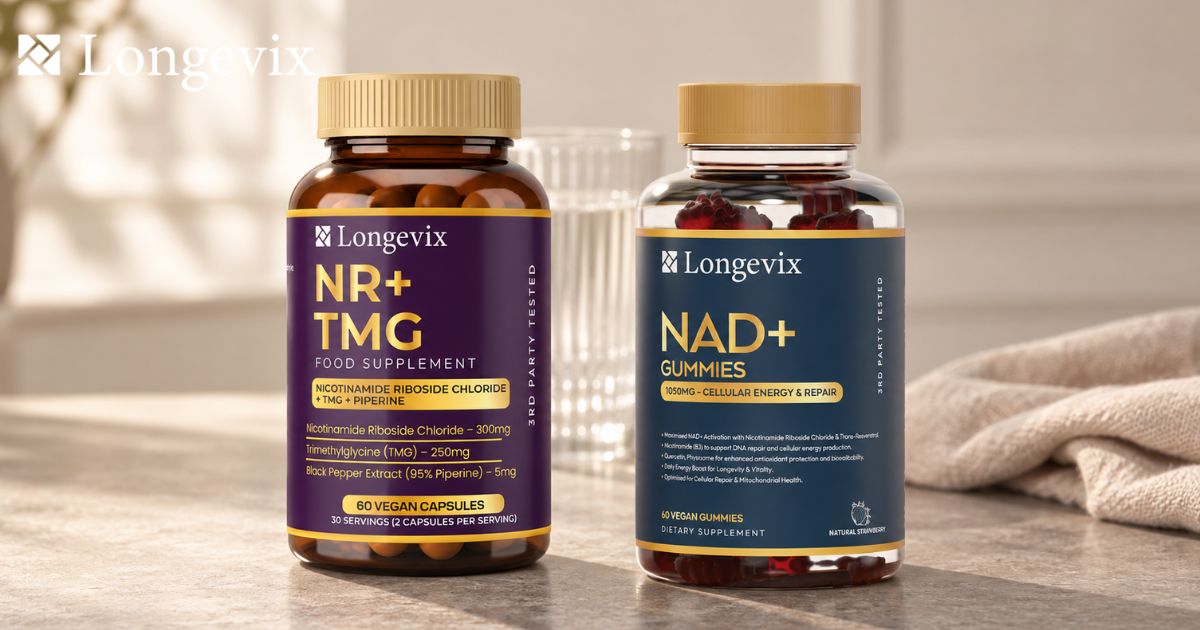
Longevix currently lists NR-containing capsules and gummies with different accompanying ingredients.
|
Product |
Listed NR amount |
Other listed ingredients per serving |
Format |
|---|---|---|---|
|
Longevix NR + TMG Capsules |
300 mg |
250 mg TMG and 5 mg piperine |
2-capsule serving |
|
Longevix NAD+ Support Gummies |
300 mg |
250 mg quercetin, 250 mg trans-resveratrol and 250 mg nicotinamide |
2-gummy serving |
These figures are taken from the current online product listings. The complete physical labels, exact ingredient forms and regulatory suitability should be confirmed before purchase or use.
Longevix NR + TMG Capsules
Longevix NR + TMG Capsules combine nicotinamide riboside with trimethylglycine, also known as TMG, and piperine.
TMG participates in methyl-donor metabolism, while piperine is an additional formulation ingredient.
However, the presence of these ingredients does not establish that this combination produces faster NAD+ changes or greater clinical benefits than NR alone.
Research on individual ingredients should not be treated as direct evidence for a finished multi-ingredient product.
Longevix NAD+ Support Gummies
Longevix NAD+ Support Gummies provide NR alongside quercetin, trans-resveratrol and nicotinamide in a gummy format.
Nicotinamide is another vitamin B3 form involved in NAD+ metabolism.
Although the formula contains multiple biologically relevant ingredients, that does not establish a particular timeline for improved energy, concentration or healthy ageing.
The clinical evidence for an individual NR ingredient cannot automatically be applied to this combination.
What About NR Powder?
NR is also available in powder formats, but the amount listed per serving requires particular attention.
Longevix currently lists a pure NR chloride powder with a 1,000 mg serving. This exceeds the 300 mg/day level specified for the general adult population in the current Great Britain novel-food authorisation entry for NR chloride in food supplements.
The product's formulation, labelled directions and regulatory position therefore require clarification before it can be recommended for routine UK supplementation.
For all NR formats, the better comparison is not simply which product contains the highest amount. Ingredient identity, formulation, supporting documentation, regulatory status and the limitations of available human evidence all matter.
The Bottom Line: When Does Nicotinamide Riboside Work?
Human research shows that nicotinamide riboside can influence NAD+ metabolism relatively quickly.
Certain NAD-related blood markers change after single doses, while controlled trials have demonstrated sustained increases in whole-blood NAD+ within approximately two weeks of repeated supplementation.
Yet these findings answer only part of the question.
There is no reliable scientific timetable for when NR will produce noticeable improvements in energy, concentration, physical performance or longevity.
An increase in a laboratory biomarker is not the same as a demonstrated health benefit.
For anyone considering NR, the most sensible approach is to review the quality of the evidence, understand the differences between formulations and check relevant UK product requirements.
You can explore further background through Longevix's science and ingredient information and review its NR-containing product listings, while remembering that formulation accuracy and regulatory suitability matter more than promises of rapid results.
References
Frequently asked questions
How quickly does nicotinamide riboside raise NAD+ levels?
Human research has detected changes in certain NAD-related blood markers within hours of a single dose. Controlled trials have also demonstrated sustained whole-blood NAD+ increases within approximately one to two weeks, depending on the intervention and measurements used.
Does nicotinamide riboside start working after the first dose?
A single dose can affect NAD-related metabolism, but this does not mean that noticeable health benefits begin immediately. Early biochemical activity and clinically meaningful outcomes are different measures.
How long does it take to feel the effects of NR supplements?
There is no established timeframe for noticeable benefits. Although NR can increase blood NAD+ concentrations, controlled studies have not consistently demonstrated corresponding improvements in energy, cognition or other everyday outcomes.
Is 300 mg of nicotinamide riboside enough to work?
A human clinical trial found measurable increases in whole-blood NAD+ with a daily intervention of 300 mg NR. This demonstrates a biochemical response under study conditions, not a guaranteed health benefit or proof that every 300 mg formulation meets applicable requirements.
What happens to NAD+ levels when someone stops taking NR?
Limited human pharmacokinetic research suggests that elevated blood NAD levels decline gradually after NR or NMN supplementation stops. The precise timeline varies, and current evidence does not establish a predictable change in how someone will feel.