NMN with TMG is attracting attention among people who want to understand NAD+ support without getting lost in supplement hype. NMN, or nicotinamide mononucleotide, supplies a precursor used in NAD+ production, while TMG, or trimethylglycine, participates in methyl-donor metabolism. Together, they connect two intriguing areas of healthy-ageing research: NAD+ precursors and methylation support. However, a plausible biochemical link doesn’t prove that everyone needs both supplements.
This guide examines what human studies actually show, why methylation enters the NMN conversation, how Longevix products differ, and where important uncertainties remain for readers in the UK and USA today.
NMN with TMG: What You Need to Know First
NMN and TMG perform different biochemical jobs. NMN contributes to NAD+ biosynthesis, whereas TMG can donate methyl groups through one-carbon metabolism. That distinction matters. Current human evidence supports studying both compounds separately, but it doesn’t establish that adding TMG universally improves the effects of NMN or creates a superior longevity protocol.
Marketing can blur that boundary surprisingly quickly. Longevix takes a more cautious approach on its Science page, where mechanisms and human outcomes are treated separately. Your diet, health, medicines, existing supplements, and goals can all influence whether another supplement adds practical value rather than simply adding complexity.
Can You Take NMN with TMG?
NMN and TMG can appear within the same supplement routine because they act through different metabolic pathways. However, combining them shouldn’t be treated as a universal requirement. Human research has examined both ingredients, yet direct trials comparing NMN alone with the same NMN dose plus TMG remain notably limited.
Is TMG Necessary When Taking NMN?
Current evidence doesn’t show that everyone taking NMN needs extra TMG. Even high-dose precursor use shouldn’t automatically be interpreted as proof of inadequate methylation. A biochemical pathway can create a research question, but it cannot diagnose methyl-donor deficiency or establish a personal need for supplementation on its own.
|
Question |
Evidence-led answer |
|
Can NMN and TMG be used within one routine? |
They can appear together, although individual suitability matters. |
|
Is TMG mandatory with NMN? |
No universal requirement has been established. |
|
Does TMG make NMN more effective? |
Direct comparative human evidence remains insufficient. |
|
Is there a proven NMN-to-TMG ratio? |
No universally validated ratio exists. |
|
Should online protocols replace the product label? |
No. Follow current label directions and appropriate professional advice. |
What Are NMN and TMG, and Why Are They Paired?
NMN stands for nicotinamide mononucleotide, a naturally occurring intermediate involved in NAD+ biosynthesis. NAD+, or nicotinamide adenine dinucleotide, participates in cellular redox reactions and enzyme signalling. Human trials show that oral NMN can raise blood NAD-related measurements, although such biomarker changes don’t automatically translate into broader anti-ageing benefits.
TMG stands for trimethylglycine, commonly called betaine anhydrous in supplements. It contains three methyl groups and participates in homocysteine remethylation. This role explains its appearance beside NMN in longevity discussions. However, biochemical proximity shouldn’t be mistaken for proven synergy between the two supplements in humans.
What Does NMN Actually Do?
NMN sits within pathways that can produce NAD+. Human trials have reported increases in blood NAD concentrations after supplementation, including a randomised 60-day study of healthy middle-aged adults. Still, increased NAD-related biomarkers don’t prove longer lifespan, disease prevention, stronger cognition, or reversal of ageing. Read the human NMN trial.
What Does TMG Powder Actually Do?
TMG acts as both a methyl donor and an osmolyte. Through betaine-homocysteine methyltransferase, it helps remethylate homocysteine towards methionine. Human studies have shown reductions in plasma homocysteine at studied doses. However, that finding doesn’t prove cardiovascular disease prevention or establish TMG as treatment for general “methylation problems”. Review the human betaine study.
How NMN, NAD+ Metabolism and Methylation Connect
The connection begins with NAD+ turnover. Cells continuously make, consume, and recycle NAD+. Nicotinamide released from NAD-consuming reactions can return through the salvage pathway, helping regenerate NAD+. Some nicotinamide can instead undergo methylation, which creates a legitimate scientific connection between NAD metabolism and the availability of methyl donors.
The NAD+/NADH pair also functions as a redox coenzyme during energy metabolism. NADH can transfer electrons into the mitochondrial electron-transport chain, where their energy contributes to ATP generation. That fundamental biology is well established. However, it doesn’t mean NMN supplementation automatically corrects tiredness or improves every aspect of mitochondrial function.

Nicotinamide, NNMT and Methylation
Nicotinamide N-methyltransferase, or NNMT, methylates nicotinamide using S-adenosylmethionine as its methyl donor. This reaction links nicotinamide metabolism with methyl-donor balance. Importantly, it doesn’t prove that NMN itself directly “uses up” TMG. Research on NNMT shows a far more intricate metabolic relationship.
NAD+, Sirtuins and DNA Repair
NAD+ also acts as a substrate for sirtuins and NAD-dependent proteins involved in DNA-damage responses, including several DNA-repair enzymes. These pathways explain why researchers study NAD metabolism in ageing biology. Yet pathway activity shouldn’t be translated directly into promises of younger cells, repaired DNA, or extended human lifespan.
NAD+ and Mitochondrial Energy
NADH transfers reducing equivalents that ultimately help drive mitochondrial ATP production. This energy supports countless processes linked with normal cellular survival and function. Still, raising blood NAD measurements doesn’t demonstrate that every organ produces more ATP or that symptoms with unrelated medical causes will improve after taking an NAD+ precursor.
Senescent Cells, CD38 and NAD+ Research
Preclinical ageing research has also examined senescent cells, inflammation, CD38 activity, and declining tissue NAD+. Experimental CD38 inhibitors have attracted scientific interest because CD38 consumes NAD+. However, these findings largely concern laboratory and animal models. They don’t justify adding experimental CD38-blocking compounds to an ordinary consumer NMN and TMG routine.
TMG Powder Benefits: What Does the Evidence Actually Support?
The clearest evidence around TMG powder concerns methyl-donor metabolism. TMG can provide methyl groups during homocysteine remethylation, helping form methionine. Controlled human studies have shown lower plasma homocysteine after betaine supplementation at specific research doses. That represents a measurable biochemical effect, but it doesn’t automatically mean fewer cardiovascular events or longer life.
TMG also acts as an osmolyte, helping cells manage osmotic stress and water balance. Researchers have consequently studied betaine in exercise, metabolism, liver biology, and body composition. Still, methylation support shouldn’t become shorthand for treating every suspected methylation issue. Evidence quality varies substantially across outcomes, populations, doses, and study durations.

TMG and Homocysteine: A Human Study Example
A controlled study used 6g of betaine daily for 12 weeks during an energy-restricted diet. Plasma homocysteine decreased, but body composition didn’t improve significantly from betaine supplementation. That contrast is useful: one biomarker changed while another outcome didn’t. Read the study.
TMG and Blood Lipids Need Nuance
Higher-dose betaine research also deserves context. A six-week trial using 6g daily found lower homocysteine alongside increases in LDL cholesterol. Therefore, portraying betaine as automatically “heart healthy” would oversimplify mixed biomarker effects. Review the lipid study before interpreting homocysteine changes as broader cardiovascular protection.
|
Research area |
What evidence suggests |
What it does not prove |
|
Methyl-donor metabolism |
TMG participates directly |
Everyone needs supplemental TMG |
|
Homocysteine |
Studied doses can reduce plasma levels |
Cardiovascular disease prevention |
|
Osmoregulation |
Betaine functions as an osmolyte |
Guaranteed hydration benefits |
|
Exercise research |
Some performance outcomes have been studied |
Universal performance enhancement |
|
Longevity |
Mechanistic interest exists |
Human lifespan extension |
|
NMN combination |
A biochemical rationale exists |
Superior outcomes versus NMN alone |
Does Taking NMN with TMG Provide Extra Benefits?
The theoretical NMN-TMG connection deserves precise language. NAD+ turnover can produce nicotinamide, while NNMT can methylate nicotinamide using SAM. TMG participates elsewhere in one-carbon metabolism. This creates a credible biochemical link. However, evidence doesn’t show that typical NMN supplementation routinely creates clinically important methyl depletion requiring additional TMG.
That distinction matters when discussing age-related metabolic dysfunction. NMN research has reported changes in NAD-related markers, while TMG research has examined methyl metabolism. Yet two biologically interesting pathways don’t automatically create a superior combined intervention. Claims involving gene expression, cognition, energy, body composition, or longevity require direct outcome evidence.
Case Study: NMN and Muscle Insulin Sensitivity
A randomised trial studied 25 postmenopausal women with prediabetes who were overweight or obese. Participants receiving 250mg NMN daily for ten weeks showed improved muscle insulin sensitivity and insulin signalling. Several other metabolic outcomes didn’t improve. Crucially, the study tested NMN alone rather than NMN with TMG. Read the study.
Does TMG Make NMN More Effective?
Current human evidence doesn’t demonstrate that adding TMG consistently makes NMN more effective. NMN trials mainly assess NAD-related biomarkers, physical measures, or metabolic endpoints. TMG studies commonly examine homocysteine and methyl metabolism. Combining those separate evidence bases into a guaranteed synergy would overstate what researchers have actually tested.
Why “Methyl Depletion” Can Be Misleading
Describing NMN simply as a methyl-group “depleter” reduces complicated metabolism to a catchy slogan. Nicotinamide can undergo methylation, but the body also recycles NAD precursors and regulates methionine-cycle chemistry dynamically. Increased theoretical methyl demand isn’t the same as proven deficiency. Clinical context matters far more than an internet protocol.
How to Take NMN with TMG: Timing, Serving and Routine
Timing advice often sounds more confident than the science allows. Human trials may standardise supplement timing to reduce experimental variation. That doesn’t establish one clock time as biologically superior. Current evidence doesn’t demonstrate that taking NMN and TMG in the same minute, morning, or evening produces better outcomes for everyone.

Similar caution applies to pharmacokinetics. Absorption, metabolism, conversion, and clearance depend on the compound and formulation studied. A reported peak plasma profile for one preparation shouldn’t be borrowed to describe another. Powder also shouldn’t automatically be marketed as faster or more effective than capsules without direct comparative evidence.
Is There a Proven NMN-to-TMG Ratio?
No universally validated NMN-to-TMG ratio has been established through controlled human trials. Popular milligram-for-milligram rules are often theoretical rather than clinically tested. A tidy 1:1 ratio may look scientific, but numerical symmetry doesn’t create evidence. Current product directions should remain the practical starting point.
What Longevix TMG Powder Provides
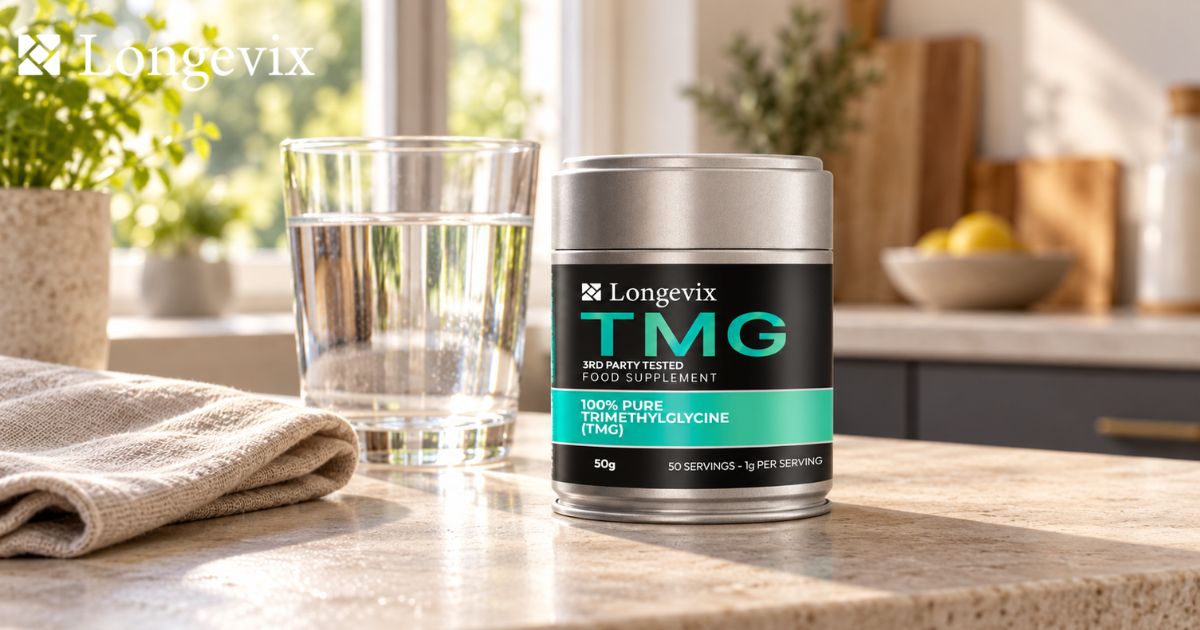
Longevix Pure Trimethylglycine Powder 50g contains trimethylglycine, or betaine anhydrous. The current labelled serving is 1,000mg using two included scoops, providing approximately 50 servings. Those figures describe the product, not an evidence-based personal requirement for everyone using NMN.
What Longevix NMN Powder Provides
Longevix Pure NMN Powder 50g includes a 500mg measuring scoop (1g labelled serving) and approximately 50 servings at that amount. Research doses shouldn’t automatically replace labelled directions because clinical studies use specific populations, endpoints, and experimental conditions that may not match everyday supplementation.
NMN Powder vs Capsules with TMG Powder: Which Format Fits You?
Format influences convenience more clearly than clinical effectiveness. Powder requires careful measuring, whereas an oral capsule provides a fixed amount. Neither format automatically provides better bioavailability without direct comparative evidence. Practical considerations include swallowing preference, portability, accurate measuring, taste exposure, storage, and whether the format helps you follow directions consistently.
Powders offer flexible measuring, although that flexibility requires greater attention. Capsules reduce measuring steps and may feel simpler when travelling. However, differences in pharmacokinetics depend on the precise formulation, not merely the words “powder” and “capsule”. Faster dissolution also doesn’t automatically mean a stronger or more meaningful biological effect.

NMN Powder with TMG Powder
Using two separate powders lets you identify and measure each ingredient independently. Longevix currently provides a 500mg measuring scoop (1g labelled serving) with its NMN powder, while its TMG powder uses two scoops for the labelled 1,000mg serving. That separation supports clear ingredient tracking, although it involves more measuring than a capsule-based routine.
NMN Capsules with TMG Powder
Longevix Pure NMN Capsules 500mg provide 500mg NMN per capsule, with 30 vegan capsules in each bottle. Combining that format with separate TMG powder removes the NMN measuring step. However, convenience doesn’t establish better absorption, stronger NAD+ responses, or superior long-term results compared with NMN powder.
|
Practical factor |
NMN Powder + TMG Powder |
NMN Capsules + TMG Powder |
|
NMN measuring |
Scoop required |
Pre-measured capsule |
|
TMG measuring |
Scoop required |
Scoop required |
|
Travel convenience |
Moderate |
Higher for the NMN portion |
|
Amount flexibility |
Greater |
More fixed |
|
Taste exposure |
Both powders |
Mainly TMG powder |
|
Proven superior effectiveness |
Not established |
Not established |
Longevix NMN and TMG Products: What You Are Actually Getting
Product accuracy matters because “NMN with TMG” can sound like one combined product. Longevix currently sells standalone NMN powder, NMN capsules, and TMG powder. Someone choosing NMN with TMG from the current range would therefore be considering separate products rather than an all-in-one NMN and TMG formulation.
Longevix also offers NR + TMG Capsules. However, NR means nicotinamide riboside, not NMN. A current two-capsule serving provides 300mg NR, 250mg TMG, and 5mg piperine. Keeping this distinction clear prevents a common product misunderstanding and improves purchasing transparency.

Current Longevix NMN and TMG Product Comparison
The current range offers different formats without implying that the formulas are interchangeable. NMN powder allows scoop-based measuring, while NMN capsules provide a fixed amount per capsule. TMG is supplied separately as betaine anhydrous powder. Because formulations can change, always check the live product page and physical label before relying on older articles.
|
Longevix product |
Current format |
Labelled amount or serving |
Pack size |
|
Pure NMN Powder |
Powder |
1,000mg labelled serving |
50g |
|
Pure NMN Capsules |
Vegan capsules |
500mg per capsule |
30 capsules |
|
Pure TMG Powder |
Powder |
1,000mg using two scoops |
50g |
|
NR + TMG Capsules |
Capsules |
300mg NR + 250mg TMG + 5mg piperine per two capsules |
60 capsules (30 two-capsule servings) |
Why Certificates of Analysis Matter
A Certificate of Analysis records results for the sample and tests shown on that particular document. It shouldn’t be assumed to cover unlisted contaminants or every future batch. The Longevix testing-document index advises readers to match the product name, batch or lot, report details, and tests performed.
NMN with TMG Safety, Side Effects and Important Precautions
Short-term NMN trials have generally reported acceptable tolerability within their specific study conditions. One randomised trial followed healthy adults receiving 300mg, 600mg, or 900mg daily for 60 days. That finding doesn’t establish lifetime safety, safety during pregnancy, or suitability alongside every medicine or medical condition. Read the trial.
TMG requires similar restraint. Higher-dose studies have reported gastrointestinal effects and changes in lipid markers under some conditions. Longevix advises following labelled amounts and seeking professional advice when pregnant, breastfeeding, taking medication, or managing a medical condition. Its TMG supplement side-effects guide provides further context.
Don’t Diagnose “Methylation Problems” from Symptoms
Fatigue, difficulty concentrating, low mood, or poor exercise tolerance can arise from many causes. They don’t prove low NAD+, impaired methylation, or mitochondrial fatigue. Likewise, supplements shouldn’t be used to self-treat suspected age-related metabolic dysfunction. Persistent or unexplained symptoms deserve appropriate clinical assessment rather than an increasingly complicated supplement stack.
UK Context for NMN
UK readers should check current regulatory information before purchasing NMN because its regulatory position remains important. The Food Standards Agency currently lists application RP-2116 for β-NMN as a novel food application. Regulatory records can change, so the live FSA entry should take precedence over older blog statements.
USA Supplement Context
US readers should distinguish market availability from FDA approval. The FDA states that dietary supplements aren’t approved for safety and effectiveness before sale in the same way as medicines. This makes truthful labelling, evidence, manufacturing controls, and ingredient transparency particularly important. See the FDA dietary supplement guidance.
“FDA does not approve dietary supplements for safety and effectiveness.” — U.S. Food and Drug Administration
Should You Take NMN with TMG? An Evidence-Based Takeaway
The most useful answer isn’t a universal yes or no. TMG has a genuine biochemical role in methyl-donor metabolism, while NMN participates in NAD+ biosynthesis. Human studies support several measurable effects within those separate research areas. However, that evidence doesn’t establish that everyone needs NMN with TMG or gains additional longevity benefits.
A better decision begins with your actual goal, diet, medicines, existing supplements, and tolerance. Avoid assuming that a longer supplement stack produces stronger results. Metabolism resembles an orchestra rather than a row of volume controls. More instruments don’t guarantee better music. Evidence, transparent labelling, suitable use, and realistic expectations matter far more.
What Human NMN Research Really Means
Human NMN trials offer promising signals rather than a final verdict. Research has reported increased NAD-related measurements and improved muscle insulin sensitivity in specific study populations. Yet studies remain relatively small or short. They don’t establish lifespan extension or an ideal NMN-TMG protocol. Longevix’s NMN evidence guide explores this distinction further.
What NAD+ Biology Does and Doesn’t Promise
NAD+ supports redox metabolism, cellular signalling, and processes connected with gene expression and stress responses. Those roles make NAD biology scientifically compelling. However, increasing a blood NAD biomarker doesn’t automatically improve cognition, physical performance, disease risk, or lifespan. A mechanism can explain why researchers investigate an intervention; clinical outcomes determine whether it meaningfully helps people.
The Bottom Line on TMG Powder Benefits
TMG powder has a well-established biochemical role as a methyl donor, while human studies support reductions in homocysteine under defined research conditions. NMN belongs to NAD+ metabolism. Combining them remains biologically plausible, but direct evidence doesn’t prove universal synergy. Confidence should come from understanding what the data support and where uncertainty remains.
For readers considering either ingredient, the strongest next step is straightforward: compare research with the actual label. Review Longevix Pure TMG Powder, Pure NMN Powder, or Pure NMN Capsules, then match any testing document to your exact product and batch.
Frequently asked questions
Do You Need to Take TMG with NMN?
Not necessarily. TMG can provide methylation support, but current human evidence doesn’t establish that everyone taking NMN requires supplemental TMG. The metabolic rationale is plausible, yet a plausible mechanism isn’t the same as a demonstrated nutritional requirement or proven improvement in NMN outcomes.
How Much TMG Should You Take with NMN?
No clinically established NMN-to-TMG ratio applies universally. Longevix Pure TMG Powder currently lists a 1,000mg serving, but that product serving shouldn’t be interpreted as an ideal NMN pairing ratio. Follow the current label and seek professional advice when medicines or medical conditions could influence suitability.
When Should You Take TMG with NMN?
Current evidence doesn’t show that morning, evening, simultaneous, or separated dosing consistently produces better outcomes. Research protocols often use fixed schedules for scientific consistency. For everyday use, following each product’s directions matters more than copying precise timing routines that haven’t been validated in comparative human trials.
Why Take TMG with NMN?
TMG is a methyl donor, and nicotinamide metabolism includes methylation through NNMT. That biochemical connection explains why people discuss TMG beside NMN. However, it doesn’t prove that TMG prevents methyl depletion, enhances NMN absorption, raises NAD+ further, or produces better health outcomes than NMN alone.
Can You Take NMN Without TMG?
Yes. Human NMN trials have investigated NMN without requiring additional TMG, and current evidence doesn’t establish TMG as mandatory. Whether another supplement belongs in your routine depends on your circumstances, diet, existing products, medicines, health status, and the quality of evidence supporting the outcome you actually want.