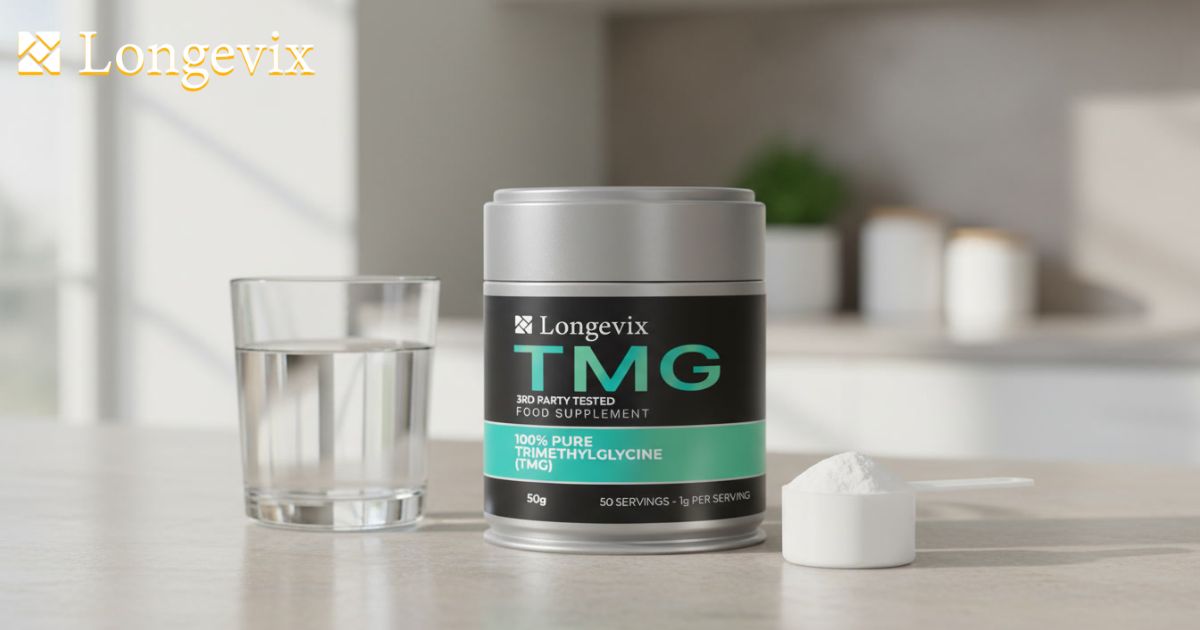
An NR and TMG supplement brings together two compounds attracting growing interest in longevity research. Nicotinamide riboside supports pathways that help your body produce NAD+, a coenzyme involved in cellular energy and essential metabolic processes. TMG, or trimethylglycine, acts as a methyl donor within methylation pathways linked to homocysteine metabolism.
The combination sounds attractive, especially if you’re exploring healthy aging. However, good biochemistry doesn’t automatically equal better health outcomes. Human research supports distinct roles for NR and TMG, yet direct evidence proving superior results from taking them together remains limited. Understanding that distinction helps separate sensible formulation from clever supplement marketing.
What Are NR and TMG, and Why Are They Paired?
Here’s where the pairing starts. Nicotinamide riboside belongs to the vitamin B3 family and acts as a precursor within NAD+ metabolism. TMG, or trimethylglycine, is also known as betaine. It participates in one-carbon metabolism by supplying chemical groups used during reactions involving methionine and homocysteine.
They don’t perform the same job. NR participates directly in pathways leading towards NAD+, whereas TMG works within methylation chemistry. Think of them as neighbouring departments in the same metabolic organisation. Their biochemical relationship explains the pairing, but it doesn’t prove that combining them delivers better clinical outcomes.
What Is an NR + TMG Supplement?
An NR + TMG supplement combines an NAD+ precursor with one of the body’s methyl donors. Longevix uses this approach in a fixed capsule format. However, formulation logic isn’t proof of synergy. Human research must determine whether a particular combination produces meaningful benefits beyond those associated with its individual ingredients.
How Does Nicotinamide Riboside Support NAD+ Production?
The biology becomes clearer once NAD+ enters the picture. Nicotinamide adenine dinucleotide is a coenzyme involved throughout metabolism. Cells continually recycle it while processing nutrients and transferring energy. This activity contributes to energy production and numerous cellular functions, although NR shouldn’t be confused with a stimulant or immediate energy source.

NAD+ also participates in reactions involving signalling, cellular stress responses, and DNA repair. These roles explain scientific interest in NAD-related cellular energy and cellular defense systems. However, involvement in these pathways doesn’t establish that raising NAD+ biomarkers slows ageing, prevents disease, or extends human lifespan.
How Does NR Become NAD+?
NR enters NAD-related metabolism through several enzymatic steps. Within cells, it can contribute to nicotinamide mononucleotide formation before NAD+ synthesis continues downstream. These biochemical reactions support normal nutrient conversion and energy transfer. The Longevix guide NR vs NAD Supplement explains why NR and finished NAD+ aren’t interchangeable.
Does Higher NAD+ Automatically Mean Better Health?
This distinction matters. Human studies show that oral NR can raise whole-blood NAD+ and related metabolites. Yet a biomarker increase doesn’t automatically mean better memory, strength, sleep, metabolism, or longevity. Longevix therefore separates pathway changes from meaningful human outcomes when discussing NAD+ precursors and ageing research.
“Mechanism is not an outcome.” — Longevix Science
Why Is TMG Added to NR Supplements?
Here’s the biochemical argument behind the combination. Nicotinamide metabolism can produce methylated metabolites, which requires methyl groups. TMG can donate methyl groups through a pathway involving betaine-homocysteine methyltransferase. This relationship created the theory that additional TMG might support methyl availability when NAD+ precursor metabolism increases.
However, human methyl metabolism resembles a network rather than a single pipeline. Folate, vitamin B12, choline, methionine, diet, genetics, and other processes also contribute. Consequently, TMG shouldn’t be presented as something every NR user must replace or replenish. Longevix’s current science guidance makes this limitation clear.
TMG, Homocysteine and Methylation
TMG attracts scientific interest because betaine can help remethylate homocysteine towards methionine through a betaine-dependent pathway. Human research has demonstrated reductions in plasma homocysteine at specific gram-level intakes. However, those findings demonstrate dose-specific biological activity rather than proving that every TMG amount produces an equivalent effect. See the human study on PubMed.

Does NR Really Deplete Methyl Groups?
This question drives much of the NR and TMG supplement debate. NR increases nicotinamide-related metabolism, and some downstream nicotinamide undergoes methylation. Increased methyl demand therefore has biochemical plausibility. However, producing more methylated metabolites isn’t equivalent to developing clinically meaningful methyl depletion, folate deficiency, or impaired methylation.
Human research provides useful perspective. An eight-week randomised trial studied 100mg, 300mg, and 1,000mg of NR daily. Whole-blood NAD+ increased dose-dependently. Researchers also assessed one-carbon metabolism and found that plasma homocysteine wasn’t disrupted, despite increased methylated nicotinamide metabolites. Read the study on PubMed.
Methylated Metabolites Aren’t the Same as Deficiency
Picture more delivery vans leaving a warehouse. Their movement shows greater activity, not an empty warehouse. Likewise, increased methylated nicotinamide metabolites indicate changing metabolic traffic. They don’t prove healthy adults have exhausted their methyl donors. Clinical measurements and controlled research provide stronger evidence than assumptions drawn from one biochemical pathway.
What Does Human Research Say About Taking NR and TMG Together?
The evidence becomes clearer when divided into three layers. Human NR studies examine NAD-related biomarkers and specific health outcomes. TMG studies examine betaine metabolism and markers including homocysteine. Direct human evidence testing a simple NR-plus-TMG combination is considerably less established, which limits confident claims about genuine synergistic effects.

That distinction matters for body composition, metabolic support, and weight management claims. Evidence from one ingredient cannot automatically validate a finished formula. A clinical trial using several grams of betaine, for example, doesn’t prove that 250mg produces the same outcome. Ingredient form, amount, participants, duration, and endpoints all matter.
|
Human evidence |
Amount studied |
Main finding |
Important limitation |
|
NR randomised trial |
100, 300 or 1,000mg/day for 8 weeks |
Whole-blood NAD+ increased dose-dependently |
Biomarker changes don’t prove broad health benefits |
|
Betaine trial |
1.5, 3 or 6g/day for 6 weeks |
Fasting homocysteine decreased dose-dependently |
Amounts exceeded those in many combination products |
|
Acute betaine study |
1, 3 or 6g once |
3g and 6g reduced plasma homocysteine |
Only 10 healthy volunteers participated |
|
NR obesity trial |
2,000mg/day for 12 weeks |
No improvement in insulin sensitivity |
Results apply to the studied population and outcomes |
|
Longevix NR + TMG label |
300mg NR + 250mg TMG per serving |
Confirms ingredient exposure |
A label amount doesn’t establish clinical efficacy |
Research amounts describe what investigators tested. They shouldn’t be interpreted as recommended doses for every consumer.
Case Study: What an Eight-Week NR Trial Found
A 2019 randomised, double-blind trial enrolled 140 overweight but otherwise healthy adults. NR at 100mg, 300mg, and 1,000mg daily increased whole-blood NAD+ by approximately 22%, 51%, and 142%. Homocysteine wasn’t disrupted. ChromaDex funded the study, so its declared conflicts should be considered alongside independent evidence. View the study.
Is There Direct Evidence for NR Plus TMG?
Current evidence doesn’t justify describing NR plus TMG as a clinically proven synergistic pair. Research has examined NR and betaine individually, while experimental multi-ingredient combinations also exist. However, animal or multi-ingredient findings cannot establish that an NR-and-TMG-only formula produces superior outcomes in humans. Direct product-specific evidence would provide much stronger support.
Do You Actually Need TMG When Taking NR?
For many readers, this is the crucial question. Current human evidence doesn’t establish supplemental TMG as mandatory whenever NR is used. NR studies have successfully raised NAD-related biomarkers without routinely pairing NR with TMG. One eight-week trial also reported no disruption of plasma homocysteine at doses reaching 1,000mg daily.
Your wider routine matters too. Diet supplies betaine and nutrients linked with one-carbon metabolism. Lifestyle also influences metabolic health independently. An NR and TMG supplement shouldn’t replace balanced nutrition, movement, sleep, or sensible intermittent fasting when appropriate. Likewise, it shouldn’t be promoted as a method for resetting your sleep/wake cycle.
NR With TMG vs NR Alone
Choosing NR with TMG mainly changes convenience and ingredient exposure. A combined capsule provides predetermined amounts within one serving, whereas standalone NR allows independent use. Neither format becomes universally superior through formulation alone. Your decision should consider the current label, research relevance, diet, existing supplements, tolerance, and appropriate professional advice.
Can Food Supply TMG and Other Methyl Donors?
Food contributes betaine and several nutrients involved in connected one-carbon pathways, including choline and folate. Therefore, methylation shouldn’t be pictured as a tank supplied only by TMG powder. Your wider nutritional pattern influences the system, which helps explain why universal claims that every NR user “must” take TMG remain difficult to support.
What’s Inside Longevix NR + TMG Capsules?
Accuracy matters most when product information enters the discussion. The current Longevix NR + TMG Capsules provide 300mg NR, 250mg TMG, and 5mg piperine per two-capsule serving. Each bottle contains 60 capsules, providing 30 labelled servings. Current directions state two capsules daily.
The formulation should be described exactly as labelled. Piperine appears at 5mg, but its presence shouldn’t become an unsupported claim about superior absorption or clinical efficacy. Longevix also provides access to a testing document and advises customers to match that document with the product and batch shown on their physical pack.
|
Longevix product |
Relevant ingredients |
Current labelled serving |
Practical distinction |
|
300mg NR, 250mg TMG, 5mg piperine |
2 capsules |
Fixed combined format |
|
|
Nicotinamide riboside chloride |
1,000mg |
Standalone NR format |
|
|
Betaine anhydrous |
1,000mg |
Standalone TMG format |
Current Longevix product records confirm these serving amounts. Always compare the article with the physical label because product information can change.
Combined Capsules vs Separate NR and TMG Powders
Separate powders offer greater control over each ingredient. Longevix Pure NR Powder currently lists a 1,000mg labelled serving, while Pure TMG Powder lists 1,000mg using two scoops. The combined capsules provide fixed amounts together. That difference concerns flexibility and convenience; it doesn’t establish that either powder or capsule formats produce better clinical outcomes.

What Do Research and Labels Say About NR and TMG Amounts?
Dose is where supplement discussions often lose perspective. Research quantities describe what scientists tested under particular conditions. They aren’t automatically ideal daily amounts for everyone. NR trials have investigated several doses, while many human TMG studies examining homocysteine have used gram-level quantities. Population, duration, formulation, and outcome remain essential context.
For example, Longevix NR + TMG Capsules provide 250mg TMG per serving. One six-week study investigated 1.5g, 3g, and 6g daily and observed dose-related homocysteine reductions. Those findings can’t simply be transferred to 250mg. Equally, taking more doesn’t automatically provide greater overall health benefits.
Why Study Dose and Supplement Dose Aren’t Interchangeable
Research resembles a recipe with controlled quantities. Change the amount and you may change the result. A study using 3g of TMG to examine homocysteine doesn’t prove that 250mg produces an equivalent response. Conversely, it doesn’t prove 250mg has no biological activity. It simply leaves that specific outcome unproven.
How Should You Read an NR and TMG Supplement Label?
Start with serving size instead of front-label language. Check the ingredient form, amount per full serving, directions, warnings, and overlapping ingredients from other products. Then compare those details with studies using similar amounts and populations. Longevix follows this principle on its Science page, where formulation relevance receives explicit attention.

What Are the Side Effects and Safety Considerations?
Safety deserves the same attention as possible benefits. Human NR studies have generally reported acceptable tolerability during the periods investigated. However, several trials remain short compared with lifelong use. Evidence surrounding long-term supplementation is therefore less complete. Any adverse side effects deserve proper assessment rather than dismissal because a product is classified as a supplement.
TMG also requires dose-aware interpretation. A six-week human study using 6g daily reported increased LDL cholesterol. Later research and meta-analysis suggest lipid responses may vary according to dose and study design. Longevix discusses these issues further in its TMG Supplement Side Effects guide.
What About MTHFR Variants?
The phrase MTHFR gene mutation appears frequently online, although common C677T and A1298C differences are better described as gene variants. They don’t automatically prove that you require TMG. The CDC’s current MTHFR guidance states that people with common variants can still process folic acid.
When Should You Take Extra Care?
Speak with a qualified healthcare professional before supplementation if you take medicines, manage a medical condition, or are pregnant or breastfeeding. This matches current Longevix guidance and FDA advice. Combining several supplements can also duplicate ingredients or create interactions, which makes reviewing your complete supplement routine particularly important.
NR and TMG Supplement: Smart Pairing or Just Hype?
The most defensible answer lies between enthusiasm and dismissal. NR and TMG have a coherent biochemical relationship. NR participates in NAD+ metabolism while TMG participates in methyl-donor pathways. That makes the combination scientifically understandable. However, human research doesn’t establish that every NR user needs TMG or that combining them produces superior healthy aging outcomes.
That distinction matters because metabolic support isn’t the same as reversing biological aging. Neither ingredient should become a shortcut for fat loss, longevity, or perfect health. A smarter approach involves checking the formulation, comparing relevant research, reviewing batch information, and keeping expectations proportionate to the evidence currently available.
The Evidence-Based Verdict on NR + TMG
NR plus TMG is best described as a biologically rational formulation rather than a proven synergistic breakthrough. If convenience matters, Longevix offers both ingredients together. If independent control matters more, separate NR and TMG powders are available. Transparent labels, relevant human research, and realistic expectations remain more useful than dramatic anti-ageing claims.
Frequently asked questions
Do I need to take TMG with NR?
Not necessarily. Human evidence doesn’t establish added TMG as essential for everyone taking NR. Controlled NR studies have raised NAD-related biomarkers without mandatory TMG supplementation, and Longevix specifically cautions against presenting TMG as universally necessary for every NR user.
Why take TMG with nicotinamide riboside (NR)?
TMG acts as a methyl donor and participates in methylation pathways. Because nicotinamide metabolism produces methylated metabolites, some formulations combine TMG with NR. This creates a plausible biochemical rationale, although current evidence doesn’t prove that the combination produces better clinical outcomes than NR alone.
How much TMG should I take with NR?
No universally established amount of TMG must accompany NR. Human betaine studies use widely varying doses for different outcomes, often at gram-level quantities. Follow the current product label rather than copying a research dose, and seek qualified professional advice when your circumstances warrant it.
Is TMG necessary when supplementing with NR?
Current evidence doesn’t establish TMG as necessary for every NR user. Individual circumstances may differ because diet, total supplement intake, medical conditions, and other nutritional factors can influence methyl-related metabolism. A plausible biochemical connection shouldn’t be converted into a universal supplementation rule.
What are the benefits of combining NR and TMG?
The clearest practical benefit is convenience: one formulation can provide an NAD+ precursor alongside a methyl donor. However, evidence hasn’t established that combining NR and TMG delivers greater health benefits than NR alone. The distinction between formulation convenience and proven clinical synergy remains important.