Choosing trimethylglycine powder looks straightforward until serving sizes, ingredient names and scientific claims start competing for attention. Also known as betaine anhydrous, TMG participates in methylation and homocysteine metabolism. However, that doesn’t mean every product, dose or health claim deserves equal confidence. Some buyers accidentally choose the wrong form. Others copy research doses or overlook TMG already hiding inside another supplement.
Before adding pure TMG powder to your routine, it pays to understand the label, evidence and serving method. These seven common mistakes explain what matters, what remains uncertain and how to make a better-informed choice without getting swept away by supplement hype.
Trimethylglycine Powder Explained Before You Make a Mistake
Understanding the ingredient gives you a useful compass before comparing products. Trimethylglycine powder, usually shortened to TMG, is a powdered form of trimethylglycine. It is also known as betaine anhydrous. Within human metabolism, TMG can donate a methyl group during the remethylation of homocysteine towards methionine.
That biochemical role is well established, although its practical implications require more care. Research has investigated betaine supplementation for homocysteine, exercise outcomes and other metabolic measures. Effects on one laboratory marker don’t automatically establish protection against disease or longer life. That distinction keeps the evidence useful rather than allowing interesting biology to become a marketing shortcut.
TMG, Betaine and Betaine Anhydrous
In supplement terminology, trimethylglycine, TMG and betaine anhydrous refer to the same core compound. “Anhydrous” describes a form without water. Betaine hydrochloride, usually written as betaine HCl, is different. Similar names can therefore mask meaningful formulation differences, which is why the complete ingredient name matters more than a large “betaine” headline.
Where Longevix Pure TMG Powder Fits
Longevix currently lists a 50g trimethylglycine powder containing TMG/Betaine Anhydrous. Its labelled serving is 1,000mg using two included scoops, providing approximately 50 servings. The product record also links to a batch-specific testing document. Always compare those details with the physical label supplied with your own product.
For a broader explanation of the ingredient, see the Longevix guide to Betaine Anhydrous Powder.
Mistake #1: Confusing TMG Powder with Betaine HCl
The first expensive mistake often begins with a harmless-looking word: betaine. Trimethylglycine powder and betaine HCl can both appear when you search for betaine supplements. However, they aren’t interchangeable. TMG is betaine anhydrous, while betaine HCl contains hydrochloride and is marketed for a different supplement purpose.
That distinction should come before price, branding or pack size. If you want TMG, look for trimethylglycine or betaine anhydrous within the ingredient information. Don’t assume any supplement carrying “betaine” on the front contains the same chemical form. Buying the wrong ingredient makes every later comparison—serving size, research and value—largely irrelevant.
Why the Exact Ingredient Name Matters
Think of “betaine” as a surname rather than a complete identity. Betaine anhydrous identifies the TMG form discussed in methylation and homocysteine research. Betaine HCl includes hydrochloride. As a result, evidence, serving instructions and intended uses shouldn’t simply transfer from one form to the other because their labels share one word.
Check the Longevix Ingredient Field
The current Longevix product page identifies its powder as Trimethylglycine (TMG/Betaine Anhydrous). It also directs customers to the physical pack for the complete ingredient statement and allergen information. That approach matters because websites, packaging and product specifications can change, while the product in your hand remains the most relevant reference.
Mistake #2: Copying Research Doses Instead of the Product Label
Clinical studies answer specific scientific questions. They don’t create a universal supplement schedule. Human betaine studies have investigated different quantities, populations and durations. A meta-analysis of trials using at least 4g daily found a statistically significant reduction in plasma homocysteine, but those research protocols shouldn’t automatically become personal dosing instructions.
Other studies have used 1g, 3g or 6g in controlled settings. Researchers may also control diet, timing, eligibility and laboratory measurements. Taking one number from an abstract removes all that context. A research dose belongs to its trial. Your daily serving should instead reflect the relevant product directions and appropriate professional advice where needed.
Why More TMG Doesn’t Automatically Mean Better
Supplement doses don’t behave like a simple volume control. Turning the number upwards doesn’t guarantee a greater benefit. A meta-analysis of trials using at least 4g of betaine daily for six weeks or longer found a modest increase in total cholesterol, while effects on LDL, HDL and triglycerides were not statistically significant in that analysis.
The Longevix 1 g Serving
Longevix Pure TMG Powder currently specifies a 1 g serving, equal to 1,000mg, using two included scoops. The 50g pack provides approximately 50 labelled servings. That serving belongs to this product. It shouldn’t be silently replaced with a larger amount taken from another manufacturer, influencer routine or unrelated clinical experiment.
Why UK and US Readers Should Check Their Labels
Current UK Food Standards Agency guidance advises consumers to read food-supplement labels, follow the recommended daily dosage and avoid taking more than recommended. In the US, FDA supplement-labelling rules require serving size and dietary ingredient amounts to appear within applicable Supplement Facts information.
Mistake #3: Measuring Trimethylglycine Powder Carelessly
Powder creates a practical challenge that capsules largely remove: somebody must measure it. A kitchen teaspoon measures volume rather than mass. Powder density, particle characteristics, packing and the way a spoon is filled can influence how much material occupies the same volume. That makes casual teaspoon conversions less reliable than they appear.
A scoop from another product creates the same problem. Two similar-looking scoops may represent different quantities. Longevix specifies two included scoops for its current 1,000mg serving. Following those product-specific directions is more sensible than estimating by eye or borrowing a serving method from an unrelated unflavoured powder.
Powder Convenience Claims Still Need Evidence
Buyers often look for powder that mixes easily, a pure unflavoured powder, or something easy to mix before breakfast. Those preferences are reasonable. However, they shouldn’t become claims about a specific Longevix product unless the current label or supporting information verifies them. Powder format alone proves neither flavour nor solubility.
What Should You Mix TMG Powder With?
Some people may prefer a protein shake, while others search for ways to combine supplements with water juice smoothies or similar drinks. The wording may be common in search queries, but the Longevix webpage doesn’t currently publish specific beverage instructions. Follow the product label rather than assuming every mixing method suits every formulation.
Consistency Matters More Than Guesswork
Good supplement habits are rarely glamorous. Use the supplied measuring method and follow the latest directions. Don’t assume one scoop equals one gram unless your label explicitly says so. Likewise, avoid switching between heaped teaspoons, level teaspoons and improvised estimates. A consistent method gives the labelled serving practical meaning.
Mistake #4: Ignoring TMG Already in Your Supplement Stack
Ingredient overlap can hide in plain sight. You might think you’re taking one TMG product, one NR supplement and one creatine product. Yet more than one could contain trimethylglycine. Product names usually highlight their headline ingredient, not every compound in the formula. That makes an occasional full-label audit surprisingly valuable.
Before adding pure TMG powder, examine every supplement you already use. Compare its serving size and ingredient quantities with your planned addition. More products don’t necessarily create a better stack. Sometimes they simply create duplicate ingredients, greater complexity and more difficulty identifying which component produced an effect or unwanted reaction.
Longevix NR + TMG Already Contains TMG
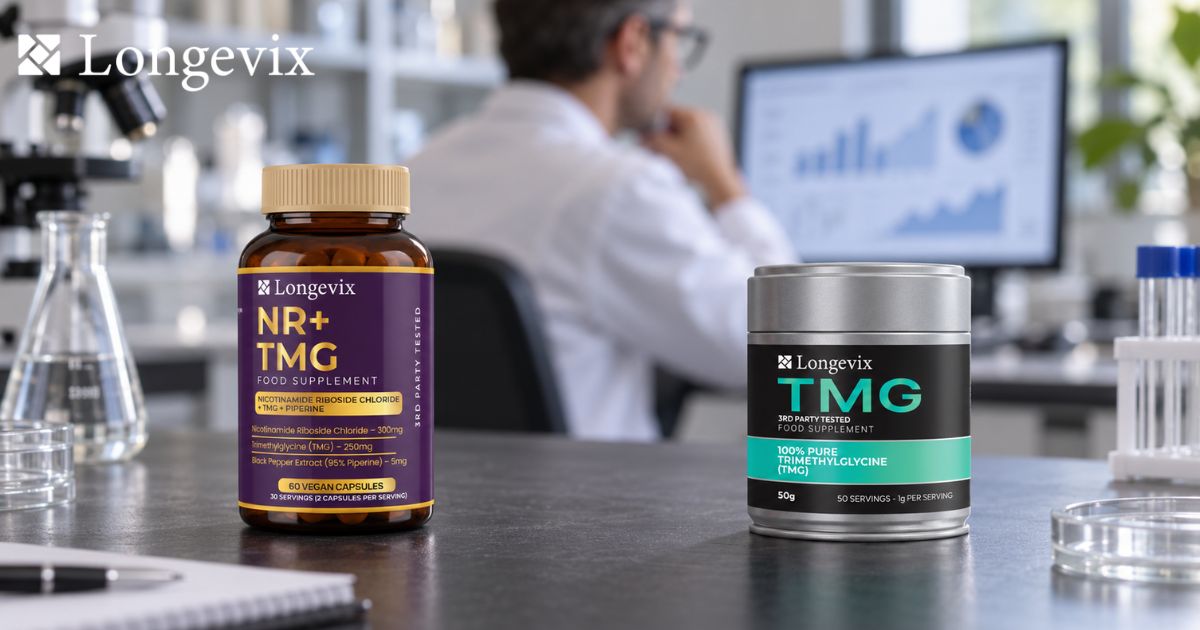
Longevix NR + TMG Capsules currently provide 300mg nicotinamide riboside, 250mg TMG and 5mg piperine per two-capsule serving. Taking that product alongside standalone TMG powder therefore increases total trimethylglycine exposure compared with using either option alone.
For the current formulation, see Longevix NR + TMG Capsules.
Creatine Products Can Create Another Overlap
Longevix Creatine Vitality Gummies also list TMG alongside creatine monohydrate, taurine and vitamin B12. Where the individual TMG quantity is not stated in accessible online information, it shouldn’t be guessed. Check the physical product label instead, particularly when combining several products around physical training.

Practical Case Study: The Hidden Double-Up
Imagine Sarah already takes a labelled serving of NR + TMG Capsules. She later buys standalone TMG after reading about methylation. Her capsules already contribute 250mg of TMG per serving. Adding powder changes her overall intake. Nothing mysterious happened; she simply counted bottles instead of repeating ingredients. That small distinction can prevent unnecessary duplication.
|
Longevix option |
Format |
Current TMG information |
|
Pure Trimethylglycine Powder 50g |
Powder |
1,000mg per labelled serving |
|
NR + TMG Capsules |
Capsules |
250mg per two-capsule serving |
|
Creatine Vitality Gummies |
Gummies |
TMG listed; check the current physical label for the individual amount |
Mistake #5: Assuming Everyone Taking NR or NMN Needs Extra TMG
The NR-and-TMG discussion starts with genuine biochemistry. Nicotinamide metabolism can involve methylation, while TMG functions as a methyl donor in one-carbon metabolism. Online explanations sometimes turn that relationship into a fixed rule: if you take NR or NMN, you must also take TMG. Current human evidence doesn’t justify such certainty.
An eight-week randomised, placebo-controlled trial tested NR at 100mg, 300mg and 1,000mg daily. NR increased blood NAD+ in a dose-dependent manner, while researchers reported that it did not dysregulate one-carbon metabolism. That result doesn’t prove TMG is unnecessary for everyone. It does challenge the claim that extra TMG is automatically required.
Mechanistic Plausibility Isn’t Clinical Necessity
Mechanisms help scientists ask good questions. They don’t always supply final clinical answers. A biochemical pathway may suggest why two nutrients interact, yet individual status, dietary intake, dose, duration and metabolism still matter. Treating a plausible methylation mechanism as proof of universal supplement dependence skips several steps between biochemistry and clinical evidence.
What About NMN and TMG?
Human NMN trials have shown that oral NMN can increase blood NAD-related measures in studied populations. However, those trials don’t establish that every NMN user must supplement TMG. Human research remains smaller and younger than many online longevity claims suggest, making cautious interpretation especially important.
Why Longevix Offers Different Formats
Longevix sells a fixed NR + TMG capsule formula as well as standalone TMG and other NAD+-related products. Different formats provide different ways to organise a supplement routine. Their existence doesn’t prove a universal biological requirement. Combined formulas offer convenience, while standalone products provide more independent control over each ingredient.
Mistake #6: Trusting “Pure” or “Lab Tested” Without Checking the Evidence
Terms such as “pure”, “premium” and “tested” sound reassuring because they compress a complicated quality question into a few words. Yet meaningful testing requires detail. You need to know what sample was examined, which batch it represents, which tests were performed, what results were reported and whether those results match stated specifications.
Claims such as lab-tested purity, high purity or lab-tested for purity therefore need supporting evidence. Identity testing, assay testing and contaminant screening answer different questions. Heavy metals testing addresses another category again. A laboratory report becomes useful when you understand its exact scope rather than assuming it proves every conceivable aspect of quality.
What a Testing Document Should Actually Show
Longevix advises readers to check the product and batch, tests performed, results and units, laboratory details, report dates and limitations. Its Certificates page also states that test panels can vary by product, ingredient, batch and testing provider. That is an important distinction because one certificate shouldn’t be generalised beyond what it actually reports.
Longevix TMG Testing Documentation
Longevix currently lists a testing document for Pure Trimethylglycine (TMG) Powder 50g under reference QDF25-0098434-02. The presence of that document supports traceability. However, any specific purity, identity or contaminant claim should still be matched to the analyses actually shown within the relevant report.
For a more detailed explanation, see Third Party Tested TMG.

“Single Ingredient” Claims Need Evidence Too
Some buyers specifically search for a single ingredient formula, single-ingredient powder or a product with no fillers. Those phrases should be verified against the current complete ingredient statement. Longevix’s online TMG page explicitly directs customers to the physical label for full ingredient information, so unsupported absolutes shouldn’t be inferred.
Vegan, Gluten and Environmental Claims Are Separate Questions
The same discipline applies to vegan friendly, gluten free and carbon neutral wording. These are distinct product or environmental claims. A powder doesn’t become vegan, gluten-free or carbon-neutral merely because trimethylglycine is its highlighted ingredient. Each statement needs appropriate evidence before being attributed to a specific product.
Mistake #7: Expecting TMG Powder to Guarantee Health or Longevity Results
Biochemistry can sound compelling enough to become marketing. TMG participates in methyl donation and homocysteine metabolism, so it’s tempting to turn those facts into broad promises. Human trials do show that betaine supplementation can reduce plasma homocysteine under certain research conditions. However, biomarker changes and clinical outcomes are not interchangeable.
A lower homocysteine value doesn’t, by itself, prove fewer heart attacks, strokes or additional years of life. Likewise, mechanistic roles in methylation don’t establish that TMG slows human ageing. Strong health content should make that boundary visible rather than hiding uncertainty behind technical language. That restraint is particularly important for longevity-focused readers.
Homocysteine Is a Biomarker, Not a Guaranteed Outcome
A systematic review and meta-analysis reported a reduction in homocysteine with betaine supplementation. The same analysis also found changes in total and LDL cholesterol across included trials. These findings help describe biological effects, but they don’t establish that supplementation prevents cardiovascular disease. Clinical outcomes require their own evidence.
Evidence Case Study: Six Grams Daily
In one controlled study, 6g of betaine daily reduced plasma homocysteine. However, investigators did not find improvements in body weight, body composition or resting energy expenditure compared with the control condition. This illustrates a useful research principle: an ingredient may change one measured outcome without improving every related health marker.
Exercise Claims Need Similar Restraint
TMG has attracted interest in physical training research, although findings vary between studies and outcomes. Evidence should therefore be described specifically rather than converted into a blanket performance promise. Terms such as supplementary sports food may describe how a product is positioned in some markets, but classification alone doesn’t demonstrate improved strength or performance.
Longevity Claims Require the Highest Bar
No convincing human evidence currently shows that routine TMG supplementation extends human lifespan. Methylation, homocysteine metabolism and osmotic functions are biologically interesting, yet none substitutes for long-term clinical evidence. A responsible longevity discussion can acknowledge promising mechanisms without quietly upgrading them into proven anti-ageing outcomes.
How to Choose Trimethylglycine Powder Without Falling for Hype
Start with information that you can verify. Confirm that the ingredient is trimethylglycine or betaine anhydrous. Read the labelled serving and measuring directions. Check the complete ingredient statement. Then inspect any testing document rather than relying on impressive front-label adjectives. Traceable facts usually tell you more than decorative claims.
Next, compare the product with what you already take. A larger tub isn’t automatically better value. An unflavoured powder isn’t automatically cleaner. A more complicated formula isn’t automatically superior. The practical question is whether the product clearly identifies its ingredient, serving, directions and evidence while fitting your existing routine without unnecessary duplication.

Marketing Terms Worth Checking Carefully
Searches for pure TMG powder, single ingredient formula, high purity, no fillers, vegan friendly and gluten free reflect genuine buyer priorities. However, each phrase represents a claim that should be supported by current product information. Good buying decisions separate attractive wording from facts you can actually verify.
Solubility and Flavour Are Product Characteristics
The same principle applies to claims that a powder mixes easily, is easy to mix, or qualifies as a pure unflavoured powder. Those descriptions may matter greatly to everyday use, but powder format alone doesn’t prove them. Check the manufacturer’s current directions and product information rather than assuming similar-looking powders behave identically.
UK and US Supplement Rules Differ
In Great Britain, food supplements are regulated as foods and cannot lawfully claim to prevent, treat or cure disease. Current government guidance also tells consumers to follow label instructions and avoid exceeding the recommended dose. In the US, dietary supplements use Supplement Facts labelling and aren’t generally approved by the FDA for safety and effectiveness before marketing.
|
What to check |
Why it matters |
Useful question |
|
Ingredient form |
Distinguishes TMG from betaine HCl |
Does the label say trimethylglycine or betaine anhydrous? |
|
Serving quantity |
Shows how much TMG the serving supplies |
How many milligrams are provided per labelled serving? |
|
Measuring method |
Reduces avoidable powder-measuring errors |
Does the product specify scoops, weight or another measure? |
|
Complete ingredients |
Helps identify additional ingredients |
What does the current physical label actually list? |
|
Testing document |
Adds traceability |
Does the report match the product and batch? |
|
Existing supplements |
Helps identify ingredient overlap |
Am I already taking TMG elsewhere? |
|
Health claims |
Helps separate evidence from marketing |
Is the claim supported by appropriate human research? |
Where Longevix Pure TMG Powder Fits into Your Options
Longevix Pure Trimethylglycine (TMG) Powder currently comes in a 50g format. Its product page identifies Trimethylglycine (TMG/Betaine Anhydrous), specifies a 1,000mg serving using two included scoops and states approximately 50 servings per pack. A batch-specific laboratory report is also linked from the product record.
Those facts are useful because customers can verify them. They shouldn’t be extended into unsupported statements about lab-tested purity, no fillers, dietary suitability, sports performance or longevity. Longevix itself directs customers to the physical pack for the complete ingredient statement, allergen information, warnings and current directions.
Powder, Capsules and Combination Products
Format changes convenience and ingredient control. Standalone powder keeps TMG separate. Longevix NR + TMG Capsules combine 300mg NR, 250mg TMG and 5mg piperine per two-capsule serving. Creatine Vitality Gummies represent another combined format containing TMG within a broader formulation. The best choice depends on what you actually intend to take.
A Better Way to Compare Longevix TMG Options
Rather than asking which option is “strongest”, compare ingredient quantities, format, serving method and overlap with your existing routine. Powder offers separate TMG control. Capsules provide a fixed combination. Broader formulas bundle several ingredients together. None of those formats should automatically be labelled superior without evidence matching the specific outcome you care about.
|
Longevix product |
Format |
Current verified TMG information |
Practical distinction |
|
Pure Trimethylglycine Powder 50g |
Powder |
1 g serving using two scoops |
Standalone TMG format |
|
NR + TMG Capsules |
Capsules |
250mg TMG per two capsules |
Includes NR and piperine |
|
Creatine Vitality Gummies |
Gummies |
TMG listed; check physical label for individual amount |
Broader combination formula |
Final Thoughts on Trimethylglycine Powder
Choosing trimethylglycine powder wisely means looking beyond the letters TMG. Confirm the exact ingredient, follow product-specific directions, measure powder consistently and check whether another supplement already contains TMG. Just as importantly, keep mechanistic theories, biomarkers and proven clinical outcomes in separate mental boxes.
Good decisions grow from traceable information rather than impressive vocabulary. Read the label. Examine the testing document. Question sweeping benefit claims. Longevix advises that food supplements shouldn’t replace a varied, balanced diet and healthy lifestyle and recommends professional advice where pregnancy, breastfeeding, medication or medical conditions are relevant.
Further Reading and Source Context
These external resources provide background or regulatory context. They do not prove that a particular Longevix product produces the health outcomes discussed above.
Frequently asked questions
What is trimethylglycine powder?
Trimethylglycine powder is a powdered form of TMG, also called betaine anhydrous. It functions as a methyl donor within one-carbon metabolism and participates in the remethylation of homocysteine towards methionine. Powder is simply one supplement format; capsules and combination products can also provide TMG.
What are the benefits of TMG (trimethylglycine)?
Human research supports an effect of betaine on homocysteine under certain study conditions. Researchers have also explored exercise, metabolic and body-composition outcomes, although results are not equally consistent across these areas. TMG shouldn’t therefore be presented as a guaranteed heart-health, performance or longevity supplement.
What is the recommended dosage for TMG powder?
There isn’t one universal TMG amount appropriate for every person and product. Follow the specific label unless a qualified professional advises otherwise. Longevix Pure TMG Powder currently provides a 1,000mg serving using two scoops, while clinical research has investigated several different doses for specific experimental purposes.
Is TMG the same as betaine anhydrous?
Yes. In the supplement context discussed here, TMG, trimethylglycine and betaine anhydrous refer to the same core compound. Betaine HCl is different and shouldn’t be treated as interchangeable simply because both product names include “betaine”.
What are the side effects of trimethylglycine powder?
Some people may experience gastrointestinal discomfort, particularly at larger intakes. Research using at least 4g daily has also identified modest changes in blood lipids, including total cholesterol in one meta-analysis. Effects depend on dose and context, so research findings shouldn’t be applied indiscriminately to every labelled serving.