Why take TMG with NR? The question matters because these nutrients support different, yet connected, pathways. NR, or nicotinamide riboside, helps your body make NAD+, a coenzyme involved in cellular energy and metabolism. TMG, also called betaine, participates in methyl transfer and homocysteine metabolism.
That connection sounds compelling, although the science needs careful interpretation. Human research doesn’t show that everyone taking NR automatically needs TMG. This guide explains the mechanism, human evidence, safety, timing, and dosing. It also shows how current Longevix products fit into the picture without turning biological theory into a health promise.
“A plausible biological pathway is not the same as a proven nutritional requirement.”
Why Take TMG with NR? The Short Answer
People usually take TMG with NR because nicotinamide metabolism can involve methyl groups. When nicotinamide undergoes methylation, an enzyme called NNMT uses S-adenosylmethionine, commonly called SAM. TMG can support a separate pathway that helps regenerate methionine, which the body can then use when producing SAM.
However, this mechanism doesn’t prove that NR supplementation causes harmful methyl depletion. Human trials have used NR without compulsory TMG and found no consistent disruption of homocysteine or the wider methyl pool. Therefore, taking TMG with NR remains a biologically reasonable option rather than a universal requirement.
Is TMG necessary when taking NR?
For most people, “necessary” goes beyond the available evidence. An eight-week randomised trial tested 100, 300, and 1,000 mg of NR daily. Whole-blood NAD+ increased significantly, while NR did not raise plasma homocysteine compared with baseline or placebo. The study therefore doesn’t support automatic methyl depletion.
What Are NR and TMG—and Why Are They Combined?
Nicotinamide riboside is a form of vitamin B3 and a precursor to nicotinamide adenine dinucleotide. Inside cells, NR can enter pathways that produce NMN and then NAD+. NAD+ acts as a coenzyme in redox reactions and also serves as a substrate for several enzymes involved in normal cellular activity.
Trimethylglycine is another name for betaine, particularly when discussing betaine anhydrous supplements. TMG contains three methyl groups. Through the BHMT pathway, it can donate one methyl group while helping convert homocysteine towards methionine. This role explains the interest in combining TMG with NAD+ precursors.
Why combine nicotinamide riboside and TMG?
NR and TMG don’t perform the same job. NR supplies material for NAD+ production, while TMG participates in one-carbon metabolism. TMG doesn’t directly convert NR into NAD+. Instead, their relationship appears further downstream, where nicotinamide metabolism can interact with methyl-transfer chemistry involving SAM and homocysteine.
The current Longevix NR + TMG Capsules provide 300 mg NR, 250 mg TMG, and 5 mg piperine per two-capsule serving. The bottle contains 60 capsules and 30 labelled servings. The live product page and physical label should remain the final references for directions and warnings.
How NR Supports NAD+—and Where Methylation Fits In
A simplified pathway runs from NR to NMN and then NAD+. NAD+ supports redox reactions that help cells process carbohydrates, fats, and other nutrients. It also acts as a substrate for enzymes involved in cellular signalling and DNA repair. These biochemical roles are well established, although supplementation outcomes require separate evidence.
The methylation question begins after NAD+ is used. Some NAD-consuming reactions produce nicotinamide, or NAM. Your body can recycle NAM back towards NAD+ or process it through other routes. NNMT can transfer a methyl group from SAM to NAM, creating methylated metabolites such as MeNAM.
A simple NR, NAD+ and methylation pathway
|
Stage |
What happens |
Why it matters |
|
NR intake |
NR enters NAD-related pathways |
Supplies an NAD+ precursor |
|
NR → NMN |
Enzymes convert NR |
Creates an intermediate |
|
NMN → NAD+ |
NAD+ is formed |
Supports redox and signalling functions |
|
NAD+ use |
Some reactions produce nicotinamide |
Nicotinamide may be recycled or cleared |
|
Nicotinamide methylation |
NNMT uses SAM |
Produces methylated nicotinamide metabolites |
|
Homocysteine cycle |
Methionine and SAM can be regenerated |
Connects methyl transfer with one-carbon metabolism |

Think of this network as connected railway lines. NAD+ travels along one busy route, while methylation uses another. The lines can influence one another at shared junctions. However, extra traffic on one line doesn’t automatically mean the entire network has run out of resources.
Why Is TMG Paired with NR? The Methyl-Donor Rationale
TMG attracts attention because it can act as a methyl donor. Betaine-homocysteine methyltransferase, or BHMT, uses betaine to help remethylate homocysteine into methionine. Methionine can then contribute to SAM production. SAM supplies methyl groups for many reactions, including protein, lipid, neurotransmitter, and nucleic-acid chemistry.
This creates a reasonable biochemical hypothesis. Greater nicotinamide turnover could increase methyl-dependent clearance. TMG could support one route involved in replenishing methionine. Yet the body doesn’t rely on TMG alone. Folate, vitamin B12, choline, methionine, dietary protein, and other nutrients interact across one-carbon metabolism.
Why folate, B12 and choline also matter
One-carbon metabolism works more like a roundabout than a single road. Folate-dependent pathways help remethylate homocysteine, while vitamin B12 supports methionine synthase. Choline can also form betaine. Therefore, methyl-folate and methyl-B12 relate to the same broad network but shouldn’t be treated as direct replacements for TMG.
That distinction matters when comparing supplement categories. The Longevix Best Methylation Supplement guide explores these differences more broadly. A methylated B-vitamin product isn’t automatically equivalent to TMG. Likewise, standalone TMG shouldn’t be described as a complete methylation formula.
Does NR Deplete Methyl Groups? What Human Evidence Actually Shows
The concern has a genuine biochemical basis. NNMT uses SAM when methylating nicotinamide, so nicotinamide clearance can consume methyl equivalents. Yet using methyl groups doesn’t automatically mean causing a deficiency. Human physiology continuously regenerates SAM and methionine through linked nutritional and enzymatic pathways. The clinical evidence therefore matters more than theory alone.
Current human data don’t show consistent methyl depletion from NR. In 140 overweight but otherwise healthy adults, researchers tested 100, 300, and 1,000 mg daily for eight weeks. Whole-blood NAD+ increased dose-dependently. Methylated nicotinamide metabolites also increased, yet plasma homocysteine did not.
Research case study: Eight weeks of NR
This study offers useful context because it included four groups and a placebo. Whole-blood NAD+ rose by roughly 22%, 51%, and 142% at 100, 300, and 1,000 mg daily. Homocysteine remained unchanged. However, the study had industry involvement, which readers should know when weighing the evidence.
Research case study: High-dose NR and the methyl pool
The NR-SAFE trial studied 3,000 mg NR daily for four weeks in 20 people with Parkinson’s disease. Serum homocysteine rose slightly at first, yet whole-blood SAM, SAH, methionine, and homocysteine remained stable. Researchers reported no depletion of the methyl-donor pool. This specialised trial doesn’t represent ordinary supplement use.
What about DNA methylation?
Another placebo-controlled Parkinson’s study examined DNA methylation in 29 participants. NR at 1,000 mg daily for 30 days did not meaningfully disturb DNA methylation homeostasis in blood or muscle. The finding also included people with common MTHFR variants, although the short study cannot settle long-term questions.
Do You Actually Need TMG When Taking NR?
Current evidence doesn’t establish that every NR user needs TMG. Several controlled human studies have administered nicotinamide riboside without compulsory trimethylglycine. Therefore, NR alone shouldn’t automatically be described as incomplete. Diet, overall supplement intake, medical history, nutrient status, and individual laboratory results can all influence a more personalised decision.
TMG may still suit someone who specifically wants both ingredients in one routine. A combined product improves convenience. Separate products provide more control over each ingredient. Neither approach has been shown to produce superior clinical outcomes simply because the ingredients are taken together.
What about an MTHFR gene mutation?
The phrase MTHFR gene mutation appears frequently online, although “gene variant” is usually more accurate for common forms such as C677T and A1298C. The CDC states that people with common MTHFR variants can process folic acid. A common variant therefore doesn’t automatically prove that somebody needs extra TMG.
Short-term NR research adds useful context. Investigators found no harmful DNA-methylation effect in participants carrying common MTHFR variants. This doesn’t make genetics irrelevant. It simply means a genotype alone shouldn’t become an automatic supplement prescription without clinical context, diet information, symptoms, and appropriate professional interpretation.
TMG, Homocysteine and Methylation—What Is Actually Proven?
Homocysteine sits at an important junction in one-carbon metabolism. It can move back towards methionine through folate-dependent or betaine-dependent pathways. Because TMG supports the latter route, researchers have studied betaine for its effect on plasma homocysteine. This remains one of the clearest areas of human TMG evidence.
A meta-analysis of five randomised controlled trials found that at least four grams of betaine daily reduced plasma homocysteine. Lower-dose research has also found reductions at 1.5 and 3 grams daily. However, these study doses answer homocysteine questions. They don’t establish the ideal TMG amount to accompany NR.
What TMG studies do not prove
Lowering a biomarker doesn’t automatically prove a better health outcome. This distinction matters when discussing healthy aging or biological aging. Reduced homocysteine alone doesn’t prove longer life, improved cognition, or fewer cardiovascular events. Older researchers themselves noted that the effect on actual cardiovascular risk remained uncertain.
Evidence around body composition also needs context. One trial using six grams of betaine daily during a calorie-restricted diet lowered homocysteine but didn’t improve body composition beyond dieting alone. Later studies and meta-analyses have produced different findings, showing why one isolated experiment shouldn’t become a universal claim.
UK health-claim context
UK-facing product language needs particular care. The authorised betaine wording states that betaine contributes to normal homocysteine metabolism only under defined conditions. The food must contain at least 500 mg per quantified portion, while consumers must receive information that the beneficial effect requires 1.5 grams daily.
The regulation also requires information that daily intake above four grams may significantly increase blood cholesterol. Longevix NR + TMG Capsules currently provide 250 mg TMG per two-capsule serving. Therefore, that specific authorised health claim should not simply be applied to the capsules. Product composition and claim conditions must match.
How Much TMG Should You Take with NR? Dose, Ratio and Timing
No scientifically established universal TMG-to-NR ratio currently exists. Internet formulas sometimes suggest taking equal amounts or matching fixed percentages. Human trials haven’t demonstrated that such ratios are optimal. Research usually studies NR and betaine for different questions, making direct mathematical comparisons between unrelated trials potentially misleading.
This distinction prevents false precision. A homocysteine trial using several grams of TMG cannot tell you how much TMG must accompany a particular NR dose. Likewise, an NR trial does not establish the required amount of a separate methyl donor. Product directions and personal circumstances remain more practical starting points.
Should you take TMG and NR at the same time?
Current human evidence doesn’t show that taking both ingredients at exactly the same time improves outcomes. Combining them may simply make a routine easier. There is also no strong evidence proving that morning or evening dosing produces superior methylation support. Consistency, tolerance, product directions, and medication timing may matter more.
The current Longevix combined serving provides 300 mg NR, 250 mg TMG, and 5 mg piperine. Directions state two capsules daily while referring users to the physical label. That 300:250 relationship is a product formulation. It shouldn’t be described as a clinically proven or universally optimal ratio.
NR + TMG Together or Separately? Comparing Longevix Options
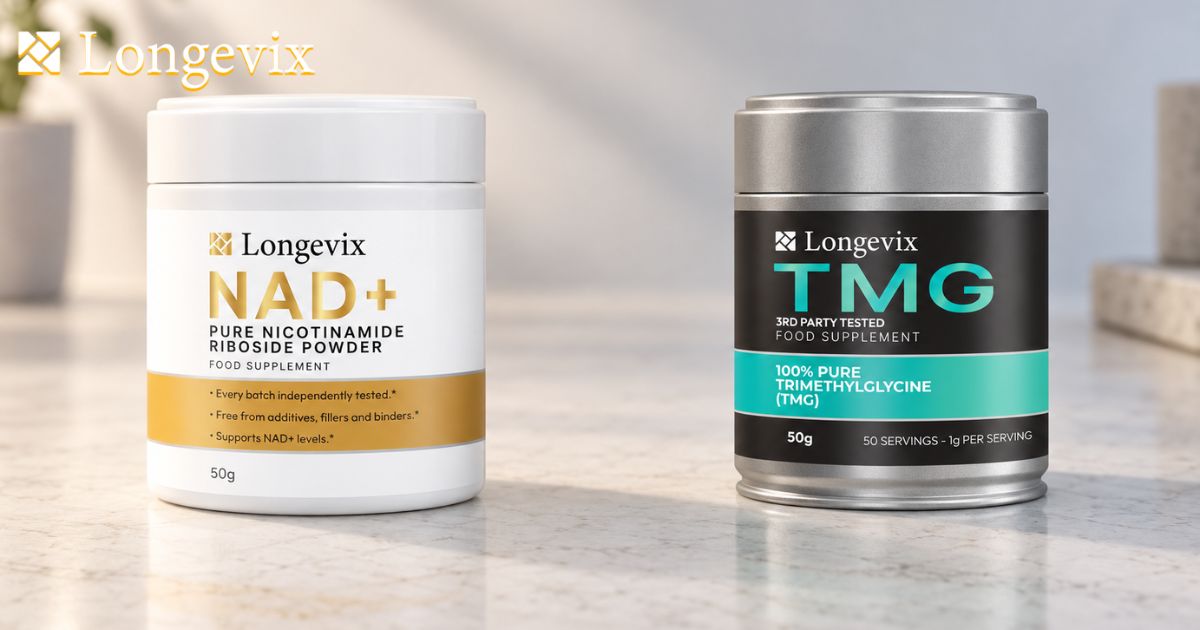
Longevix currently offers combined and standalone approaches. NR + TMG Capsules provide fixed amounts in one serving. Pure NR Powder offers standalone nicotinamide riboside, while Pure TMG Powder offers standalone trimethylglycine. Each format solves a different practical problem rather than representing a scientifically superior route.
Separate powders provide more control over individual ingredients, although careful measuring becomes important. Capsules remove that measuring step but keep a fixed ratio. Anyone combining several supplements should check total intake across every label. The same ingredient can appear under different names, especially TMG and betaine anhydrous.
|
Longevix option |
Current labelled serving |
Relevant ingredients |
Practical difference |
|
NR + TMG Capsules |
2 capsules |
300 mg NR, 250 mg TMG, 5 mg piperine |
Fixed combined formula |
|
Pure Nicotinamide Riboside Powder 50g |
1,000mg |
NR chloride |
Standalone NR |
|
Pure Trimethylglycine Powder 50g |
1,000 mg |
TMG / betaine anhydrous |
Standalone TMG |
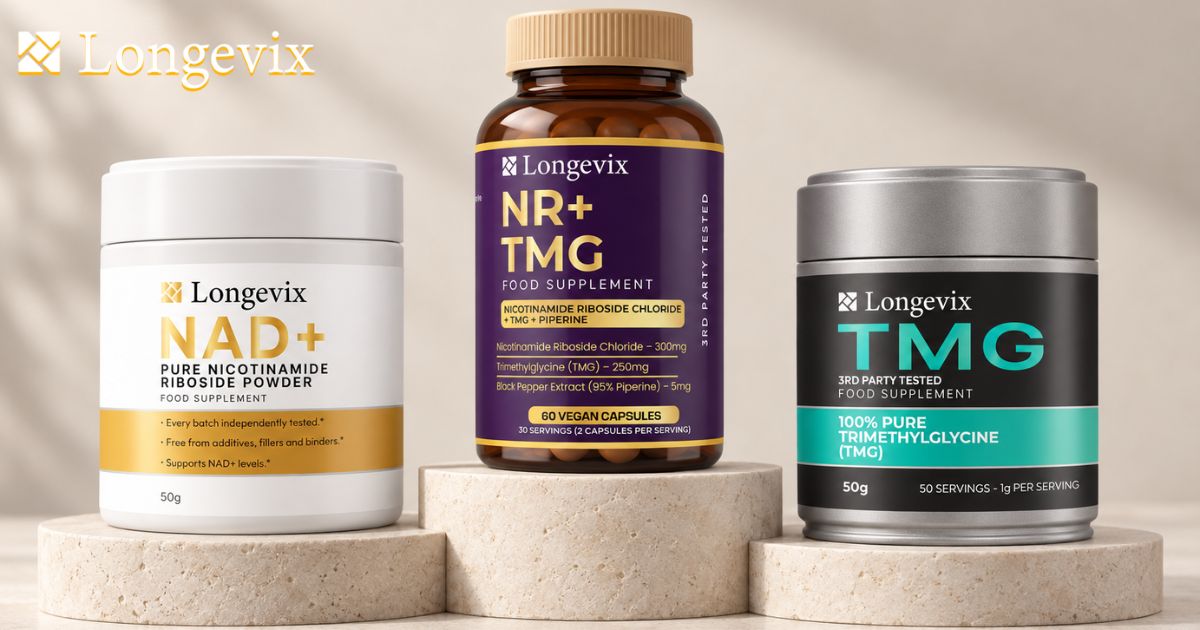
The Longevix Pure Nicotinamide Riboside Powder 50g comes in a 50 g format with a 1,000mg measuring scoop. At the labelled serving, the tin provides approximately 50 servings. The live record also links to a batch-specific testing document.
The Longevix Pure TMG Powder 50g lists a 1,000 mg serving using two included scoops. The ingredient is trimethylglycine, also described as betaine anhydrous. The 50 g tin provides approximately 50 labelled servings.
Why testing documents matter
Testing documents can support specific facts about the sample examined. Depending on the report, they may cover identity, assay, purity, or particular contaminants. They don’t prove benefits for healthy aging or clinical effectiveness. The Longevix Certificates and Testing Documents page tells readers to match reports to the relevant product and batch.
Is Taking NR with TMG Safe? Side Effects and Precautions
Short-term human NR research has generally reported good tolerance under studied conditions. In the eight-week trial of up to 1,000 mg daily, adverse events did not differ significantly from placebo. A much smaller Parkinson’s trial also reported tolerability at 3,000 mg daily for four weeks, although that dose required study monitoring.
TMG has separate considerations. Research using higher betaine intakes has reported gastrointestinal effects and changes in blood lipids. Meta-analyses found reductions in homocysteine but also identified increases in total or LDL cholesterol under some dosing conditions. That makes “more is better” a poor assumption.
Why more doesn’t mean better
Biochemistry rarely behaves like a simple fuel tank. A nutrient can support a normal pathway without producing greater benefits at ever-higher doses. The same applies to methylation. More methyl-donor intake doesn’t necessarily create “better methylation”, particularly when several pathways already regulate methionine, SAM, folate, choline, and homocysteine.
People who are pregnant, breastfeeding, taking medicines, or managing a medical condition should seek qualified professional guidance before supplementation. Longevix gives the same precaution across its current shop. Food supplements should not replace a varied, balanced diet or healthy lifestyle, and the physical product label remains the final directions source.

Why NAD+ Research Doesn’t Automatically Prove Healthy Ageing Benefits
Interest in NR often comes from research on healthy aging, cellular energy, and NAD biology. NAD+ clearly participates in core metabolic processes. It acts as a coenzyme in redox reactions and serves enzymes connected with DNA repair and signalling. However, establishing a cellular role doesn’t prove that raising NAD+ slows human ageing.
The same caution applies to biological aging claims. A supplement can alter a blood metabolite without changing lifespan, frailty, cognition, or disease risk. Clinical outcomes require direct testing. This distinction is especially important for YMYL content, where attractive mechanisms should never be presented as guaranteed health benefits.
Can NR improve cellular energy?
NAD participates directly in cellular energy metabolism, including reactions involved in glycolysis, fatty-acid oxidation, and mitochondrial respiration. Yet raising NAD-related metabolites doesn’t guarantee that a person will feel more energetic. Human symptoms depend on many factors, so biochemical activity should not be confused with a predictable subjective benefit.
Final Takeaway: Why Take TMG with NR?
Why take TMG with NR? The strongest answer involves biochemical logic rather than proven necessity. NR increases the supply of an NAD+ precursor, while TMG functions as a methyl donor within homocysteine remethylation. These pathways intersect indirectly, but current evidence doesn’t show that every person taking NR must add TMG.
Human studies have increased NAD+ and methylated nicotinamide metabolites without consistently showing depletion of the methyl pool. TMG independently lowers homocysteine under certain studied conditions. However, researchers haven’t established that NR plus TMG provides better clinical outcomes than NR alone for the average supplement user.
|
Key question |
Evidence-based answer |
|
Why take TMG with NR? |
The pairing has a plausible methyl-donor rationale |
|
Does NR use methyl groups? |
Nicotinamide methylation uses SAM-derived methyl groups |
|
Does NR always deplete methyl groups? |
Current human evidence does not show universal depletion |
|
Is TMG mandatory with NR? |
No universal requirement has been established |
|
Is there an ideal TMG-to-NR ratio? |
No clinically proven universal ratio exists |
|
Can TMG lower homocysteine? |
Human studies show reductions under tested conditions |
|
Does lower homocysteine prove longer life? |
No |
|
Should product directions be followed? |
Yes, with professional advice when appropriate |
Readers wanting a fixed formula can review Longevix NR + TMG Capsules. Those wanting separate ingredients can compare standalone NR and TMG powders. For broader terminology, NR vs NAD Supplement: The Honest Difference Explained provides additional context.
Important Information
This article provides general educational information and does not diagnose, treat, cure, or prevent disease. Human evidence around NR, TMG, NAD biology, and long-term supplementation continues to develop. Product formulations can also change, so current Longevix product pages, physical labels, and matching batch documentation should always take priority.
For broader methylation information, see the Longevix Best Methylation Supplement guide. For product testing, review Longevix Certificates and Testing Documents. These resources help separate label facts, laboratory documentation, and general scientific evidence rather than treating them as interchangeable forms of proof.
Further Reading and Source Context
These external resources provide background or regulatory context. They do not prove that a particular Longevix product produces the health outcomes discussed above.
Frequently asked questions
Do I need to take TMG when supplementing with NMN or NR?
Not necessarily. Human NR studies have not established that everyone taking NR requires added TMG. Evidence showing NR can increase methylated metabolites does not, by itself, prove harmful methyl depletion or a universal need for supplemental betaine.
Why should I pair a methyl donor such as TMG with nicotinamide riboside?
TMG can support homocysteine remethylation, while nicotinamide metabolism can use SAM-derived methyl groups. That creates a plausible biochemical reason to combine them. However, no strong human evidence currently shows that pairing TMG with NR is clinically necessary for every user.
Does NR or other NAD+ precursors deplete methyl groups in the body?
NR metabolism can increase methyl-dependent nicotinamide clearance, but human studies have not consistently shown meaningful depletion of methyl groups. Even 3,000 mg daily for four weeks did not deplete the measured methyl-donor pool in a small Parkinson’s trial.
What is the recommended dose or ratio of TMG to take with NR?
No scientifically established universal TMG-to-NR ratio exists. Research on NR and TMG has generally studied different outcomes and doses. Follow the relevant product label, consider total intake from all supplements, and avoid assuming equal doses or popular online ratios are clinically optimal.
Are there other supplements that should be taken with NR?
No additional supplement is universally required with NR. Folate, vitamin B12, choline, methionine, and TMG participate in related metabolic pathways, yet individual requirements vary. Adding supplements without a nutritional reason can increase complexity without providing a proven additional benefit.