NMN and niacinamide are different compounds that both contribute to the body's NAD+ metabolism, but they are not interchangeable. NMN (nicotinamide mononucleotide) is an intermediate involved in NAD+ production, while niacinamide (nicotinamide) is an established form of vitamin B3 that participates in NAD+ synthesis and recycling.
The distinction matters when comparing supplements. A 2026 human study found different blood NAD+ responses to NMN and niacinamide, although it did not establish that either produces better long-term health outcomes.
This guide compares their chemistry, clinical evidence, safety considerations and UK regulatory status, helping you understand what the research supports before interpreting supplement claims.
NMN vs Niacinamide: Key Differences at a Glance
NMN and niacinamide belong to related metabolic pathways, but they differ in chemical structure, nutritional role and the evidence available for supplementation.
|
Feature |
NMN |
Niacinamide |
|---|---|---|
|
Full name |
Nicotinamide mononucleotide |
Nicotinamide |
|
Common abbreviation |
NMN |
NAM |
|
Chemical identity |
Nucleotide containing a nicotinamide component |
Form of vitamin B3 |
|
Main biological role |
Intermediate in NAD+ biosynthesis |
Vitamin B3 source involved in NAD+ synthesis and recycling |
|
Relationship to NAD+ |
Can contribute to NAD+ production |
Converted to NMN through a cellular salvage pathway |
|
Essential dietary nutrient? |
Not established as a separately required dietary nutrient |
Recognised form of essential vitamin B3 |
|
Human research |
Trials report increases in blood NAD-related measurements |
Established nutritional role; research also investigates supplemental NAD+ responses |
|
Direct 2026 comparison |
Increased baseline whole-blood NAD+ after 14 days at the tested amount |
Did not produce the same sustained baseline increase at its tested amount |
|
Long-term health benefits |
Not established |
Adequate vitamin B3 intake is essential, but additional high-dose supplementation has not been shown to extend lifespan |
|
UK regulatory considerations |
Novel-food authorisation concerns |
Established vitamin B3 ingredient subject to applicable food and supplement rules |
The most important difference is not simply which molecule produces a higher laboratory measurement. It is what each substance does biologically, what supplementation has demonstrated in humans and whether a particular product is suitable and legally marketable.
What Are NMN and Niacinamide?
What Is Nicotinamide Mononucleotide (NMN)?
NMN is a naturally occurring molecule produced within the body. It participates in the pathways that maintain nicotinamide adenine dinucleotide, commonly abbreviated as NAD+.
NAD+ is essential for numerous cellular processes, including reactions involved in energy metabolism and the activity of certain enzymes that regulate cellular functions.
Researchers are interested in NMN because NAD+ metabolism changes with age and under different physiological conditions. Human studies have shown that oral NMN can influence blood NAD-related measurements.
However, this does not establish that taking NMN slows biological ageing, prevents illness or extends human lifespan.
For a broader examination of these claims, see Longevix's evidence-based review of whether NMN really works.
Is Niacinamide the Same as Nicotinamide?
Yes. Niacinamide and nicotinamide are two names for the same molecule.
Nicotinamide is a form of vitamin B3. The body uses vitamin B3 to produce NAD and related coenzymes that support normal metabolic functions.
Unlike NMN, nicotinamide has a well-established nutritional role. It can be obtained through food and is found in some supplements and fortified products.
The NIH Office of Dietary Supplements describes niacin as a broad term that includes nicotinic acid, nicotinamide and related derivatives.
Is Niacinamide the Same as Niacin?
The terminology can be confusing.
Vitamin B3 is commonly called niacin, but the term can refer to several related chemical forms. Two important examples are nicotinic acid and nicotinamide.
Both contribute to vitamin B3 nutrition, although their effects are not identical.
High supplemental amounts of nicotinic acid can produce flushing, characterised by warmth and redness of the skin. Nicotinamide generally does not cause the same flushing response.
That does not mean unlimited amounts of nicotinamide are safe. High supplemental intakes still require appropriate consideration of adverse effects and individual circumstances.
How Do NMN and Niacinamide Contribute to NAD+?
Both ingredients connect to NAD+ metabolism, but they enter the relevant cellular pathways at different points.
NAD+ helps enzymes transfer electrons during metabolic reactions. It also participates in cellular signalling and is consumed by certain enzymes involved in processes such as DNA-damage responses.
The body continually produces, uses and recycles NAD+.
The Nicotinamide Salvage Pathway
One important recycling pathway starts with nicotinamide.
The enzyme nicotinamide phosphoribosyltransferase, or NAMPT, helps convert nicotinamide into NMN.
Another enzyme, nicotinamide mononucleotide adenylyltransferase (NMNAT), converts NMN into NAD+.
The simplified pathway is:
Nicotinamide (NAM) → NMN → NAD+
This explains why both compounds are relevant to NAD+ metabolism.
It does not mean that swallowing either compound necessarily produces the same result. Digestion, absorption, metabolism and the regulation of cellular pathways can all affect the response.
Where NMN Fits in NAD+ Production
NMN is already an intermediate in this pathway.
At first glance, that might suggest taking NMN would always be more effective than taking nicotinamide. However, biological systems are more complicated than a pathway diagram.
What happens after oral NMN is consumed may involve conversion into other metabolites, and researchers continue to investigate the contribution of intestinal microorganisms to its effects.
The 2026 study published in Nature Metabolism explored these questions using both human supplementation data and experiments involving human gut microbiota.
Its findings suggest that microbial metabolism may help explain differences between NAD+ precursors, although the precise contribution of those processes inside the human body remains uncertain.
Why Supplement Amounts Do Not Tell the Whole Story
A label stating 500mg of nicotinamide and another stating 500mg of NMN does not establish that the products will have identical effects.
These are different molecules with different molecular weights.
Their responses may also depend on the formulation, study population, duration and biological measurements used.
Comparing milligrams alone is therefore not enough to establish nutritional equivalence or clinical effectiveness.
For more information about how scientific findings should be interpreted, explore Longevix's approach to supplement evidence.
What Did the 2026 Human NMN vs Niacinamide Study Find?
One of the most useful direct comparisons was published on 15 January 2026 in Nature Metabolism.
The research, titled The differential impact of three different NAD+ boosters on circulatory NAD and microbial metabolism in humans, investigated NMN, nicotinamide and nicotinamide riboside (NR).
This is particularly relevant because it compared the compounds within the same study rather than relying entirely on results from separate trials.
Study Design, Participants and Amounts Tested
The trial was randomised, open-label and placebo-controlled.
A total of 67 participants were randomised. Two received an incorrect study product and were excluded from the modified intention-to-treat analysis, leaving 65 participants.
The researchers assessed changes in whole-blood NAD+ over 14 days.
|
Study group |
Daily research amount |
Participants analysed |
|---|---|---|
|
NMN |
1,000mg |
15 |
|
Nicotinamide (niacinamide) |
500mg |
17 |
|
Nicotinamide riboside |
1,000mg |
16 |
|
Placebo |
No active NAD+ precursor |
17 |
These amounts were selected for a controlled research protocol. They are not recommended daily supplement doses.
The quantities were also not equal on a molar basis. NMN and nicotinamide therefore cannot be described as having been compared at chemically equivalent amounts.

Sustained Versus Temporary Changes in NAD+
After 14 days, NMN and nicotinamide riboside significantly increased baseline whole-blood NAD+ concentrations compared with placebo.
NMN produced an approximately twofold increase under the study conditions.
Nicotinamide did not show a statistically significant sustained increase in the same baseline measurement.
However, nicotinamide produced a more temporary change in the blood NAD+ metabolome after consumption.
This finding is important because it demonstrates that the response depends partly on what is measured and when it is measured.
A compound might affect the metabolism of NAD+ without producing the same sustained change in a particular blood measurement.
What the Study Cannot Prove
The study provides useful biochemical evidence, but it does not establish that NMN is better for human health.
Several limitations matter.
First, the intervention lasted only 14 days. That is insufficient for establishing long-term safety or benefits related to ageing.
Second, the participants were healthy adults with an average age of approximately 35 years. The findings cannot automatically be applied to older adults or people managing medical conditions.
Third, the primary outcome was a change in a blood biomarker, not improvement in energy, physical performance, disease risk or lifespan.
Finally, the interventions involved different amounts, and the study had commercial research affiliations.
The appropriate conclusion is that NMN and niacinamide produced different NAD-related responses under the tested conditions.
It would be misleading to turn that result into a general claim that NMN improves health more effectively than niacinamide.
Do Higher NAD+ Levels Mean Better Energy or Healthy Ageing?
NAD+ is indispensable to normal cellular metabolism, which makes it an interesting subject for healthy-ageing research.
However, a compound's biological importance is not the same as evidence that taking more of it improves health.
A blood test can demonstrate that a supplement changes a biomarker. It cannot, by itself, establish improved physical function, better memory or a longer life.

What Other NMN Human Studies Have Reported
A randomised trial published in GeroScience in 2023 investigated 80 healthy middle-aged adults over 60 days.
Participants received placebo or NMN at 300mg, 600mg or 900mg daily.
The researchers reported increases in blood NAD-related measurements in NMN groups. They also observed differences in certain secondary assessments, including six-minute walking performance and self-reported general health.
Those findings deserve investigation, but the trial was relatively small and short, with commercial sponsorship. They do not establish lasting clinical benefits across the general population.
The complete study is available through PubMed Central.
A later 24-week randomised trial published in September 2026 investigated 1,250mg of NMN daily in older adults.
Although blood NAD+ and related metabolites increased, the researchers found no significant improvement in the primary auditory-function endpoint or physical-performance measures.
Some exploratory findings did not remain statistically significant after correction for multiple comparisons.
These results illustrate why a promising biochemical effect must be assessed separately from meaningful changes in health.
What the Broader Research Suggests
A 2026 systematic review in Ageing Research Reviews examined human and preclinical research involving NAD+ interventions.
The review reported evidence that oral NAD+ precursors can influence NAD-related biomarkers, while findings for metabolic, vascular and physical-performance outcomes were mixed.
Animal studies have generated hypotheses about how NAD+ biology might influence ageing. Those findings cannot be assumed to apply directly to people.
|
Research question |
Current interpretation |
|---|---|
|
Does NAD+ have an essential cellular role? |
Yes, this is established biochemistry |
|
Can NMN affect blood NAD+ measurements? |
Yes, demonstrated in human trials |
|
Does nicotinamide contribute to NAD+ metabolism? |
Yes, it has an established biological role |
|
Do NMN and niacinamide produce identical responses? |
No, not in the 2026 direct comparison |
|
Does increasing blood NAD+ guarantee more energy? |
No |
|
Has NMN been shown to extend human lifespan? |
No |
|
Has high-dose niacinamide been shown to slow human ageing? |
No |
The distinction between laboratory measurements and real health outcomes is essential when interpreting supplement research.
NMN vs Niacinamide: Safety, Side Effects and Dose Context
Safety depends on the ingredient, quantity, duration of use and individual health circumstances.
Neither NMN nor niacinamide should be considered automatically safe simply because both participate in natural cellular pathways.
What Short-Term NMN Trials Tell Us
Several human NMN trials have reported generally acceptable short-term tolerability within their particular study populations.
The 2026 direct comparison recorded a small number of probably product-related adverse events, including a headache in the NMN group.
The longer 24-week trial also reported generally acceptable tolerability under monitored research conditions.
However, relatively small clinical trials cannot identify every uncommon adverse effect. They also cannot establish the consequences of taking a substance continuously for many years.
Research amounts should never be interpreted as a universal recommendation for personal use.
Niacinamide Safety and High-Intake Considerations
Niacinamide has a long-established role in human nutrition.
According to the NHS guidance on vitamin B3, taking 500mg or less of supplemental nicotinamide daily is unlikely to cause harm.
Importantly, this is a general safety statement, not an instruction to take 500mg or proof that the amount is appropriate for everyone.
The NHS also notes that evidence about the effects of taking high doses of nicotinamide every day is insufficient.
High supplemental intakes may raise concerns about adverse effects, including liver-related risks at excessive quantities.
Nicotinamide should not be confused with nicotinic acid, whose high-dose side-effect profile includes flushing.
Why Research Amounts Are Not Personal Recommendations
A clinical trial may use a particular quantity to investigate a biological mechanism.
That amount is chosen within a controlled study, with defined eligibility criteria, monitoring and research objectives.
It does not automatically become a suitable retail serving, a nutritional requirement or an authorised amount for sale.
Pregnant or breastfeeding individuals, people with health conditions and those taking medicines should seek appropriate medical advice before considering supplementation.
For a separate discussion of NMN quantities investigated in clinical trials, read the Longevix NMN dosage evidence guide.
Is NMN Authorised in the UK? Regulatory Differences Explained
Regulatory status is one of the most important distinctions for UK readers considering NMN and niacinamide.
The two substances should not be treated as having identical market status simply because both contribute to NAD+ metabolism.
The Current Great Britain Position on NMN
In Great Britain, novel foods require appropriate authorisation before they can legally be placed on the market.
NMN has been the subject of a novel-food application.
As checked on 14 November 2026, the Food Standards Agency's official register listed β-nicotinamide mononucleotide application RP-2116 as in progress at the risk-assessment stage.
An application undergoing risk assessment is not an authorisation.
Readers and businesses should consult the FSA's official β-NMN application record for the applicable current position.
The appearance of an NMN product on a retail website does not, by itself, demonstrate that it has the authorisation required for commercial sale.
Niacinamide and Vitamin B3 Rules
Niacinamide is an established form of vitamin B3.
However, its recognised nutritional role does not mean manufacturers can make any health claim they wish.
In Great Britain, commercial nutrition and health claims must comply with the applicable legislation and the conditions of the Great Britain Nutrition and Health Claims Register.
Permitted vitamin B3 claims depend on relevant conditions being met.
These should not automatically be extended to every NAD+ precursor or used to suggest that a supplement treats disease, reverses ageing or delivers unproven clinical benefits.
What Did EFSA Conclude About NMN in 2026?
The European Food Safety Authority published a scientific opinion on β-NMN in May 2026, subsequently amended in July.
EFSA assessed a specified, chemically synthesised β-NMN preparation with a purity of at least 99%.
It concluded that the preparation was safe under the proposed conditions of use, involving up to 300mg daily in adult food supplements, excluding pregnant and breastfeeding women.
The assessment also found that the preparation could serve as a bioavailable source of nicotinamide.
The complete assessment is available in the EFSA Journal.
This was a safety opinion about a particular preparation and specified conditions.
It was not a general endorsement of all NMN products, proof of anti-ageing effectiveness or an automatic authorisation for marketing in Great Britain.
The assessed 300mg/day condition should not be treated as a personal dosage recommendation.
Northern Ireland, the EU and the United States
The regulatory picture differs across markets.
|
Market |
Important distinction |
|---|---|
|
Great Britain |
NMN novel-food authorisation must be assessed under the applicable GB framework; the identified FSA application remained in progress |
|
Northern Ireland |
EU-aligned novel-food rules generally apply, subject to relevant Windsor Framework arrangements |
|
European Union |
EFSA's scientific safety assessment does not itself constitute a European Commission market authorisation |
|
United States |
The FDA reconsidered its earlier exclusion position on NMN in September 2025, but other dietary-supplement, safety, notification and advertising obligations remain applicable |
In the United States, reversing the earlier ingredient-definition exclusion should not be described as blanket FDA approval of NMN products.
For UK readers, the practical lesson is straightforward: scientific safety findings, nutritional classification and legal market authorisation are separate questions.
How to Read NMN and Niacinamide Supplement Labels
Supplement names can be confusing, particularly when products are advertised using broad terms such as NAD+, NAD+ support or cellular health.
The ingredient statement is more informative than the marketing name.
Identify the Actual Ingredient
NMN, nicotinamide and nicotinamide riboside are different substances.
A product containing NR should not be described as containing NMN unless its actual ingredient list confirms that both are present.
Similarly, a product described as supporting NAD+ metabolism is not necessarily a product containing NAD+ itself.
Understanding Real Longevix Product Formulations
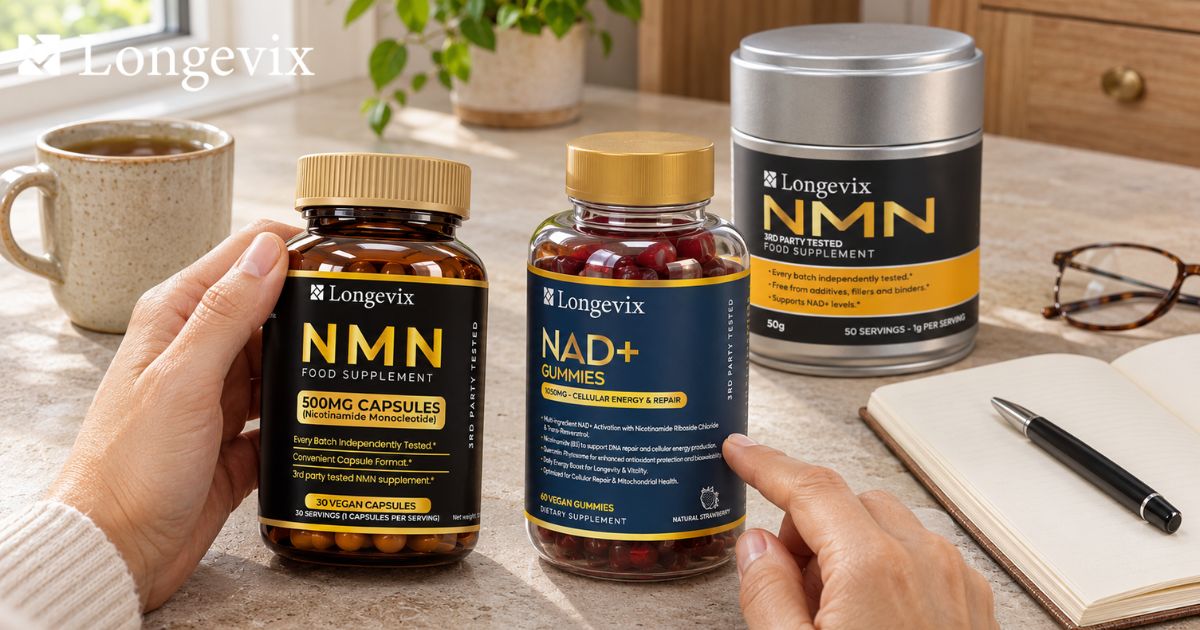
The following examples illustrate ingredient identification using product information published on Longevix. They are included for label-reading education, not as purchase recommendations or confirmation of UK market authorisation.
|
Longevix product example |
Website-listed ingredient details |
What to understand |
|---|---|---|
|
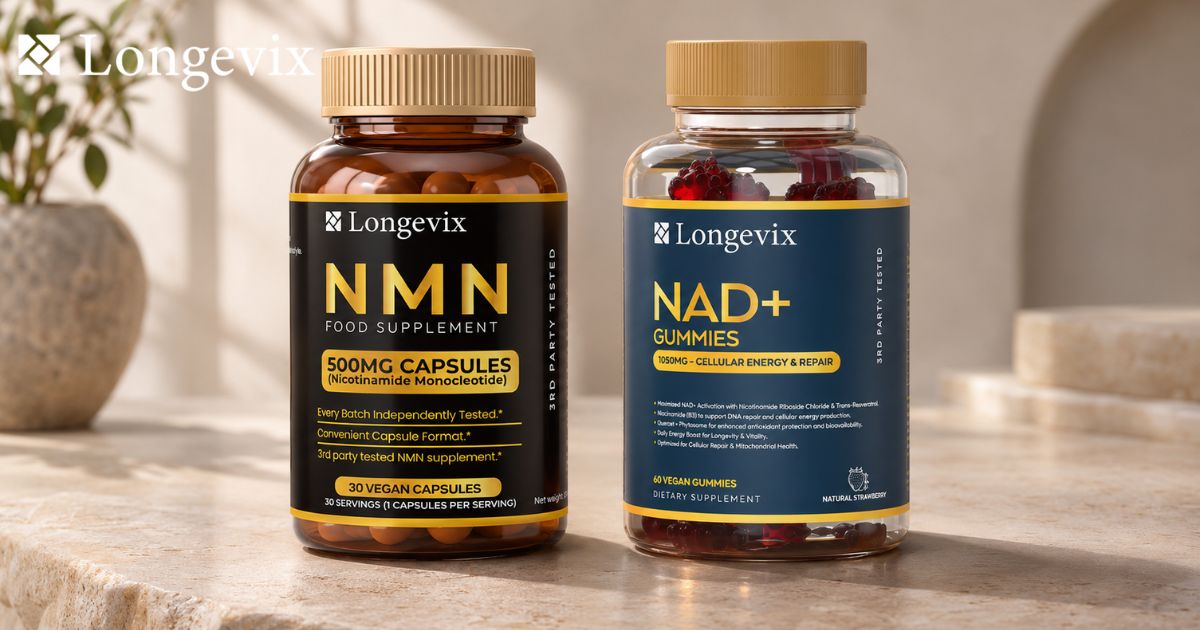
500mg NMN per capsule; 30 capsules per bottle |
NMN is the identified active ingredient, not niacinamide |
|
|
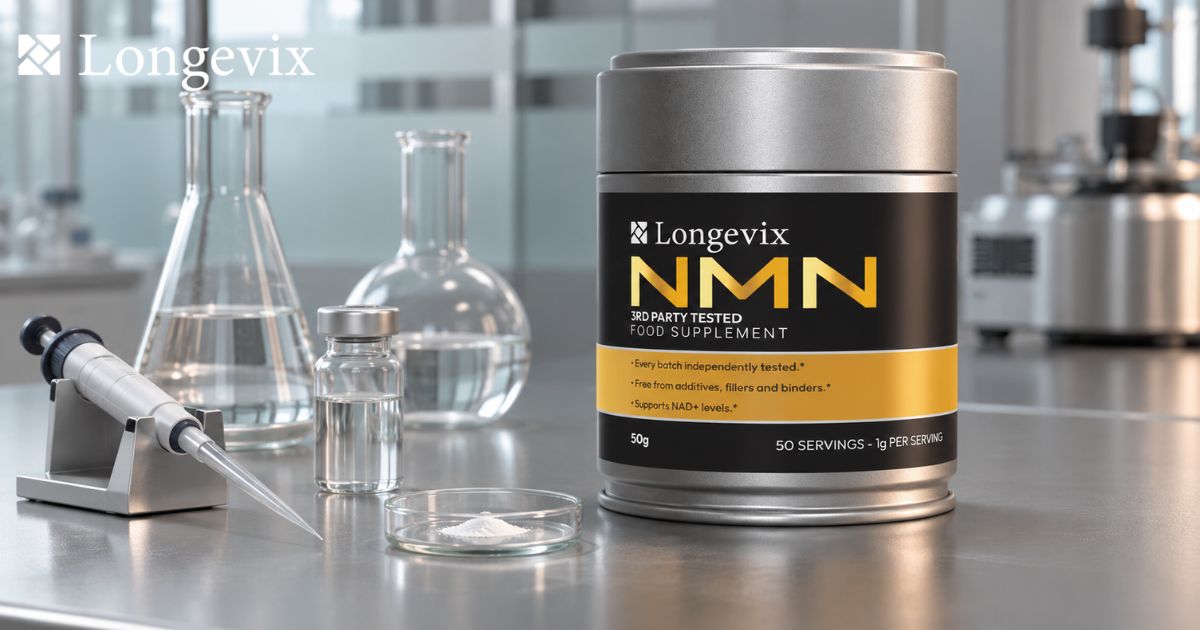
NMN powder; 1,000mg labelled serving; 50 servings |
The website-listed serving is not an established recommended dose or proof of regulatory compliance |
|
|
Per two gummies: 300mg NR, 250mg nicotinamide, 250mg quercetin and 250mg trans-resveratrol |
Contains nicotinamide and NR, but does not list NMN |
The NMN products' displayed serving quantities require particular regulatory review in light of the unresolved GB novel-food position. They should not be interpreted as endorsed or authorised daily amounts.
These details were taken from website product listings and should be checked against the latest physical packaging before being used in commercial materials.
Do Testing Documents Prove a Supplement Works?
A certificate of analysis may provide useful information about a particular batch, including tests for identity, composition or contaminants.
Its meaning depends on what was tested, the methods used, the laboratory and whether the document matches the product and batch.
However, even a valid laboratory certificate does not demonstrate that taking the product improves energy, prevents disease or extends lifespan.
Nor does a testing document replace the need for applicable food-market authorisation.
When evaluating any supplement, distinguish ingredient identity, labelled quantity, laboratory testing, clinical evidence and legal compliance. Each answers a different question.
NMN or Niacinamide: Which Makes More Sense for Your Goal?
The most useful answer depends on what you are trying to understand.
If Your Goal Is Adequate Vitamin B3 Nutrition
Niacinamide is an established form of vitamin B3, an essential nutrient.
The NHS advises that most people should be able to obtain sufficient niacin through a varied and balanced diet.
Foods including meat, fish, eggs and certain grain products can contribute to dietary vitamin B3 intake.
There is no established requirement for healthy adults to take NMN supplements to meet ordinary vitamin B3 nutritional needs.
If You Are Interested in NAD+ Research
NMN is relevant to research investigating NAD+ metabolism.
The direct 2026 human study found a sustained increase in baseline whole-blood NAD+ with NMN under its tested conditions, whereas nicotinamide showed a different response.
That is an interesting finding.
It is not sufficient evidence to recommend NMN over niacinamide for better health, more energy or longer life.
The broader evidence remains incomplete, especially for long-term clinical outcomes.
If You Are Comparing Supplement Claims
Focus on the actual ingredient rather than the promise printed on the front of the packaging.
Ask whether the stated benefit has been demonstrated in human studies using the same ingredient and a relevant amount.
Consider whether the research measured a laboratory marker or an outcome that matters to everyday health.
Check the applicable regulatory position and consult a qualified healthcare professional when individual safety concerns arise.
If you also want to understand how other NAD+ precursors differ, Longevix has separate guides covering nicotinamide riboside versus niacinamide and NMN versus NR.
Those are different comparisons and should not be treated as interchangeable answers.
Key Takeaways
NMN and niacinamide are related to the same essential metabolic system, but they are chemically different substances.
Niacinamide is an established form of vitamin B3 involved in normal nutritional metabolism. NMN is a distinct molecule investigated for its role in NAD+ production.
A 2026 clinical comparison found that NMN increased baseline whole-blood NAD+ after 14 days under the tested conditions, while niacinamide did not show the same sustained response.
The result does not establish that NMN is clinically superior or that either supplement slows ageing.
For UK readers, regulatory status is equally important. A favourable safety assessment or an existing product listing must not be confused with market authorisation.
The sensible approach is to prioritise adequate nutrition, reliable human evidence, transparent product information and applicable regulations rather than assuming that a larger NAD+ measurement guarantees better health.
References
Frequently asked questions
Is NMN the Same as Niacinamide?
No. NMN is nicotinamide mononucleotide, whereas niacinamide is nicotinamide, a form of vitamin B3. They are different molecules involved in related pathways that maintain NAD+ metabolism.
Does NMN Raise NAD+ More Than Niacinamide?
In a 14-day human study published in 2026, NMN increased baseline whole-blood NAD+ compared with placebo, while niacinamide did not produce the same sustained response at the tested amount. This does not establish that NMN always performs better or produces superior health outcomes.
Can Niacinamide Replace NMN?
They are not chemically interchangeable in supplement formulations or research studies. However, niacinamide contributes to established vitamin B3 nutrition, while routine NMN supplementation has not been established as a nutritional requirement.
Does Niacinamide Cause Flushing Like Niacin?
Niacinamide generally does not cause the flushing associated with higher amounts of nicotinic acid. Nevertheless, high supplemental intakes may cause adverse effects, and individual safety considerations remain important.
Is NMN Approved for Food Supplements in the UK?
As of 14 November 2026, the identified Great Britain FSA β-NMN novel-food application remained in risk assessment, rather than showing authorisation. EFSA's 2026 safety opinion does not itself authorise NMN marketing in Great Britain. Readers should check current official records because regulatory decisions can change.