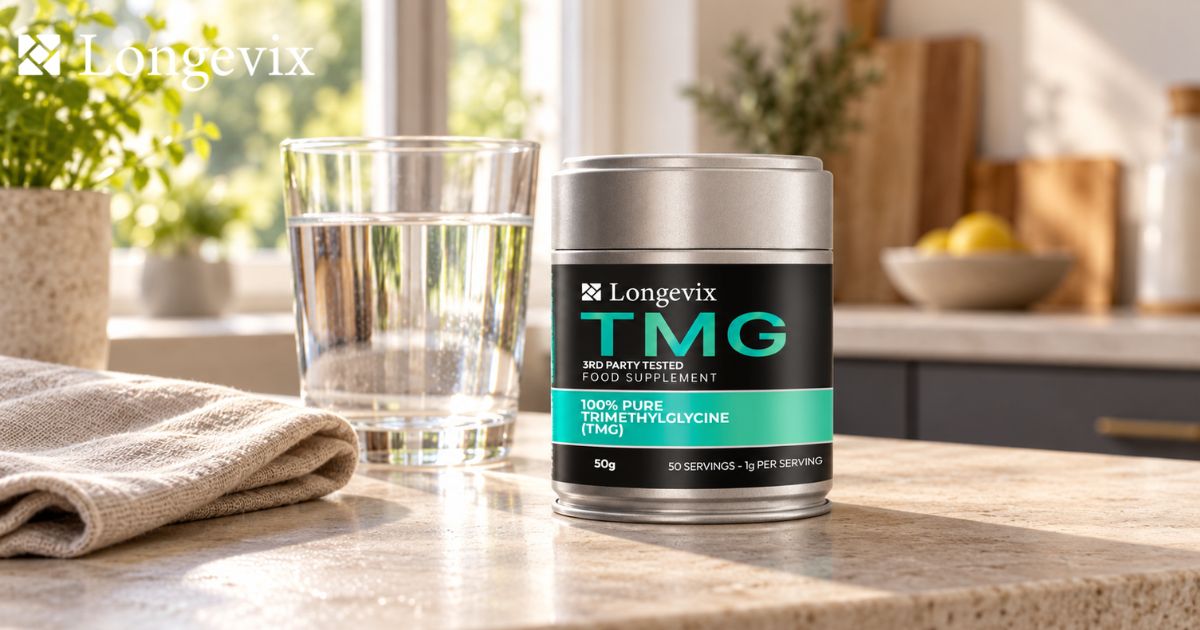
A TMG supplement for adults provides trimethylglycine, also known as betaine anhydrous, a naturally occurring compound involved in methylation and homocysteine metabolism. Human studies show that certain amounts of TMG can lower blood homocysteine, but that does not mean everyone needs a supplement or that taking one prevents heart disease, improves memory or extends life.
Before choosing TMG, it helps to understand the research, compare clinical study amounts with product labels and consider possible side effects, including changes in blood cholesterol.
This UK-focused guide explains what TMG does, where it occurs naturally, what human trials have demonstrated and how to assess supplement formulations responsibly.
Do Most Adults Actually Need a TMG Supplement?
There is no established requirement for every healthy adult to take a TMG supplement. Although trimethylglycine performs an important biochemical function, the body can obtain it from food and produce it through the metabolism of choline.
This distinction matters because a substance being involved in normal metabolism does not automatically mean that consuming more of it will improve health.
TMG is often marketed alongside claims about methylation, healthy ageing, physical performance and cardiovascular health. However, these topics involve different biological processes and clinical outcomes. Evidence supporting one effect cannot automatically establish another.
For example, a clinical trial showing lower blood homocysteine does not prove that participants experienced fewer cardiovascular events or lived longer.
There is also no generally established recommended daily allowance specifically for TMG comparable to those used for essential vitamins and minerals.
The sensible question is therefore not simply whether TMG performs a useful function, but whether additional supplementation has been shown to achieve the outcome an individual is seeking.
Adults considering TMG for a particular medical concern should discuss that concern with a qualified healthcare professional rather than attempting to manage it through supplementation alone.
What Is TMG and How Does It Work?
Trimethylglycine is a naturally occurring compound that contains three methyl groups attached to a glycine-based structure. These methyl groups help explain its role in one-carbon metabolism, a network of biochemical reactions involved in normal cellular function.
TMG can participate in transferring a methyl group to another molecule, which is why it is described as a methyl donor.
The body obtains betaine from dietary sources and can also form it through the oxidation of choline. Choline itself is an essential nutrient, and its wider metabolic functions are described in the NIH Office of Dietary Supplements' choline fact sheet.
TMG, Betaine Anhydrous and Betaine HCl: What's the Difference?
In nutritional discussions, trimethylglycine, glycine betaine and betaine anhydrous generally refer to the same core compound.
Betaine hydrochloride, usually written as betaine HCl, is a different formulation commonly associated with products marketed for digestive acidity.
The distinction is important because products with similar names may have different intended uses, quantities and safety considerations.
|
Ingredient terminology |
What it means |
Practical relevance |
|
Trimethylglycine (TMG) |
The compound commonly discussed in methylation research |
Found in food and nutritional supplements |
|
Betaine anhydrous |
Another name for the anhydrous form of TMG |
Common on supplement labels |
|
Glycine betaine |
Another name used for the same core substance |
Common in scientific literature |
|
Betaine HCl |
A hydrochloride formulation |
Should not be treated as interchangeable with standalone TMG |
For a more detailed explanation, see Longevix's guide to the difference between betaine and trimethylglycine.
Methylation, Homocysteine and the BHMT Pathway
One important function of TMG involves an enzyme called betaine-homocysteine methyltransferase (BHMT).
This enzyme uses a methyl group from betaine to help convert homocysteine into methionine. During the process, betaine becomes dimethylglycine.
Homocysteine is an amino-acid-related substance produced during normal metabolism. Elevated blood levels may occur for several reasons, including nutritional deficiencies, genetic factors, kidney function and certain medical conditions.
The BHMT pathway provides one route through which the body processes homocysteine. Other pathways involve nutrients such as folate and vitamin B12.
Understanding this mechanism explains why researchers have investigated TMG supplementation and blood homocysteine.
However, methylation is not a single process that can simply be increased to produce better health. It consists of numerous interconnected reactions that depend on different nutrients, enzymes and physiological conditions.
A supplement's participation in one pathway does not establish that taking more improves every methylation-related outcome.
What Benefits Do Human Studies Actually Support?
The most consistent human evidence for betaine supplementation concerns changes in blood homocysteine.
Other proposed benefits, including exercise performance, weight management, cognitive function and longevity, have considerably different levels of support.

Homocysteine: The Most Consistent Human Finding
A 2003 controlled human study by Olthof and colleagues examined 76 healthy adults divided into four groups.
Participants received placebo or 1.5g, 3g or 6g of betaine daily for six weeks.
Compared with placebo, fasting plasma homocysteine levels were approximately:
· 12% lower in the 1.5g group.
· 15% lower in the 3g group.
· 20% lower in the 6g group.
These findings demonstrate that betaine can affect homocysteine metabolism under the studied conditions.
A 2013 meta-analysis of five randomised controlled trials also found a statistically significant reduction in plasma homocysteine. The pooled reduction was approximately 1.23 µmol/L.
However, those five studies used at least 4g of betaine daily, over periods ranging from six to 24 weeks.
The important limitation is that lowering a blood marker is not the same as demonstrating better long-term health outcomes.
Although elevated homocysteine has been associated with cardiovascular risk, these supplementation findings do not establish that routine TMG consumption prevents heart attacks, strokes or cardiovascular disease.
Exercise Performance and Other Potential Effects
Researchers have also investigated whether betaine supplementation influences physical performance.
A 2024 systematic review and meta-analysis included 17 studies involving 317 participants aged 15–60.
The analysis reported favourable findings for certain measures of maximal strength, particularly lower-body strength. However, the results were not consistently positive across other measures of muscular performance.
The participant population also included some people younger than 18, limiting its direct application to an exclusively adult audience.
These findings suggest that particular exercise outcomes warrant further research. They do not demonstrate that TMG reliably improves strength, endurance, recovery or sporting performance for every adult.
Longevix examines this evidence in more detail in its TMG exercise performance guide.
What Research Has Not Demonstrated
TMG is sometimes discussed in connection with fat loss, liver health, cognitive performance and healthy ageing.
These claims require more caution.
For example, a randomised trial involving 42 adults with obesity investigated 6g of betaine daily alongside an energy-restricted diet for 12 weeks.
Although the supplemented group experienced a reduction in homocysteine, betaine did not produce additional improvements in body weight, body composition or resting energy expenditure compared with the control group.
Likewise, research into betaine and liver disease has not established that ordinary TMG supplements are effective treatments.
Claims about better memory, increased energy, improved DNA repair or longer lifespan also lack convincing direct human clinical evidence for routine TMG supplementation.
The following comparison summarises what can reasonably be concluded.
|
Research area |
What human research suggests |
What remains unproven |
|
Homocysteine |
Reduced blood concentrations at certain studied intakes |
Prevention of cardiovascular events |
|
Exercise performance |
Possible improvements in selected strength outcomes |
Consistent improvement across all performance measures |
|
Weight management |
Homocysteine changes observed in trials |
Reliable additional fat loss or weight reduction |
|
Liver health |
Investigated in clinical populations |
Effective treatment of liver disease |
|
Cognition and longevity |
Biological hypotheses and limited direct investigation |
Better memory, prevention of cognitive decline or longer human lifespan |
The strongest interpretation is also the most useful: TMG has established biochemical functions and measurable effects in some human trials, but its wider health benefits should not be assumed.
Can You Get TMG from Food Instead?
Yes. Betaine occurs naturally in several foods, particularly certain vegetables and grain products.
Relevant dietary sources include beetroot, spinach, wheat bran and some wholegrain foods.
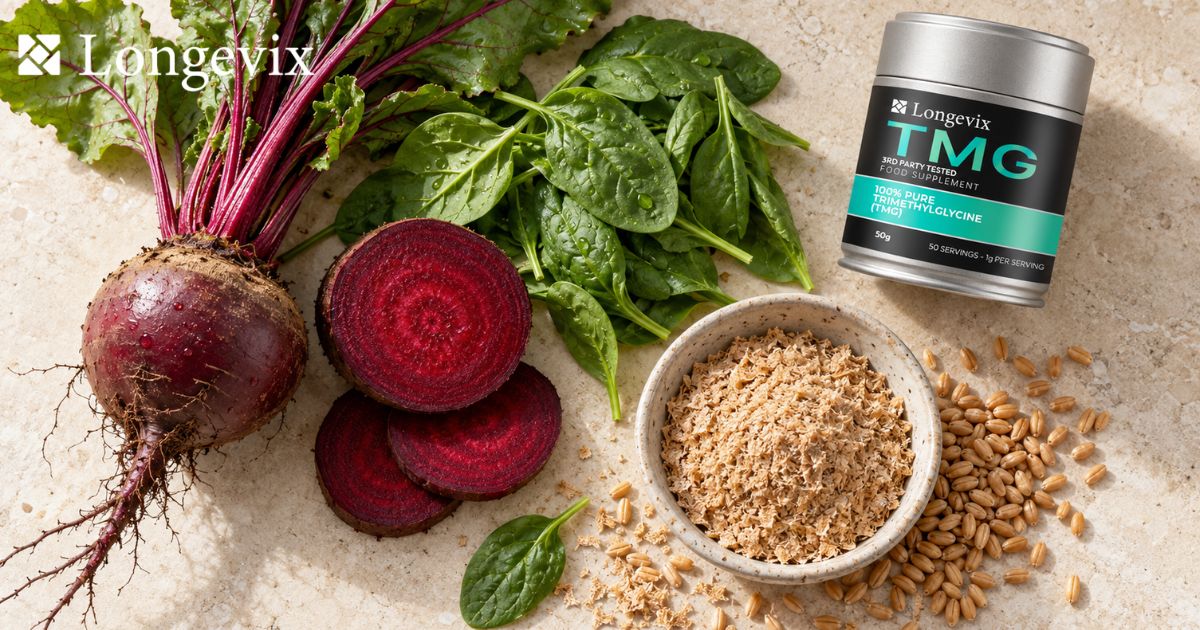
The body can also produce betaine from choline, which occurs in foods such as eggs, meat, fish and certain plant-based foods.
This means dietary intake and internal production both contribute to normal betaine metabolism.
A concentrated supplement differs from food because it supplies a defined quantity of a particular ingredient in one serving. Food, by contrast, provides betaine alongside other nutrients and dietary components.
For adults interested in general wellbeing, a varied, balanced diet remains a sensible starting point.
It is important not to assume that eating a particular quantity of beetroot or spinach produces the same blood concentrations or outcomes as a controlled supplementation study. Food betaine concentrations vary, and the available research does not support treating ordinary meals and studied supplement regimens as interchangeable.
Nor does the existence of dietary betaine establish that everybody requires an additional supplement.
How Do Studied TMG Amounts Compare with Product Labels?
One of the most important details when interpreting supplement research is the difference between a study's administered amount and a product's labelled serving.
Research amounts are selected for specific scientific purposes. They are not automatically suitable daily recommendations for consumers.
Research Amounts Are Not Personal Dosage Recommendations
The six-week Olthof trial used 1.5g, 3g and 6g of betaine daily.
Another randomised crossover study involving ten healthy adults examined single amounts of 1g, 3g and 6g.
In that small study, single 3g and 6g amounts reduced plasma homocysteine over the observation period, whereas the single 1g amount did not demonstrate a statistically significant acute reduction.
This does not prove that taking 1g daily over several weeks is ineffective. The study examined an immediate response in a very small population.
It does, however, illustrate why results obtained with one amount and duration cannot simply be transferred to another.
Comparing Longevix's Published TMG Serving Information
Longevix currently lists a Pure Trimethylglycine (TMG) Powder 50g product with a stated serving of 1,000mg using two included scoops.

Its NR + TMG Capsules contain 250mg TMG per two-capsule serving, alongside other ingredients.
|
Reference |
TMG amount |
What the figure represents |
|
Longevix Pure TMG Powder |
1,000mg |
Published two-scoop serving |
|
Longevix NR + TMG Capsules |
250mg |
TMG contained in the published two-capsule serving |
|
Olthof human trial |
1,500–6,000mg daily |
Amounts studied for six weeks |
|
Small acute crossover trial |
1,000–6,000mg |
Single experimental amounts, not a daily-use recommendation |
A clinical trial using 3g does not establish that a product supplying 1g will deliver the same result.
Equally, consumers should not increase a product's stated serving simply to match a research study or a health-claim condition.
Follow the current product label and seek individual professional advice when supplement suitability is uncertain.
What Are the Risks and Side Effects of TMG?
TMG supplementation is not free from potential adverse effects.
The practical concerns include digestive symptoms, possible changes in blood lipids at higher studied intakes, and uncertainty about the long-term effects of routine use in different populations.
Digestion and Blood Cholesterol
Reported digestive effects associated with betaine use include nausea, diarrhoea, bloating and abdominal discomfort.
These symptoms may also be influenced by the product formulation, accompanying ingredients or individual circumstances. Reliable reaction rates for otherwise healthy adults using ordinary retail supplements are limited.
Blood cholesterol deserves particular attention.
A systematic review and meta-analysis published in 2022 reported that betaine supplementation was associated with reductions in homocysteine but increases in total and LDL cholesterol across the studies analysed.
An earlier meta-analysis found a moderate increase in total cholesterol with betaine amounts of at least 4g daily, although its pooled LDL finding was not statistically significant.
These findings do not establish that every amount of TMG raises cholesterol in every person. They do show why lowering homocysteine cannot automatically be interpreted as an overall cardiovascular benefit.
For readers seeking further detail, Longevix has a dedicated explanation of TMG supplement side effects.
When to Seek Professional Advice
Adults should obtain individual guidance before using concentrated TMG supplements if they are pregnant, breastfeeding, taking medication or managing a significant medical condition.
Particular care is appropriate when someone has elevated cholesterol, liver or kidney disease, or a diagnosed disorder involving homocysteine or methionine metabolism.
Prescription betaine anhydrous is used under specialist supervision for certain forms of homocystinuria. That medical treatment involves different circumstances, monitoring and intended outcomes from ordinary retail supplementation.
Someone receiving prescribed betaine should not add another TMG product independently.
Similarly, an elevated homocysteine test result requires appropriate clinical interpretation. It may be associated with factors that need investigation rather than a self-selected supplement.
Seek professional assessment for persistent or troublesome symptoms, and urgent medical care for severe symptoms such as breathing difficulty, fainting or chest pain.
Should TMG Be Combined with NR, NMN or Other Supplements?
TMG is frequently discussed alongside NAD+ precursors, including nicotinamide riboside (NR) and nicotinamide mononucleotide (NMN).
The suggested connection involves methylation and nicotinamide metabolism, but an interesting biochemical relationship does not establish that a combination improves clinical outcomes.
Why TMG Appears in NR and NMN Discussions
NR and NMN participate in pathways that contribute to NAD+ production.
During the metabolism of certain nicotinamide-related compounds, methylation reactions can occur. Researchers and supplement manufacturers therefore discuss whether methyl donors such as TMG might have a complementary role.
However, the body regulates these pathways through multiple interconnected processes.
Current human evidence does not establish that everyone taking an NAD+ precursor requires additional TMG, or that combining these ingredients produces superior benefits for ageing, cognition or general wellbeing.
Longevix discusses the rationale and limitations in its guides to TMG with NR and NMN with TMG.

Why Biochemical Plausibility Does Not Prove Synergy
For a combination to demonstrate a particular benefit, researchers would ideally test that combination in humans using relevant amounts, a suitable comparison group and outcomes that matter to participants.
Showing that two substances operate in connected pathways is not equivalent to demonstrating that taking them together improves health.
The same principle applies to combinations involving TMG, folate, vitamin B12, choline or creatine.
These substances have distinct physiological roles. They should not be treated as interchangeable or assumed to produce better results simply because more ingredients are included.
Checking Total Intake Across Multiple Products
Combining products can also make it harder to understand how much of an ingredient someone is consuming.
As an illustration, the published serving of Longevix TMG Powder contains 1,000mg TMG, while its NR + TMG Capsules contain another 250mg per labelled serving.
Using both labelled servings would produce a combined 1,250mg of TMG before considering other sources.
That calculation is an example of ingredient accounting, not a recommendation to combine the products.
A complete review should include every supplement being taken, its actual serving instructions and its other active ingredients.
TMG Powder, Capsules or Gummies: What Should Adults Compare?
Choosing between supplement formats should begin with the ingredient list and labelled serving, rather than assumptions that one form is inherently superior.
Powders can provide a measured standalone ingredient. Capsules may contain additional substances. Gummies can combine several ingredients in a different format.
These differences may affect convenience and label interpretation, but they do not automatically establish differences in clinical effectiveness.
Comparing Longevix's Published Product Information
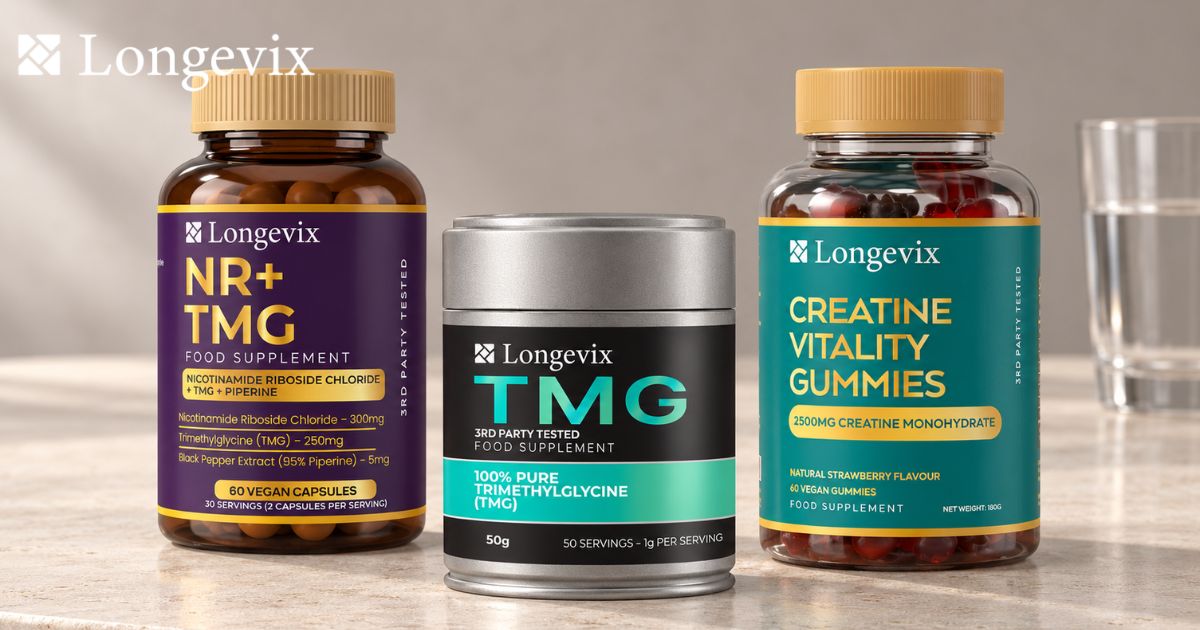
Longevix lists three relevant TMG-containing formulations.
|
Product |
Published ingredients |
Format and serving |
What to check |
|
TMG / betaine anhydrous |
50g powder; 1,000mg using two scoops; approximately 50 servings |
Full physical label, measuring directions and batch documentation |
|
|
300mg NR, 250mg TMG and 5mg piperine per serving |
Two capsules; 60 capsules per bottle; 30 servings |
Complete formulation, capsule ingredients and potential medicine-related considerations |
|
|
Creatine monohydrate, TMG, taurine and vitamin B12 |
Four-gummy serving; 60 gummies; 15 servings |
Individual ingredient quantities on the physical label |
These are published product details, not evidence that the finished products have been clinically tested for the outcomes discussed in this article.
The gummies' precise TMG amount could not be established from their inspected online ingredient description and should not be estimated.
The NR + TMG formulation also contains piperine, so consumers taking medicines should have the complete formulation reviewed rather than considering TMG in isolation.
What Does Product Testing Documentation Establish?
Longevix provides a Certificates of Analysis and testing documents page, including a document associated with its standalone TMG powder.
A laboratory report can provide useful information about the sample tested and the measurements performed.
However, the presence of a certificate does not automatically demonstrate that every batch has been tested for every possible contaminant or that a finished product produces a health benefit.
When reviewing product documentation, check the product identity, batch or lot number, testing date, actual measurements and stated laboratory methods.
A useful product assessment distinguishes information published by the manufacturer, results documented for a particular laboratory sample, and evidence from independent human clinical trials.
These are three different forms of information.
What Should UK Consumers Know About TMG Claims and Regulations?
UK supplement consumers should distinguish scientific research from the specific claims that businesses are permitted to make about food products.
A finding may be scientifically interesting without permitting an unrestricted marketing claim.
The regulatory position also depends on the particular ingredient, finished formulation, intended use and market.
Great Britain's Betaine Health-Claim Conditions
The applicable Great Britain framework includes an authorised health claim stating:
“Betaine contributes to normal homocysteine metabolism.”
The relevant health-claim legislation specifies conditions for its use.
These include at least 500mg of betaine per quantified portion, consumer information that the beneficial effect is obtained with 1.5g daily, and a warning that daily intake above 4g may significantly increase blood cholesterol.
These figures must be interpreted correctly.
The 1.5g amount is a condition attached to the permitted claim. It is not a universal recommendation that every adult should consume 1.5g of supplementary TMG.
Likewise, a labelled product containing 250mg TMG per serving should not automatically be presented as meeting the claim's portion requirement.
Authorised health-claim wording and evidence from clinical studies must not be extended into promises of disease prevention, enhanced cognition or increased lifespan.
Why Novel-Food Status Requires a Separate Check
Novel-food authorisation is a separate regulatory question from whether particular health-claim wording is permitted.
The Food Standards Agency's Great Britain register includes an authorisation for betaine under NOVEL-19.
That specific authorisation identifies defined ingredient characteristics and permitted categories of use. It does not expressly list ordinary standalone food supplements among its authorised categories.
This does not, by itself, determine the legal status of every betaine supplement. Ingredient source, manufacturing process, product classification, relevant market history and other possible legal bases must be considered.
A product being available for purchase is not proof that every applicable regulatory condition has been satisfied.
Any commercial statement asserting that a particular TMG formulation is legally authorised should be supported by a formulation-specific regulatory assessment.
More generally, UK government guidance on nutrition and health claims prohibits presenting food supplements as products that treat, prevent or cure disease.
Northern Ireland and US Considerations
Great Britain's food regulatory framework must not automatically be treated as identical to the rules applying in Northern Ireland, where relevant EU-aligned requirements may differ.
Consumers and businesses should check the requirements applicable to the market in which a supplement is supplied.
In the United States, the regulatory framework is different again.
The US Food and Drug Administration explains that dietary supplements generally do not receive FDA approval for safety and effectiveness before marketing.
The Federal Trade Commission also requires appropriate substantiation for health-related advertising claims.
Neither the UK nor US framework should be used to imply that ordinary TMG products have been approved as medical treatments.
How Can an Adult Make an Evidence-Led TMG Decision?
A considered supplement decision begins with the outcome a person hopes to achieve.
If the objective is to improve general wellbeing, it is worth asking whether any evidence demonstrates a meaningful additional benefit from TMG supplementation in otherwise healthy adults.
If the concern involves elevated homocysteine or an underlying medical condition, professional assessment is more appropriate than relying on supplement marketing.
A practical decision involves five questions:
1. Is my intended outcome supported by direct human evidence? A biochemical explanation or animal experiment is not enough to establish a consumer health benefit.
2. Does the research actually apply to the amount on the label? Compare the studied quantity, duration and formulation rather than assuming all TMG products reproduce the same findings.
3. Have I considered the potential risks? Digestive symptoms, cholesterol considerations, medications and underlying conditions may all affect suitability.
4. Do I know what the complete formulation contains? Check the current physical label, particularly when a product combines TMG with other active ingredients.
5. Can I verify relevant quality and regulatory information? Review product documentation and avoid assuming that a certificate, an online listing or a scientific reference automatically establishes compliance or clinical effectiveness.
Sometimes the most appropriate decision will be not to add another supplement.
For someone who wants to learn more before making a choice, Longevix's detailed TMG powder guide provides additional format-specific information, while its supplement testing documentation offers a starting point for examining published product records.
The Bottom Line on TMG Supplements for Adults
TMG plays a genuine role in normal metabolism, and human research demonstrates that certain supplemental amounts can lower blood homocysteine. That evidence should be understood alongside its limitations.
There is no convincing basis for promising that routine TMG supplementation prevents cardiovascular disease, improves cognition, repairs DNA or extends human lifespan. Possible cholesterol changes, digestive effects, individual medical circumstances and differences between study amounts and product labels all deserve attention.
For UK adults considering TMG, the most useful next step is to assess the intended purpose, read the complete product information and discuss any clinical concerns with an appropriate healthcare professional.
A well-informed supplement decision depends on relevant evidence and transparent information, not the number of promising benefits listed on a product page.
This article provides general educational information and does not replace individual medical advice, diagnosis or treatment
Frequently asked questions
Do Healthy Adults Need a TMG Supplement?
There is no established general requirement for every healthy adult to take supplementary TMG. Betaine occurs naturally in foods and can be produced from choline, while evidence for routine supplementation delivering broader health benefits remains limited.
What Is the Difference Between TMG and Betaine?
Trimethylglycine, glycine betaine and betaine anhydrous generally describe the same core compound in nutritional discussions. Betaine hydrochloride is a different formulation and should not be treated as interchangeable.
Does TMG Lower Homocysteine?
Human trials have demonstrated reductions in plasma homocysteine at certain studied betaine intakes. However, reducing this blood marker does not establish that supplementation prevents cardiovascular disease.
Can TMG Supplements Increase Cholesterol?
Some human studies and meta-analyses have reported increases in total or LDL cholesterol, particularly with larger supplemental amounts. The effect is not established as identical at every intake, making individual risk assessment important.
Is It Necessary to Take TMG with NR or NMN?
No universal requirement to combine TMG with NR or NMN has been established in human research. Although the ingredients participate in related metabolic discussions, their combination has not been proven necessary for everyone taking an NAD+ precursor.